Category Archives: “Arab Spring”

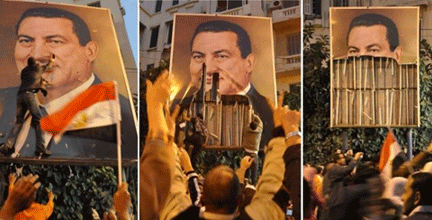
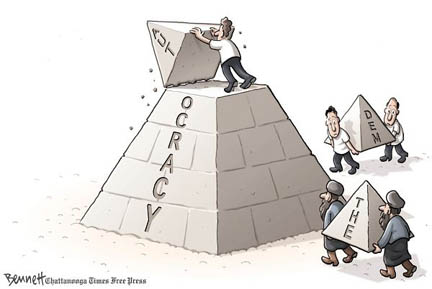
Winners and Losers in a Post-Mubarak Arab World

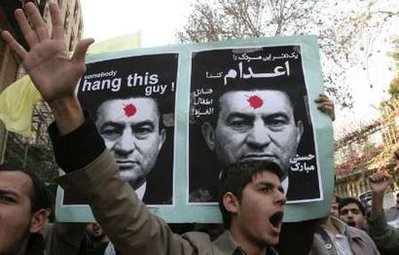
By Yousef Munayyer, Palestine Center, The Jerusalem Fund, February 14, 2011

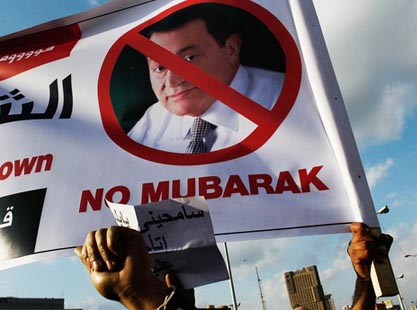
Thirty years ago the Soviet Union was at the beginning of a long campaign in Afghanistan, the average person was lucky to have an advanced recording technology called a “VHS tape,” and Mohammad Hosni Mubarak took control of Egypt, the most populous nation in the Arab Middle East. This week, the last of these beginnings came to an end when millions of Egyptian protestors succeeded in toppling one of the longest standing rulers in the 5,000-year history of Egypt.

But as with all eras, Hosni Mubarak’s established norms, some national and others regional, which have now irreversibly changed. What type of government may take form in Egypt in the coming weeks and months is yet to be seen, however, it is highly unlikely that any new government can afford to repeat the mistakes of the previous regime which eliminated pluralistic political participation in the formulation of both domestic and foreign policy.

Many different global players had an investment in the outcome of the drama that finally concluded in Egypt with Mubarak’s departure. So after this transformational moment, who are the winners and who are the losers?

The Winners

1. The People of Egypt – After only 18 days, the people of Egypt succeeded in removing a ruler who had governed Egypt for three decades. But the victory for the people of Egypt is far greater than the removal of one person like Mubarak or his family. Continue reading Winners and Losers in a Post-Mubarak Arab World
Breadom


by el-Sayed el-Aswad, United Arab Emirates University

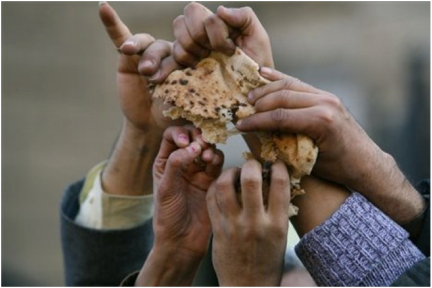
The word “Breadom” is not a spelling mistake; rather it is a combination of the words “bread” and “freedom” indicating, respectively, the “body” and “soul” of the Mother of the World (umm ad-duniya, Egypt), which is currently being affected by a novel form of revolt. In the bread uprising of January 18-19, 1977, falsely depicted by Sadat as “the uprising of thieves” (intifada haramiyya), Egyptians, especially the poor, were interested in securing the ‘bread of their livelihood’ (luqmat al-‘aysh), while in the revolt beginning on January 25th, 2011, they showed profound interest in both bread and freedom. The Arabic word “‘aysh” means both “bread” and “life or living.” These two inseparable meanings have made the phrase “‘aysh al-huriyya” (life of freedom) the best iconic gift crafted, engraved and offered, through victorious young Egyptians of victorious Cairo (al-Qahira), in the Freedom Square (Tahrir Square) opening a new chapter of Egyptian (Arab) history.

It is not surprising to hear people in Tahrir Square, directing their chanting to the government and its businessmen, shout forcefully, “thieves, thieves, thieves” (haramiyya). Also, there was a phrase written in huge letters on the ground of Tahrir Square that says “catch a thief” (imsik haramy). Such phrases resonate and reverberate in the Egyptian folk saying, “its guard is its thief”, (hamiha haramiha), with reference to a plundering and deceitful governor. Continue reading Breadom

The Music of Rebellion


The revolution in Egypt never would have happened as fast and as ultimately peacefully as it did without the new digital age in full bloom. Now that Mubarak has resigned, the protesters are attempting to go back to life with an air of freedom conquering the stale odor of fear. Last night was one of jubilation as Egyptians of all stripes danced in the streets. The withdrawal of Mubarak was music in the ears. And, indeed, music was part of the process. Here is a hip-hop protest on Youtube with a range of video and still photographs by the Egyptian rap group known as Arabian Knightz. Other rap groups also found the recen protests worthy of Youtube. For yet another early video on the protests, click here. And here is a collage from the rapper Marcel Cartier.

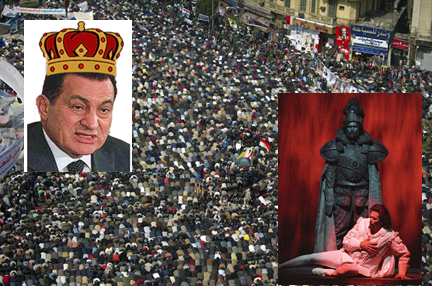
Hosni Mubarak and Don Giovanni


Eighteen days and no longer counting. On this day of farewell, although the wellness wished was not very strong for Hosni Mubarak among the thousands upon thousands of protesters gathered today in Tahrir Square, the Pharaoh left Thebes for good. There have been so many questions swirling in central Cairo and streaming into households worldwide that none of the thousands of pundit-pandered answers were able to satisfy. Never has a revolution been witnessed by so many people; never have so many questions been asked with so little ability to predict precisely what would happen. Will he leave? Or perhaps, more likely, when will he leave? Or, perhaps, has he already exited, stage right? Now we know, Mubarak has resigned.

Yesterday there was a brief spell of hope that Mubarak had finally accepted his fate. I attended an Egyptian event in Manhattan about as far away from the protests in Tahrir Square as can be imagined. This was a performance of Mozart arias translated into Arabic, some into Egyptian dialect. A friend arrived full of relief, having heard the earlier news that Mubarak was planning to leave. The old man’s long and self-serving speech seemed to squelch any hopes for that; the sighs and groans of the unified Egyptian spirit of protest could then be heard around the world. During intermission a long-time Egypt watcher told me that Mubarak will not leave and violence was sure to start up again. Thankfully, he was wrong. Continue reading Hosni Mubarak and Don Giovanni

Why Egyptians Should Insist that Citizen Mubarak Stay


by Mohammed Fadel, Palestine Note, February 2, 2011

Following a week of unprecedented anti-regime demonstrations that culminated in the “million-person” march, Hosni Mubarak, Egypt’s president for the last thirty years, finally announced that he would not seek re-election in September. He reiterated his determination, however, to remain in office until the expiry of his term, in part, to assure a smooth transition in power and help effect the reforms demanded by the people. Pointing to his record of military service defending Egypt, as well as the achievements of his regime, he reiterated his determination to live out the rest of his days in Egypt and to die on Egyptian soil with the dignity of an Egyptian citizen.

Predictably, reaction to his speech has been almost uniformly negative, with many Egyptians dumbfounded, and others just enraged, that he still believes he is in a position to negotiate with the Egyptian people over the terms on which he will give up office. I may be the only Egyptian who is willing to take him up on this offer, but only if he is serious about the “citizen” part. Continue reading Why Egyptians Should Insist that Citizen Mubarak Stay

Streaming Revolution, Screaming Revolution


Al Jazeera offers live coverage of events in Egypt on the internet

Not even Rupert Murdoch, the media mogul who I suspect lies awake at night (just as many of his news outlets lie throughout the day) thinking of new ways to manufacture news, could have imagined the current crisis streaming live on the cable channels and over the Internet for well over a week. America has had its tea party and birthers with Fox gobbling up Sarah Palin to supplement the loonies already on the payroll. I suppose the Israel/Palestine issue was getting too stale, so why not a domino fury across North Africa and the Middle East? No, Murdoch did not cause the overthrow of Ben Ali, the massive anti-Mubarak protests in Egypt, the ripple effect of less virulent protests in Yemen, Jordan, Syria, and Sudan. There are very good local reasons why the streets are filled with angry people from all walks of life (well not the corrupt elites who benefit from dictatorial spoils).

It is not about hating the United States, not when the signs spell out freedom and democracy instead of “Death to America.” It is not even about Islam, certainly not the silly rantings of Glenn Beck that a new chalkboard caliphate is in the making. It is about frustration that reached the boiling point, the astronomical rises in food costs, the lack of jobs, the growing income gap between the average person and friends of the regime. When you have a president alleged to be worth 40 billion dollars, you get the picture of why there has not been an end to the takeover of Tahrir Square in Cairo. Continue reading Streaming Revolution, Screaming Revolution

Alwan for Egypt and Tunisia


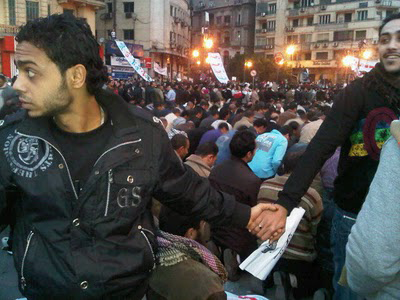
Egyptian Christians holding hands to protect, if in name, if in symbolism only, their Muslim countrymen during prayer as the protests continue; photo by Nevine Zaki in Cairo

Alwan for the Arts is sponsoring a fundraiser: In Solidarity -The Morning After on
Saturday, February 5, 2011 12:00 pm at Alwan for the Arts (16 Beaver Street
4th Floor, New York, NY 10004 (646) 732 3261

12:00-2:00 Reception
2:00-4:00 Al-Jazeera Live Feed
4:00-5:00 Skype and phone Conversations with Egypt and Tunisia
5:00-5:30 Break
5:30: Live Concert by Arab Performers

Suggested Donations: $25

Over a pier, the first beacon inflamed —
The vanguard of other sea-rangers;
The mariner cried and bared his head;
He sailed with death beside and ahead
In seas, packed with furious dangers.

By our doors Great Victory stays …
But how we’ll glory her advent?
Let women lift higher the children! They blessed
With life mid a thousand thousands deaths —
Thus will be the dearest answered.- Anna Akhmatova Continue reading Alwan for Egypt and Tunisia