Category Archives: “Arab Spring”

Mubarak did not get the message


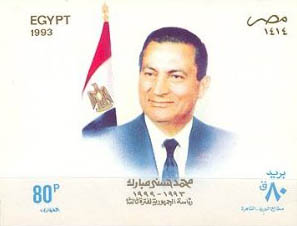
In 1993 Anthropologist Fadwa El Guindi wrote a provocative call for President Mubarak of Egupt to resign. This was almost two decades before events forced him out of office. I post the 1993 commentary by El Guindi here, courtesy of the author.

Mubarak Should Call an Election and Step Aside

Egypt: The country is a wreck; before radicals force a bloody change, he should allow open elections for a successor.

By FADWA EL GUINDI, Los Angeles Times, FRIDAY MARCH 26. 1993

If President Hosni Mubarak is smart, he will take a hard look at the shambles Egypt has become and step down, before he is overthrown or assassinated. An honorable exit might earn him forgiveness for his otherwise disgraceful record.

Egypt had its revolution in 1952, yet it remains a dependency. For example, Egyptian cotton, the highest-quality cotton in the world, is marketed in the United States as towels and bed sheets made in Israel, Britain and America. Egypt’s only part is to provide the natural resource produced by the sweat and labor of peasants living under substandard conditions. This is how it was for Egypt under British colonialism. If Egypt cannot use its very fine cotton to also make and internationally market towels, after 40 years of the revolution that promised industrialization, and if most of its income comes from Westerners visiting the accomplishments of Egyptians of millennia past, something is fundamentally wrong. And it is not fundamentalism, as the government wishes to believe or portray. Continue reading Mubarak did not get the message
“Today, I Am a Muslim Too” Rally


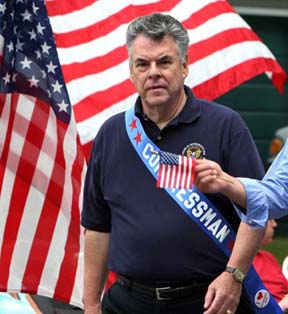
Congressman Peter King

“Today, I Am a Muslim Too” Rally
Time : Sunday, March 6 · 2:00pm – 5:30pm
Location : Times Square, New York, 7th Avenue at 42nd Street, New York, NY

Take the 1/2/3/7/A/C/E/N/R/Q/Shuttle trains to 42nd Street – Times Square. Check MTA for planned service changes: http://tripplanner.mta.info/_start.aspx

In response to the March 8th congressional hearings dubbed “The Radicalization of Muslim communities in America” led by Congressman Peter King (R-LI), members of diverse faith communities throughout New York City will join in unity and support of American Muslims.

Stand with us on March 6th to show Congress that we are all together, that we share friendship and trust and cannot be divided. Such hearings will send the wrong message, alienating American Muslims instead of partnering with them, and potentially put lives at risk by stirring up fear and hatred.

Thanks to all who are supporting the event, the list is below: Continue reading “Today, I Am a Muslim Too” Rally

Looting the Pharaohs before Mubarak


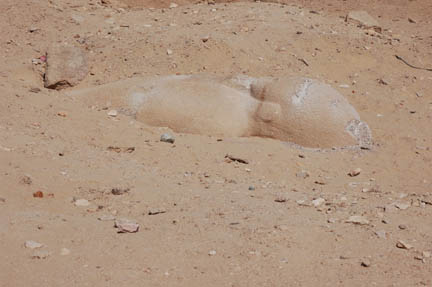
Statue of Ramses II in Aswan

The status of Egyptian antiquities today, 3 March, 2011

by Zahi Hawass, March 3, 2011

When the revolution began on January 25, 2011, and through its first week, there were only a few reports of looting: at Qantara East in the Sinai, and at the Egyptian Museum, Cairo. However, since Mubarak’s resignation, looting has increased all over the country, and our antiquities are in grave danger from criminals trying to take advantage of the current situation.

The Egyptian Museum, Cairo

On Saturday, 29 January, I entered the museum the morning after the break-in and I could see through the museum’s monitor, objects were broken and thrown all over the galleries. However, all of the masterpieces seemed to be present. At first glance, it did not seem that objects were missing and I announced that the museum was safe.

After our preliminary inventory, we discovered that eighteen items were missing. Thankfully four of these items have already been recovered. The Heart Scarab of Yuya and the body of the goddess from the statue of Menkaret carrying Tutankhamun were both found on the west side of the museum near the new gift shop, and one of the missing shabtis of Yuya was discovered under a showcase inside of the museum. The statue of Akhenaten as an offering bearer was discovered by a young protester near the southern wall of the museum in Tahrir Square. His family immediately contacted the Ministry of State for Antiquities to arrange the statue’s return to the museum. I am now waiting for the Registration, Collections Management and Documentation Department to complete its final report on what else, if anything, is missing from the Egyptian Museum, Cairo. The General Director of the museum has told me that this report will be completed by Sunday. Continue reading Looting the Pharaohs before Mubarak

The Owl’s Cry


Marsh Owl, Morocco, Merja Zerga February 12th, 2006 © Daniele Occhiato

by Anoaur Majid, Tingis Redux, March 1, 2011

Now that the fever for freedom has seized the minds of Arabs and others across the world, the question of what exactly needs to be done is sure to be the next preoccupation. The list of demands is obvious across the board—end of corruption and abuse of power, free quality education and health care for all, the right to work (which is, by the way, a human right enshrined in the United Nations’ Universal Declaration of Human Rights), a social order based on respect and dignity, and several other rights that may be specific to one community but not to others.

For example, the Moroccan magazine TelQuel recommends a secular constitution for Morocco that doesn’t make Islam the official religion of the state; the absolute end of polygamy and full rights for women; the ability to discuss the royal and military budgets; better wages, unemployment benefits and social security coverage; freedom of religion; freedom of the press; prison reform and the formal abolition of the death penalty; making the darija Morocco’s national language (something I called for years ago); and so on. TelQuel lists 50 items and the reader, I am sure, could add a whole lot more.

The thing to remember, however, is that meaningful sustained reform is going to take time. Some of these objectives could be implemented in short order, others may take at least a decade, and a number of projects could easily involve the work of generations. I like to tell people that Morocco will probably be the place of my dreams after I have left this world. I know many opportunities were wasted since 1956 (the year Morocco got its independence), but I also know that no one can bend the arc of time to suit a political agenda. Most change doesn’t happen overnight, and progress depends on the seeds we plant today. In any case, now that the people’s genie is out in the streets, one thing’s for sure: There is no going back to the status quo ante. Continue reading The Owl’s Cry

Gaddafi: odd and daffy to the end


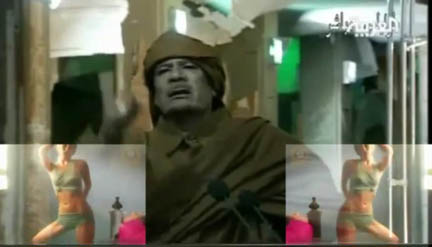
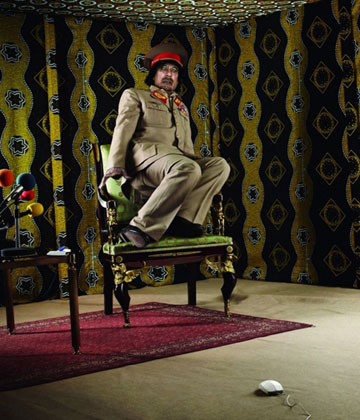
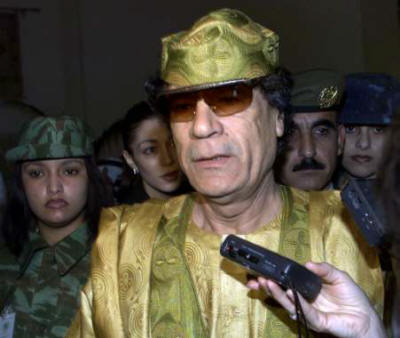
After the outing of two long-standing autocrats in Tunisia and Egypt, the domino theory pizza delivery is now at the shores of Tripoli. What can one say about Colonel Muammar Gaddafi that does not sound like a bad Hollywood movie? He is, of course, also a dear friend of Italy’s clown prince Berlusconi. If Gaddafi did not exist in his Libyan tent, guarded by a bevy of young ladies, Monty Python would have invented him. Here is a guy who came to power at age 27 in the year that Led Zeppelin dominated the pop chart with ‘Whole Lotta Love.” That was over four decades ago. It appears that in Libya today there is not a whole lotta love for this odd and daffy caricature.

Gaddafi is too easy to satirize. Blaming Al-Qaeda for putting drugs in the coffee of young Libyans is about as bizarre a claim as one can imagine. One of the few admirable qualities may be that Gaddafi never promoted himself to General; although he hardly needed to do so given his absolute power. His ruthless response to the recent peaceful protests follows on his long history of brutality against Libyans who dare to oppose him. At present he is clinging on to power in Tripoli with mercenaries and a few surviving “loyal” supporters. Those who stand to lose may stay “loyal” for the moment, but as his power grip nears the end I suspect he will have few if any willing to follow him into exile (or die fighting). Thus far perhaps as many as 2,000 Libyans have been killed with indiscriminate firing in the squares and side streets. The scene has become far uglier than anything that transpired in either Tunisia or Egypt. Fortunately, it appears that a large part of the army has deserted Gaddafi. Continue reading Gaddafi: odd and daffy to the end

On Egypt and Islam

Uprising in Egypt: Islam and the compulsion of the political
by Jeremy F. Walton, The Immanent Frame (SSRC), February 23, 2011

Invariably, contemporary discussions of Islam seem to begin and end with the relationship between Islam and politics—both anti-Islamic pundits and critics of Islamophobia vigorously assert that the mechanics and kinetics of this relationship are central to the evaluation of Islam today. A nexus of paranoia, fear, ignorance, and old-fashioned bigotry typically animates arguments on one side, while those on the other tend toward the polemics and apologetics of subaltern critique. Both camps, however, assume that discussions of Islam necessarily traverse and trouble the domain of the political. This exclusive emphasis on the political marks the difference between Islamphobia à la mode and the older Orientalist discourses of Edward Said’s interrogation: unlike today’s Islamophobia, classical Orientalism constituted a total romance of the East that subsumed political, aesthetic, religious, and cultural forms. In contrast, contemporary Euro-American public debate about Islam evinces what I call the compulsion of the political. While this compulsion achieved hegemony rapidly in the wake of September 11, 2001, it stretches back at least to the seventies and eighties, with high water marks during the Iranian Revolution and the Rushdie Affair.

Much commentary on the recent events in Tahrir Square, throughout Egypt, and across the Middle East has inevitably recapitulated the compulsion of the political in relation to Islam. Despite the deeply ambiguous relationship between the Egyptian pro-democracy demonstrations and politically-oriented Islamic organizations such as the Muslim Brotherhood, pundits from across the political spectrum have seized on the relationship between Islam and politics as the crux of the matter. Arguments have crystallized around two poles, dystopian and utopian, respectively: either the dismantling of Hosni Mubarak’s autocracy will yield the nightmare of a theocracy led by the Muslim Brotherhood (as Ayaan Hirsi Ali fulminated in the New York Times on February 3), or the post-Mubarak era will witness the triumph of pluralist, liberal democracy, with the Muslim Brotherhood as one prominent voice among a multitude (as Tariq Ramadan asserted in a recent interview on al-Jazeera). Continue reading On Egypt and Islam