Category Archives: “Arab Spring”

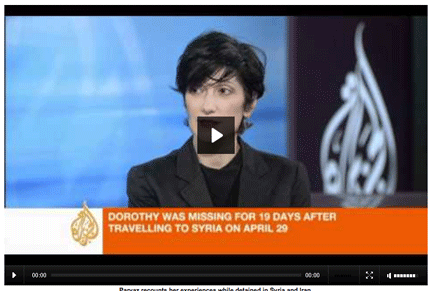
Detained in Syria

[Webshaykh’s Note: There is a definite frost on the Arab Spring in Syria. Read the chilling report by reporter Dorothy Parviz, who was detained and describes the horrors of those held in detention and beaten.]

Inside Syria’s secret prisons

by Dorothy Parviz, Al Jazeera, May 18, 2011

I was standing in two fist-sized pools of smeared, sticky blood, trying to sort out why there were seven angry Syrians yelling at me. Only one of them – who I came to know as Mr Shut Up during my three days in a detention center, where so many Syrians ‘disappeared’ are being kept – spoke English.

Watching them searching my bags, and observing the set of handcuffs hanging from the bunk bed wedged behind the desk in the middle of the room, I guessed that I was being arrested – or, at the very least, processed for detention.

“Why are you doing this?” I asked.

“Shut up! SHUT UP!” said Mr Shut Up.

I’d arrived there moments before, dragged by a handful of hair from a car where I’d been wedged between two armed men. They’d tried to convince me that they were taking me to my hotel, but, of course, I knew that there was no way plain-clothed security personnel would be kind enough to escort me to my accommodation.

I did, however, manage to resist being forced to wear a blindfold, figuring that if they were going to shoot me, they really didn’t need a reason to do so.

After about 20 minutes, we pulled off the highway and through two checkpoints. By this point, the rather handsy security guard to my left had pulled my scarf over my eyes. Continue reading Detained in Syria
What Syrians want …


What do we want?

by Amina A., A Gay Girl in Damascus, May 9, 2011

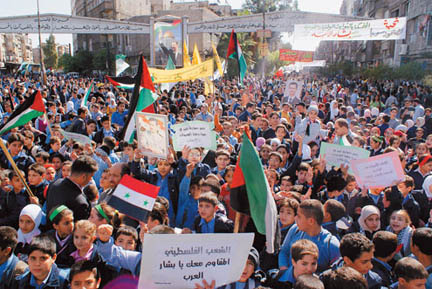
The regime claims that they have no idea what we in the opposition want. I find that hard to believe … haven’t they been watching us, listening to our slogans, reading what we write? Do they have facebook? Seriously, it’s spelled out there: “The solution is simple: Stop shooting at demonstrators, allow peaceful demonstrations, remove all your photos and those of your father, release all political prisoners, allow political pluralism and free elections in six months.”

And for Asad? “You will be the pride of contemporary Syria if you can transform Syria from a dictatorship into a democracy. Syrians would be grateful for that, and it is possible to do”
But maybe they do not get it. Maybe it is too simple. Didn’t Emma herself claim in that awful Vogue article that they practice democracy inside the royal household?
Well maybe more specifics would help …

We want an end to dictatorship. We want free and fair elections. We want freedom. Continue reading What Syrians want …

The Middle East’s oldest dictatorship


Israel’s resolute occupation of Palestinians in not just historic Palestine, but in the West Bank and Gaza Strip specifically, can be considered the oldest quasi-dictatorship in the Middle East, Bishara argues [GALLO/GETTY]

by Marwan Bishara, Al Jazeera, April 21, 2011

As the conventional wisdom goes – especially in the West – Israel is the “only democracy” in the Middle East. And that is so, particularly for its Jewish citizens. However Israel has been anything but democratic for the indigenous people of the land, the Palestinian Arabs.

By nature and precedence, foreign military occupation is temporary. Colonialism on the other hand, and more precisely civilian colonisation, is a socio-political system of ruling over another people.

Since its inception at the end of the 19th century, Zionism preached self-determination for the Jewish people in “their” homeland. In reality, Israel has directly or indirectly driven Palestinians out of their homeland, confiscated their properties, rejected their right to return to their homeland despite UN resolutions, and occupied and colonised the rest of their homeland for the last four decades.

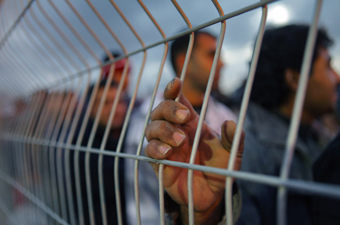
Throughout, Israeli military and security services ruled over another people against their will. They oppressed, tortured, exploited and robbed the Palestinians of their land, water and most importantly, their freedom. There has been more political prisoners in Israeli jails than any of its neighbours.

In denial over their predicament, Israeli leaders have taken shelter in the illusion of surplus morality. Continue reading The Middle East’s oldest dictatorship

Yemen after Ali Abdullah Salih


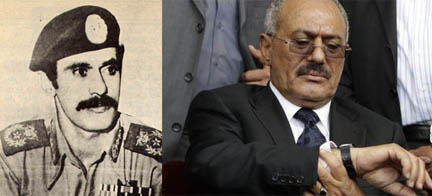
Ali Abdullah Salih, from 1978 to 2011

From the latest news reports in the region it appears that President Ali Abdullah Salih has agreed to step down within a month in an agreement brokered by the GCC. The plan calls for Salih to hand over power to his Vice President one month after the opposition signs on to the agreement, which they have reportedly done. Although, as I write this Salih’s decision to step down has not been broadcast in the state-run Yemeni newspaper al-Thawra or on his personal website. Two months later a national election is to be held. A possible sticking point is the immunity that this agreement provides President Salih and his family. The U.S. administration has already blessed the plan and it seems likely that it will be finally resolve Salih’s departure.

The protests against Salih have left the country divided and the economy, weak as it was to begin with, has basically ground to a halt. The poorest country in the Middle East is even poorer after three months of protests across the country. So what happens now?

The removal of President Salih will not solve the range of economic, ecological and social problems facing Yemen. Unemployment will continue, as the oil production nears an end; water tables will draw down even more drastically; imported Salafi conservatism will divide the population even more. In a sense Salih has been out of power for the past three months, simply hanging on as the protests gained more and more momentum. Unable, and apparently unwilling, to stop the street protests militarily (as Qaddafi is desperately trying), Salih deftly tried to garner his own supporters as a counter to those who wanted him to leave. But the hand writing was on the wall all along, given the wide coalition of groups who had grievances against his regime. The opposition seemingly united in its primary goal of removing Salih, but there is no single leading opposition party or leader waiting in the wings. Continue reading Yemen after Ali Abdullah Salih

History repeats itself: The case of Egypt


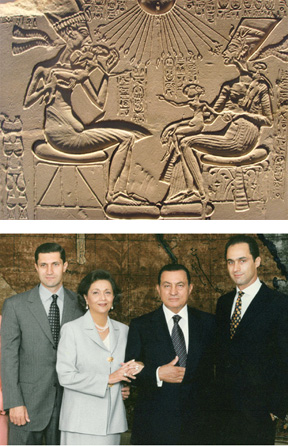
Ruling families not fondly remembered in Egypt

The history of divine kingship and dictatorial hubris has a consistent theme: elevating a ruler’s name above all others and stamping that name on just about everything in sight. In Saddam Hussein’s Iraq his image was everywhere, at times in the heroic proportions of a Babylonian king; visit Syria and you will find Assad and son lionized in every nook and cranny; Timur is resurrected in Uzbekistan. Then there is Hosni Mubarak, whose fall from power is now accompanied by an erasure of his public visage. As reported in Al Jazeera:

An Egyptian court has ordered the names of Hosni Mubarak, the country’s former president, and his wife Suzanne, to be removed from all public places, including streets and parks. Judge Mohammad Hassan Omar ordered on Thursday that Mubarak’s name and picture be removed from sport fields, streets, schools, libraries and other public establishments, according to the state-run al-Ahram newspaper. Currently, various public spaces, including squares, streets and about 500 public schools bear the names of either Hosni, Suzanne or Gamal Mubarak.

Continue reading History repeats itself: The case of Egypt

If Salih read the Qur’an


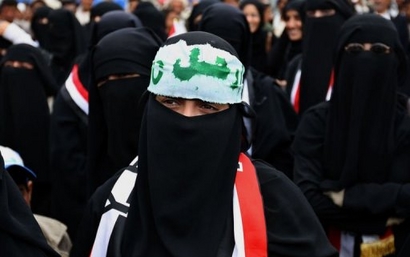
The rhetorical standoff in Yemen continues with only a limited amount of violence even while hundreds of thousands of people have been protesting, mostly against the decades-old regime of President Ali Abdullah Salih. Yesterday the New York Times commented that the protests in Yemen remain remarkably peaceful, with isolated cases of individual violence (mainly by those who support Salih) but no major clashes with the army or between tribal groups. President Salih holds a weekly rally of his supporters (some of whom have clearly been paid to come to the rally, as reporters note) as a counterpart to the far greater numbers protesting all over the country against his continued rule. He is holding on to power with a very thin string; indeed it is hardly even ‘power” any more given that much of the country is basically ignoring him and he is diplomatically isolated.

The only thing more incongruous than dictators (a military man installed in a coup after an assassination of the previous leader and who has remained in power for over three decades is at least an honorary dictator) talking about democracy is when dictators start talking about religion. Unlike Yemen’s Zaydi imams, whose millennium long rule was abolished in 1962, none of the military leaders of Yemen are noted as Quranic scholars; some could barely read and write when they came into office. Continue reading If Salih read the Qur’an

Pornographic War Gazing: Why We Don’t Look Away


[This commentary was origially published in Religion Dispatches, April 12, 2011.]

When it comes to grabbing attention bad news is the best news. Whether selling war or natural disaster or a fugitive serial killer, the competitive edge goes to the media outlet that can scoop the most violence, brutality or sheer inhumanity in an event.

The most recent news cycle of political protests started out on a hopeful note. As the spirit of frustrated youthful protest spread at tweet speed to dictatorial regimes and elitist monarchies, journalists flocked to North Africa and the modern day Holy Land. Live coverage has shifted from country to country, depending in large part on where the most violence is erupting. Yet, as much as the story may be promoted as one of hope and liberation, the hook is all about devastation. Continue reading Pornographic War Gazing: Why We Don’t Look Away