Category Archives: “Arab Spring”

These ‘virginity tests’ will spark Egypt’s next revolution


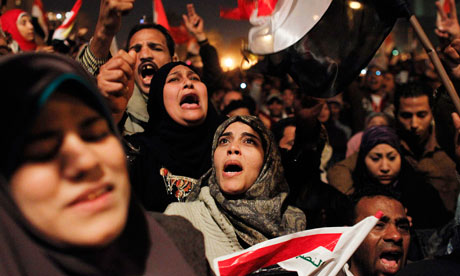
Egyptian women protest in Tahrir Square, Cairo. A general has admitted that women detained during protests in the square a month after Mubarak’s overthrow had been subjected to ‘virginity tests’. Photograph: Tara Todras-Whitehill/AP

by Mona Eltahawy, The Guardian, June 2, 2011

There’s a thin line between sex and politics, and it is nonsense to keep repeating the mantra that Egypt’s revolution “wasn’t about gender”. What revolution worth its salt can be fuelled by demands of freedom and dignity and not have gender nestled in its beating heart – especially in a country replete with misogyny, religious fundamentalism (of both the Islamic and Christian kind) and which for 60 years has chafed under a hybrid of military-police rule?

If the “it wasn’t about gender” mantra is stuck on repeat so that we don’t scare the boys away, then let them remember the state screwed them too, literally – ask political prisoners, and remember the condoms and Viagra found when protesters stormed state security headquarters. Continue reading These ‘virginity tests’ will spark Egypt’s next revolution
How to protest peacefully


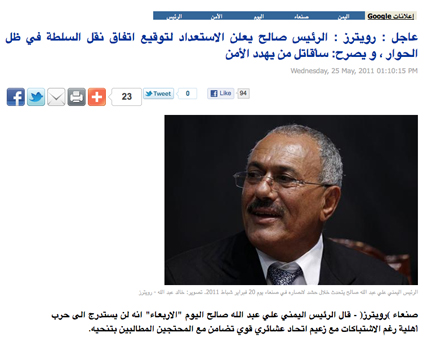
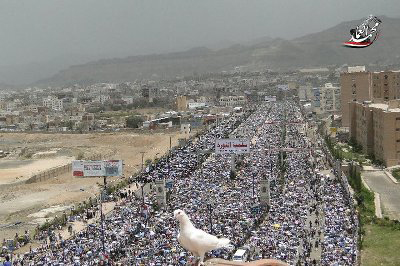
Protests in Sanaa on Friday; if only everyone could follow the dove

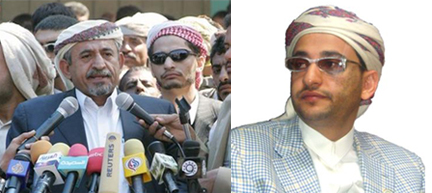
The past few days has witnessed a turn to violence in the ongoing protests in Yemen. An altercation between President Salih’s forces and the major Hashid tribal family of al-Ahmar left scores dead and threatened to accelerate into a civil war. It appears that Salih would like nothing better as once again he could find an excuse to hold on to power. But as the young Husayn al-Ahmar said yesterday:

صالح قال اليمن ليست مصر ولا ليبياوأناأقول له إن صنعاء ليست طرابلس ومهلة الضمانات انتهت.
“Salih said that Yemen isn’t Egypt nor Libya, but I say to him that Sanaa is not Tripoli and the time for making a decision about guarantees has passed.”


Sadiq al-Ahmar, left; Husayn al-Ahmar, right

Continue reading How to protest peacefully

Crisis Hopping


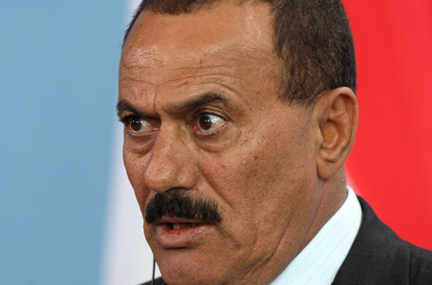
As someone who has a long standing interest in the peoples and cultures of the region geographically maligned as the “Middle East,” I am beyond being overwhelmed by the daily turn of events. To see the streets of Yemen turned into bloody confrontation after three months of amazingly peaceful protests is so sad. I had always wondered if Ali Abdullah Salih was really trying to be a father-of-his-country figure (despite the widespread corruption and nepotism) or if it was mainly his inability to be a brutal dictator in the Ben Ali mode that ruled the day. His recent flirtation with leaving office, only to back down each time, suggests that he has no intention of leaving and is looking for any way to prolong his rule. The Al Qaeda on the doorsteps alibi has not fooled anyone, including the U.S. terrorism money machine. So it seems his latest insane step, right out of a really bad thriller movie, is to foment civil strife. Today’s news about his attempt to alienate the leader of the Hashid confederacy has indeed plunged the capital into street fighting. One thing is clear: Ali Abdullah Salih loves Ali Abdullah Salih and the country he has ruled over for over three decades be damned.

Then there is Syria, where Bashar al-Asad, once thought to be a rather weak version of his towering (at least in all the statues strewn about the former Umayyad enclave) father, has decided to be the old-fashioned Stalinesque strongman. Not content to believe that the mere 96.7% of the votes in his last presidential referendum meant anything other than the normal one-man-rule politics, he is apparently trying to get rid of anyone who opposes him by whatever mean means work. To protest in Syria, as in Libya, means to risk life and limb. Continue reading Crisis Hopping

Is this the last dance for Ali?


Reports coming out of Yemen today suggest that Ali Abdullah Salih may finally have no choice but to sign his abdication. Yesterday’s altercation with supporters of Hashid shaykh Sadiq al-Ahmar near his fortified house in Sanaa expanded to the Ministry of Interior. Today it is reported that Sanaa International Airport is closed and the Central Bank of Yemen has been shut down as well. Yemen is currently in the dark, both literally and politically.

Having run his country into a ditch, indeed quite a large wadi, President Salih is desperately trying to go out with some kind of moral victory. He will not let the country succumb to Civil War, like Somalia. He will not let Yemen become a failed state and fall to Al Qaeda. He will stay in the country and join the opposition. The words sound conciliatory enough, but his political kalam machine has been spewing forth similar justifications ever since he took power lo those many years ago. Even the little boy who cried “wolf” in the fabled children’s story only did so three or four times. Continue reading Is this the last dance for Ali?

The Crucible of Yemen


The crucible of Yemen

The two opposing forces of unity and disunity are helping to shape the future of the struggle against Saleh in Yemen.
by Larbi Sadiki, Al Jazeera, May 22, 2011

There has never been a single Yemen, and maybe there will never be one. What is nonetheless exceptional about the revolt engulfing Yemen is that it represents a united stand, a cry for freedom and dignity. Thus it echoes the cry for freedom in Tunis’ Habib Bourguiba Avenue and Cairo’s Tahrir Square.

However, Yemen presents a prominent specificity; it’s a unity-disunity pairing that shapes and re-shapes the current moment of popular empowerment, constantly stirring the politics concocted within the Yemeni crucible.

Note that Yemenis feel insulted by the brand of nepotism and dynasticism engineered by Saleh and his ilk. The fissiparous forces which Saleh controlled, kept in check or used to his own ends through cunning, money, and even violence, are today largely rallied against him.

He dropped them like hot potatoes when political expediency demanded it. Now they are returning the favour. In this, Saleh’s foes seem to be united.

The interplay of unity and disunity are responsible for both Yemen’s moment of popular empowerment and weakness, as far as democratic protest and change are concerned.

One Yemen, many Yemens

In every sense, Yemen is breathtaking. It is a quilt of colours, climes, landscapes, regions, sects, tribes, customs, ideologies, histories and identities. Anthropologists would have a field day exploring it. But not so if one approaches Yemen with a narrow political science set of lenses. The risk to miss the “Archimedean point” – wherever that might be – is greatest here. Continue reading The Crucible of Yemen

dilly dally, ya Ali


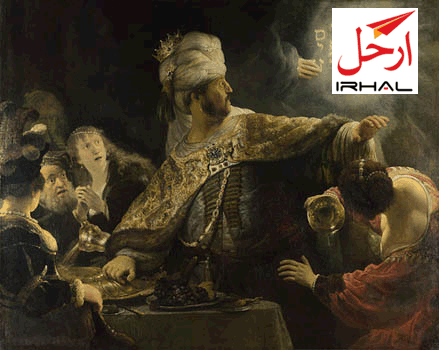
Rembrandt’s ‘Belshazzar’s Feast’ (1635)

Mene mene tekal upharsin. Some two and a half millennia ago it did not take King Belshazzar of Babylon too long to get this Aramaic message. Here is the gist, as recorded in the biblical book of Daniel (5:25-28):

And this is the writing that was written, MENE, MENE, TEKEL, UPHARSIN. This is the interpretation of the thing: MENE; God hath numbered thy kingdom, and finished it. TEKEL; Thou art weighed in the balances, and art found wanting. PERES; Thy kingdom is divided, and given to the Medes and Persians.

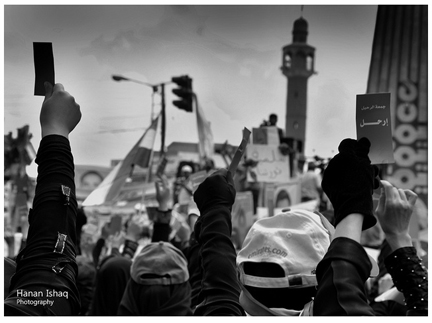
The ink on this populist uprising, with over 100 days of signs held aloft in Yemeni protests saying “irhal ya Ali”, has long since dried and Ali Abdullah Salih has been dilly dallying all along. The latest deal, brokered by the GCC with the U.S. and E.U. seals of approval, was signed yesterday by the opposition parties and Salih was supposed to sign today. Continue reading dilly dally, ya Ali

Doomed to Disappoint


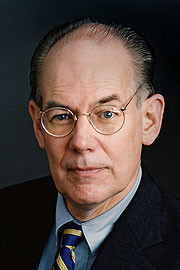
John J. Mearsheimer

by John J. Mearsheimer, Pink Tank, May 19, 2011

Barack Obama gave a major speech on the Middle East today and it is clear from the subsequent commentary that he impressed few people. The main reason is that he did not say much new or indicate that there would be any serious changes in US policy in the region. It was essentially more of the same with the some tweaking here and there. Nevertheless, he did manage to anger some people. For example, Israel’s hard-line supporters were outraged that he said, “Palestine should be based on the 1967 lines with mutually agreed swaps.” For them, the 1967 borders are “Auschwitz borders” and thus can never serve as a basis for negotiations.

Many Palestinians, on the other hand, did not like Obama’s assertion that it made little sense for them to go to the UN General Assembly this September and win recognition for a Palestinian state based on the 1967 borders. Surely they also noticed that shortly after saying that “every state has the right to self-defense, and Israel must be able to defend itself,” the president said that the Palestinians would have to be content with “a sovereign non-militarized state,” which means that they will not be able to defend themselves against Israel or any other state for that matter. Hypocrisy appears to be wired into the DNA of American foreign-policy makers. Continue reading Doomed to Disappoint