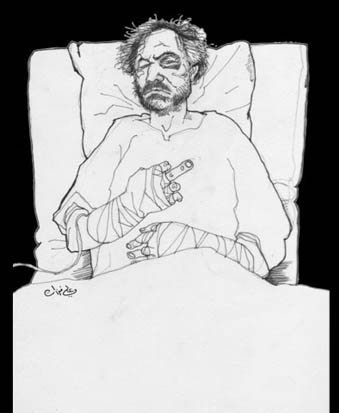
علي Ùرزات يواصل الرسم ويوجه رسالة إلى النظام
Category Archives: “Arab Spring”
Humor in the Dark
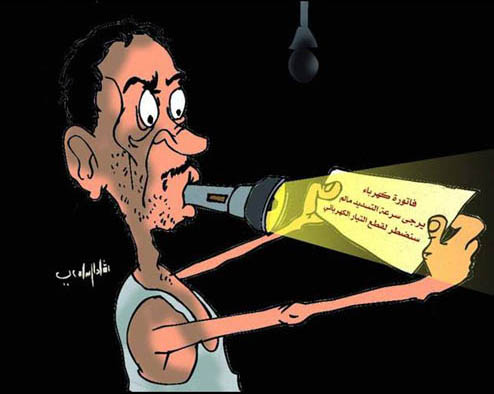
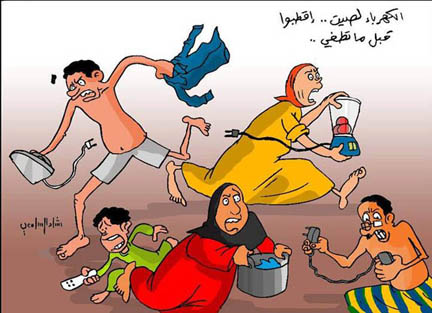
The recent breakdown in Yemen of basic services, including electricity and buta-gas, has not stopped the cartoonists…
A Screen shot is worth a thousand words
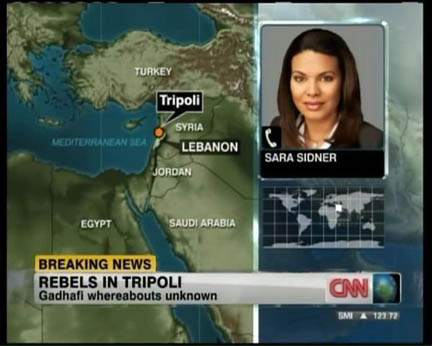
I wonder if CNN sent any reporters to Cairo, Illinois a few months back…
Ba’d kharab Tripoli
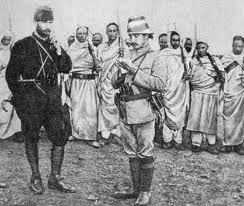
“After a short naval bombardment, Tripoli fell to 1500 Italian sailors on October 3, 1911”
Watching the media coverage of the “rebel” pick-up entry into the outskirts of Tripoli is a chilling reminder that we continue to be a culture of spectator pornography. I can imagine my ancient Roman ancestors quaffing goblets of wine as they reveled in the blood flowing from indentured swordsmen and Christian martyrs fed to the lions. How little is changed when fans break out in fights at a pre-season American football game and soccer hooliganism remains a curse on civility in Britain. On our screens we see the sanitized version of war, of course, not the sun-scorched corpses, the unrecognizable twisted body parts, the agony at the receiving end of grenade blast. The number of casualties, invariably inflated by some and deflated by others, is duly noted as though it could be the up and down daily tick of the stock market. Ah yes, the “mad dog” of Libya, ruthless dictator as he clearly has been, is about to disappear from the scene. Hooray for the good guys…
One can celebrate the overturn of a dictatorial regime, but is it ever worth celebrating individual deaths? Martyrs are always those who die on your own side; the other bodies might as well be animal dung. This was the fate of Mussolini at the end of World War II. History will be rewritten by those who assume power, but the memories of widespread destruction will continue to haunt a generation or two or three or more. The pain continues because old wounds are continually reopened and the scars never really go away. If you live through a war, that war will not die with you as an individual; often, not even with a generation.
There is nothing new going on in Libya; it is the age-old toppling of one regime and ascendancy of another. The Phoenicians had their turn; then the Romans; then the barbarians that swept through Rome, the Ottomans and then again the Italians in 1911. There is always this sense that this time around it may be permanent, a road to future progress. Clearly, almost any kind of regime in Libya after Qaddafi will be better for most people, but in the broad historical perspective it may only be one pendulum swing in the sad history of humanity’s intolerance. No, the problem is not Islam, not the West, not the monetary policies of the World Bank, not even fascism, communism or any specific ideology. We have evolved as a species dependent on cooperation because we also have the propensity of a will to power over others. Those who fight for peace, often by refusing to fight in the mode of a Gandhi, only highlight the fact that peace is not the normal state of affairs for our species over the long haul. The hope that one day a Messiah, a Jesus, or any dreamed up deliverer, will come and set things straight is as old as the need for such a hope.
There is an old Arabic proverb, ba’d kharab Basra (after the destruction of Basra), one that gained new resonance during the regime of Saddam Hussein in his disastrous war with Iran and then the two Gulf Wars that eventually brought about his end. So now is it to be ba’d kharab Tripoli? Continue reading Ba’d kharab Tripoli
All eyes on Tripoli
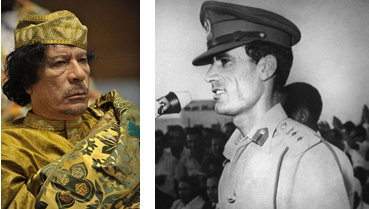
Yesterday the news out of Libya indicated a sudden reversal of fortune for the forces opposed to Qaddafi. Two of his sons are now in custody, many parts of Libya are no longer under his control and the residents of the city are finally free to join the revolution. The Arab Spring has weathered a hot summer in Libya. It seems only a matter of time before Qaddafi is captured, killed or escapes to a safe haven. The pundits are spinning away, but predicting the actions of a megalomaniac who has exercised total power for some 42 years is a difficult task.
The future of Libya is uncertain, as is the case for Yemen and Syria, where protests continue despite the reluctance of a dictatorial leader to yield power. But the fact that Qaddafi could be in power for such a long time, be so ruthless to his own people and sponsor terrorism abroad is a chilling reminder that morality as a human right inevitably takes back seat to the Machiavellian bent of politics. The irony is that the Qaddafis of this world did not rise out of a desert vacuum, but are products of European intrusion into the region. In the case of Libya, Italy vexed its power under Mussolini over its southern neighbor, attempting to make it a fascist enclave and succeeding to a certain extent. After Italy’s defeat in World War II, King Idris (who had fled to Egypt in 1922) was reinstalled by the Allies. The king was deposed when Colonel Qaddafi assumed power in a coup in September of 1969. Idris was the one and only “king” of Libya, and survived after his expulsion until death in Cairo in 1983.
Today all eyes are on Tripoli and the ragtag collection of Libyans who rode the back of NATO airstrikes and direct foreign assistance to finally break Qaddafi’s grip. Continue reading All eyes on Tripoli
Still no Irhal for Ali
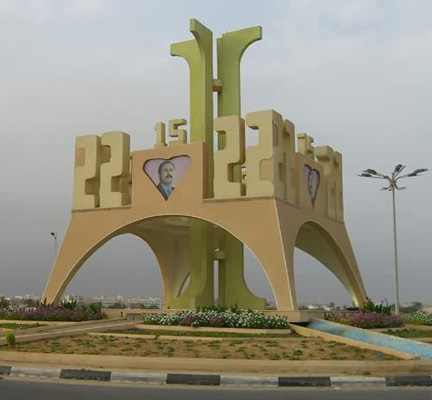
The protests that began way back in February in Yemen have yet to abate. Since that time the country has come to an economic standstill, perhaps even a backslide, and the brink of civil war. Fate intervened on June 3, when President Ali Abdullah Salih was severely injured in a bomb blast at his residence mosque. It was a full month later before he appeared on television and only a week ago when he was discharged from the hospital in Saudi Arabia. Rumors continue to circulate that he will return, although this seems more and more unlikely given his lingering health problems. Meanwhile, like all long-standing dictators, reminders of his power still dot the landscape. The picture above is a heart-shaped image in the southern city of Mukalla. I suspect it may no longer be unblemished. Way back when this all began I thought the protests would not unseat Salih, then changed my mind and thought it would happen soon. But all bets are off because there is no way to predict the turn of events that will occur. I strongly suspect Salih will not return to Yemen and he will grudgingly sign the accord he almost did three times in the past. But as I find so often inscribed in the manuscripts I read, الله اعلم.
Interview with Abu Bakr al-Qirbi
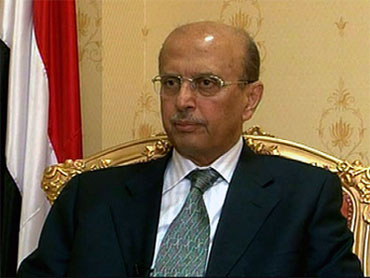
Asharq Al-Awsat talks to Yemeni Foreign Minister Abu-Bakr al-Qirbi
By Mohammed Jumaih, Asharq Al-Awsat, July 31, 2011
London, Asharq Al-Awsat-
During the visit by Yemeni Foreign Minister Abu-Bakr al-Qirbi to the British capital, London, Asharq Al-Awsat met him and interviewed him on the latest developments on the Yemeni scene. Al-Qirbi spoke about the regional and international roles in helping to resolve the Yemeni crisis. Al-Qirbi spoke about the efforts of the vice president and his discussions with the UN secretary general’s envoy in this regard. Al-Qirbi pointed out that the Gulf Initiative is the appropriate grounding for the solution while taking into consideration the views of the United Nations. Al-Qirbi stressed that if matters proceed in the right direction then they are heading toward announcing early elections in the country. Al-Qirbi spoke about the Al-Qaeda file in Yemen and other issues during this meeting.
Following is the text of the interview:
[Asharq Al-Awsat] First, what is the nature of your visit to the United Kingdom?
[Al-Qirbi] As you know, many British, German and American envoys visited us in Yemen and there is communication with European and Gulf decision-makers. We in Yemen prefer that meetings be held at the highest levels with the officials in these countries in order to explain the picture in a more detailed way and to discuss views that are close to reality regarding the Yemeni issue.
As a journalist you know that what is written about Yemen has been exaggerated to the point an expert analyst finds it difficult to follow, let alone a minister who is busy with other matters. Above all, the decision-makers in these countries are receiving a kind of simplified synopsis that does not reflect the picture fully and accurately. This is why we in Yemen want to hold such meetings with brotherly and friendly officials so we can portray a clear picture of the true situation in Yemen in a balanced way despite what is being said in the media which often lack accuracy and objectivity.
[Asharq Al-Awsat] What is the nature of the European and American role toward what is witnessed on the Yemeni scene today in terms of popular movements, which the opposition calls a revolution and you call a political crisis? Continue reading Interview with Abu Bakr al-Qirbi
Brother, can you spare a revolution
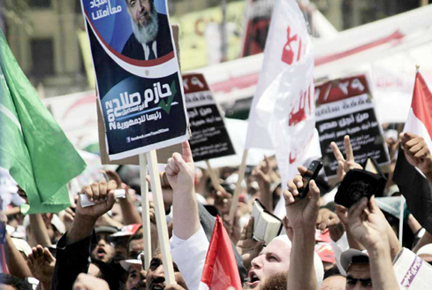
An Egyptian shouts slogans during a protest of Islamist groups at Tahrir Square, the focal point of Egyptian uprising, in Cairo, Egypt, Friday, July 29. (AP Photo/Amr Nabil)
Egypt rally not harbinger of Islamic state: analysts
By Jailan Zayan / Agence France-Presse, thedailynewsegypt.com July 31, 2011
CAIRO: A massive show of force by Islamist groups at a rally in the Egyptian capital on Friday may have showcased their organizational skills, but their actual political clout remains limited, analysts say.
Hundreds of thousands of Islamists from across the country packed Cairo’s Tahrir Square to defend what they called “Egypt’s Islamic identity” in the country’s largest protest since a revolt ousted president Hosni Mubarak in February.
But while the protest may have been visually dramatic, divisions within the Islamist groups and their lack of nationwide support are bound to restrain their strength, analysts said.
Chants calling for Egypt to “implement the law of God” rang across Tahrir in an impressive display of religious banners and slogans, dotted with Saudi flags.
Hardline Salafis (fundamentalist Muslims) in coordination with the Muslim Brotherhood have been organizing the rally for weeks, sparking fears of clashes with secular protesters who have been camped out in the square since July 8.
The sheer size of the protest appeared to have angered, and in some cases intimidated, secular activists.
But analysts say that while Friday’s rally showcased the Islamist groups’ organizational skills and their ability to mobilize members efficiently, its political impact remains limited. Continue reading Brother, can you spare a revolution