Category Archives: “Arab Spring”

Academic Freedom and Professional Responsibility


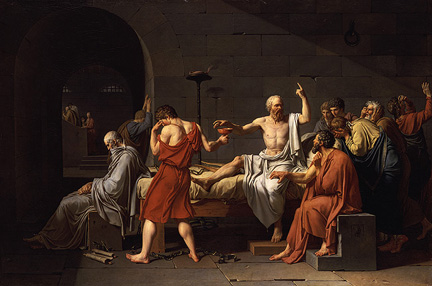
“Death of Socrates” by Jacques-Louis David, 1787, Metropolitan Museum of Art

Academic Freedom and Professional Responsibility:
A Handbook for Scholars and Teachers of the Middle East

Attempts to undermine professors’ abilities to teach and do research are increasingly directed at scholars who seek to provide a contextualized and critical view of recent international developments and their interaction with US foreign policies and practices.

The first draft of the handbook was based on research undertaken by the Taskforce on Middle East Anthropology to understand available institutional resources, as well as on ethnographic interviews conducted with academics who have encountered obstacles in their teaching and scholarship. The handbook was revised in 2012 by a group of current graduate students and recent PhDs in Middle East Anthropology, at the behest of the original handbook committee.

The revision aimed to evaluate the current atmosphere of academic freedom via a survey distributed to faculty and graduate students studying the Middle East, update the document to reflect legal changes that impact the ability of academics to carry out their scholarship and teaching, review major controversies over academic freedom since the original version of the handbook was published, and update links, citations, and contact information.

The handbook provides concrete suggestions for how to respond to attacks on academic freedom and to avoid them in the first place. It considers the potentials and limitations of internal university structures, professional organizations, legal recourse, and media outlets. Finally, it contains useful pedagogical tools for dealing with difficulties in the classroom, and an informative bibliography of recent writings on academic freedom.

“Academic Freedom and Professional Responsibility: A Handbook for Scholars and Teachers of the Middle East” (2012). Click here for information on how to download a pdf of this report.
New Online Issue of CyberOrient


CyberOrient, the online journal of the Middle East Section of the American Anthropological Association, has just published its 2012 issue on “The Net Worth of the Arab Spring.” The guest editor is Ines Braune, who writes in the Introduction:

When I was asked to be the guest editor of the current issue of CyberOrient, I realized this is a welcome opportunity to arrange and re-sort some aspects, points, and arguments about the role of the media during the Arab Spring. In the course of the events late in 2010 and early in 2011, I felt enthusiastic and overwhelmed – not primarily as a scholar with a background in Middle Eastern and media studies, but as someone who was part of the peaceful German revolution in 1989 as a young teenager. Upon reflection, I took up the role of a media researcher considering how the use of media shaped these events. Though much has already been said and written about the media and Arab Spring, it would be worthwhile after a bit more than a year to reflect and reevaluate the relationship between the media and revolutions. Due to my involvement in this edition, and after numerous discussions with colleagues, and students in my media seminar in the summer term, I frequently came across the following three points: the significance of mediatization processes, the online-offline dichotomy, and various kinds of amnesia.

The articles discuss the role of social media in Egypt, Iran, and Al Jazeera, along with two book reviews.

How to Defend the Prophet?


Supporters of Lebanon’s Hezbollah leader Sayyed Hassan Nasrallah wave Hezbollah flags and shout slogans at a protest against a film made in the US that mocks the Prophet Mohammad, in southern Lebanon, Sept. 19, 2012. The Arabic on the headscarves read, “In your name prophet of God.” (photo by REUTERS/Ali Hashisho)

by Alaa al-Aswany, Al-Monitor, September 19, 2012

Whether you are Muslim, Christian or follow any other religion, you have the right to practice your faith, and others must respect your religious convictions without anybody mocking or degrading your beliefs. Thus, every Muslim has the right to feel angry upon watching a pathetic and badly made movie that depicts their prophet in a shameful, deceitful and insulting manner. Muslims were also within their rights when they felt angered by the cartoons that mocked the Prophet that were published in Denmark a few years ago. Furthermore, they were right to be angered by the movie Fitna (strife) — a film produced by right-wing Dutchman Geert Wilders in 2006 — which derided the Muslim faith and considered it the source of all the world’s terrorism. In all of these instances, Muslims were justifiably angered, and they had the legitimate right to embark on a campaign aimed at convincing the world that they were entitled, as human beings, to see their religious beliefs respected without prejudice. But, unfortunately, and as a result of these campaigns, Muslims lost that aforementioned right, and themselves contributed in distorting the image of Islam and Muslims because they let their anger get the best of them by overlooking the following facts:

First: The nature of freedom of expression in the West Continue reading How to Defend the Prophet?

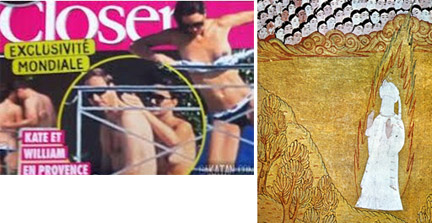
Body Politics: Muhammad and Middleton


The offending photographs of Kate Middleton, left; an Islamic depiction of Muhammad by not showing his face, right


[Note: The following commentary has been posted to my column “Middle East Muddle” on the online website of Anthropology News, published by the American Anthropological Association. To read the entire commentary, click here. For more commentaries on “Middle East Muddle, click here.]

Two scandals have dominated the news, at least in Europe and America, over the week following the 9/11 anniversary. The first, which has yet to abate as I write this, is the widespread protests against a pathetic anti-Muslim film trailer trolled from Youtube, rhetorically warmed over in Arabic and promoted by extremist Muslims to stir up violence. The troll took a toll with the American ambassador and several other Americans killed in Libya, violent clashes in Egypt and in Yemen and a range of protests (many of which have remained peaceful) across Muslim communities. The second, which is equally absurd as a pretext, is the voyeuristic publishing by French, Irish and Italian tabloids of a long-distance photograph of the naked breasts of Kate Middleton, the newly wed wife of Britain’s Prince William. The paparazzi have once again harmed Britain’s royal family, first by chasing Princess Diana and now by turning a powerful lens on a private moment in a private home while Diana’s son vacationed in France. In both the body is all about politics…

For the entire commentary go to “Middle East Muddle” by clicking here.

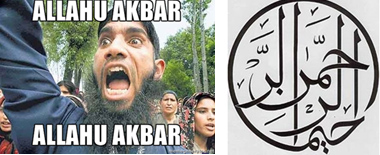
Beyond Allahu Akbar: WWMD, WWJD, WWYD


The manipulated political fury expressed in religious rhetoric over a pathetically provocative anti-Islamic film trailer buried among the millions of needles in the haystack that is Youtube continues, now with a focus in Pakistan. It is not surprising that most Muslims should find the film’s absurd claims offensive. Yet, despite the media images of angry rock throwers holding signs in English, this does not drive the vast majority into the streets or trespassing into Western consulates. If all the cameras stopped rolling, the riots would stop cold. But, of course, now the cameras never stop and any bit of footage can appear on Youtube in a nanosecond. What should we do?

My friend Omid Safi posts on a commentary blog he calls “What Would Muhammad Do?” In his comments on this controversy, he notes that there is enough textual information to reconstruct what Muhammad did when he was insulted:

Yet we know that our Prophet himself was the target of repeated assaults and mockery, and even in his moment of triumph when he had the power to punish, he chose to forgive his enemies and set a higher moral example.

We invite Muslims from every country to raise their voice and be heard, and yet to do so in a way that honors the very example of the manners, the ethics, the path, and the being of the Prophet that we so adore.

There is no way, other than by religious faith in sacred writings, to know what the real Muhammad would do in the modern world, all those hadiths notwithstanding. So in effect Omid and everyone else must argue for what they would expect Muhammad to do if he did live today. But he doesn’t, and neither does Jesus or Moses or any of the revered prophets of the three major monotheisms. In a sense all of the commentary on the reaction to the film is WWWWMTD “what we would want Muhammad to do.”

WWMD is, of course, a take off on WWJD. Since J (as in Jesus) happens to be a revered prophet in Islam as well as Christianity, in principle a Muslim can accept that Muhammad and Jesus would do the same thing morally as guided prophets of the same God. Continue reading Beyond Allahu Akbar: WWMD, WWJD, WWYD

Syrian Refugees in Lebanon


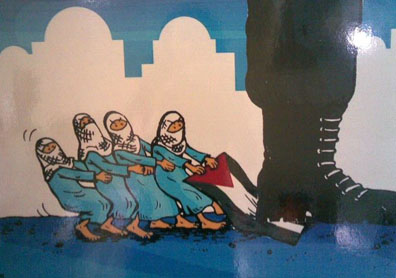
Image from Museum of Resistance in Lebanon; photograph by Estella Carpi

Syrian refugees in Lebanon: when the Apollonian cannot expect anything from the Dionysian

by Estella Carpi

While based in Lebanon, I personally find no way of getting out of the emotional whirlwind of suffering that the Syrian revolution, the merciless state repression and the subsequent armament of the revolutionaries have been giving rise to for 18 months. Without aiming at prematurely assessing the size of the emergency response to the “Syrian humanitarian crisis”, I would like to discuss here the Lebanese phenomenological approach to the current events by using the Syrian refugees’ lens.

Although used to regarding Syria as a model of stability and harmony, and as a place where people allegedly identify through the imposed order, the Lebanese suddenly find themselves taking care of the Syrian Leviathan. If Lebanon has always embodied the Dionysian, with its several war scars, social open wounds and its incontrollable emotionalities, Syria has always represented the rational, organized and balance-keeper Apollonian to the outsider’s eye. Continue reading Syrian Refugees in Lebanon

Finally, Indonesian Outrage Looks Productive


by Kevin Fogg

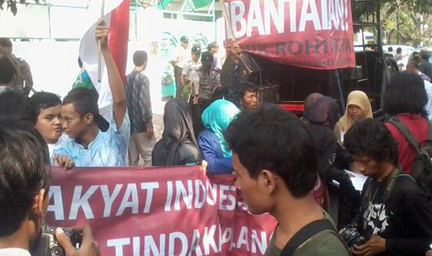
In the last week, as protests have flared around the Muslim world about the film Innocence of Muslims, Indonesia has not been left out. Protests in Jakarta and Surabaya (the capital and second largest city, respectively) on Friday and Saturday were led by the group Hizbut Tahrir. Today more violent protests flared at the US Consulate in Medan and again at the US Embassy in Jakarta, where police arrested four instigators from the frequently-unruly group Front Pembela Islam (Islamic Defenders’ Front).

Since democratization in 1998, Indonesians (especially those in Jakarta, but also in other cities) have not been shy about protesting. Protests in front of the American Embassy (which also faces the central square in Jakarta and the site of most major protests) are not uncommon, but other countries are also frequently the target of protests, including majority-Muslim countries like Malaysia. Most of these protests about overseas issues have no impact on government policy, or on the issues that they are protesting about, but one case this summer shows the flip side of the coin: protests that became productive in international relations

Indonesians were outraged at news in June and July about sectarian clashes involving the Muslim Rohingya minority in Burma. These deaths were not the worst in the ongoing struggles of the Rohingya–involving denied refugee status, limitations on international aid, years of discrimination, and other woes–but the opening of the press in Myanmar allowed news on the conflict, which fed into Indonesian Muslim outrage. Not sparing anyone in their anger, Indonesians even loudly criticized Nobel Prize Winner Aung San Suu Kyi for not paying enough attention to this issue. This led in August to several demonstrations across the country, even including the leader of the national Indonesian Ulama Council. Indonesian attention has kept up since the initial news, too, with the largest Islamically-minded paper in the country hosting a special page for news on the “Rohingya Tragedy,” with new articles almost every day. Continue reading Finally, Indonesian Outrage Looks Productive

Islam Without Red Lines

By Anouar Majid

The violence that erupted in the wake of the YouTube on the Prophet Mohammed is a wake-up call to all who care about the future of human civilization and, particularly, that of Arabs and Muslims living in Muslim-majority nations. (Muslims living in the United States are having the time of their lives—the land of what Iranian mullahs call Great Satan is the best place on earth for them.) Still, Muslims everywhere have been unable to unbind their ties to religious orthodoxy, clinging tenaciously to the decrees of religious scholars in mosques, as well as to the fatwas pronounced on the tube and the net alike.

I arrived in Morocco, arguably the most liberal country in the Arab world and a reliable partner of the West for decades, on the eve of the YouTube trailer controversy. As soon as I heard about the murders in Libya and the violent protests in Egypt and elsewhere, I chose not to be silent in the face of Islamist fury. I spent time explaining to cab drivers, unemployed youths, poorly educated workers, and highly educated professionals that the US government can’t control what people post on the Internet. I tried to get my interlocutors to understand that Muslims are laughably easy to manipulate—all one only has to do is draw a caricature of the Prophet or make a film about him to turn them into the world’s laughingstock. Continue reading Islam Without Red Lines