Category Archives: “Arab Spring”

What ails humanitarian aid in Lebanon


The high social price of media and humanitarian dissimulation in North Lebanon.

by Estella Carpi

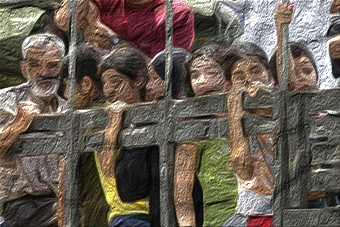
In the aid provision sphere of North Lebanon, international media in close connection with humanitarian agencies often hasten to show how North Lebanon’s hospitality of Syrian refugees coming in large numbers to flee destruction, scarcity, repression, chronic fear and instability is huge. Such hospitality is actually a product of a quite complex picture with an up-close look, unlike the idyllic scenario humanitarian practitioners and local people usually provide. In addition, social dynamics are normally depicted in the media in ethnicized terms: that is to say Lebanese versus Syrians.

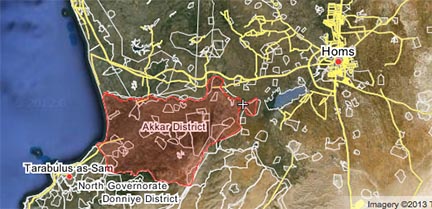
A few months ago, while conducting my fieldwork in Lebanon, I was told that some Lebanese threw stones to humanitarian workers during the food kits’ distribution for Syrian refugees in a town in Akkar, the northern region. The episode had been interpreted by local people themselves as an outburst of tension because of the sudden massive presence of humanitarian organizations in the area, which has always been neglected by state and non-state actors due to lack of political interests. The latter, in fact, were slightly more localized in Beirut and in the south of the country, vexed by Israeli occupation and by a consequent local impoverishment (1978-2000).

The humanitarian agencies operating in that town decided not to let journalists publish about the episode. Others published about it by contending that local people in North Lebanon would definitely stop “hostilities” and warm up if aid were provided to them too. The main reason behind the omission and amendment of this kind of information is apparently the intention not to generate further frictions between the local community and the Syrians. Continue reading What ails humanitarian aid in Lebanon
Yemen’s National Dialogue


Yemen’s President Rabu Mansour Hadi has issued decree No. (12) for 2013 on Sunday, March 17, forming the presidium of the Comprehensive National Dialogue Conference, which starts today. The officers are listed below:

1- President Abdo Rabu Mansour Hadi as president of the conference.
2- Abdul-Kareem al-Iriani as a vice-president for the conference.
3- Yasin Saeed No’man as a vice-president for the conference.
4- Abdul-Wahab Ahmed al-Anisi as a vice-president for the conference.
5- Sultan Hizam al-Atwani as a vice-president for the conference.
6- Ahmed Bin Fareed al-Sorimah as a vice-president for the conference.
7- Saleh Ahmed Habrah as a vice-president for the conference.
8- Abdullah Salem Lamlas as the conference’s reporter.
9- Nadia Abdul-Aziz al-Sakkaf as a deputy for the reporter.

For a complete list of the 565 participants in Arabic, go here.

The term “dialogue” is ambitious, given the general disrespect held in Yemen for the UN, which is sponsoring this 6-month long exercise. It is hard to imagine how over 500 people can engage in a meaningful dialogue. Is the six months so they can each take the floor and filibuster? While a wide net has been cast, there is still major grievance from the southern secessionists, who staged a strike in Aden on Sunday. Although none of the former major political players will be physically present (including former President Salih, General Ali Mohsen and Sheikh al-Ahmar), they will certainly be represented by some of the participants. One is always hopeful that a path to national reconciliation can be forged. Yemenis did it themselves after the bitter civil war in the 1960s, but that was before decades of military rule eroded most Yemeni support for the central government. Still, talk is always better than bullets, so let the dialogue begin.

The high social price of humanitarian dissimulation


By Estella Carpi

A few months ago, while conducting my PhD fieldwork in North Lebanon, I shared my ideas on the current humanitarian assistance to Syrian refugees with a journalist working in Lebanon. I reported that I was told by some Lebanese from Halba that their neighbors threw stones at humanitarian workers during the food kits’ distribution for Syrian refugees in a little town in ‘Akkar (North Lebanon). Apparently it was just an outburst of tension because of the sudden massive presence of humanitarian organizations in loco. In the past they have always neglected this area in Lebanon due to lack of political interests, since the Israeli occupation and the consequent local impoverishment were primarily vexing the south of the country (1978-2000).

The humanitarian agency that the journalist was working for at that time first decided to omit such information before publishing the article. After that, in order not to be accused of censorship, with a cringe-worthy diplomatic move, they published it by elegantly modifying the content of the stones episode, and contending that local people in North Lebanon would definitely warm up if aid were provided to them too. This is a human dynamic that, unfortunately, I had never got the insight of in the field. The humanitarian agency at issue declared that this “information amendment” was carried out in a bid not to generate further frictions between the Lebanese and the Syrian communities. My “Wikileaks philosophy” pushes me instead to broach out the subject overtly and try to analyze it. Continue reading The high social price of humanitarian dissimulation

Karim Ben Khelifa: “The World is Changing, Change With It”


Karim Ben Khelifa

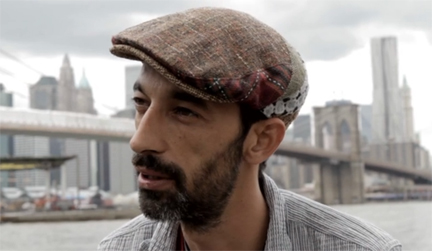
Photojournalist Karim Ben Khelifa is interviewed about his work in war zones with a collage of his photographs on Vimeo. This is a short video; check it out for an excellent insight into the art of photojournalism in the Arab Spring and other conflict contexts. For his website of older galleries, click here. For his Twitter account, click here. Karim has also found a new online photojournalism site called Emphasis.is.


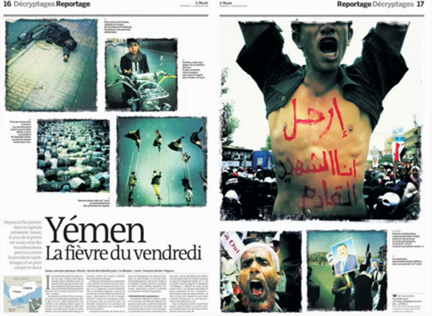
Karim’s work in Le Monde

Continue reading Karim Ben Khelifa: “The World is Changing, Change With It”

USAID in Yemen


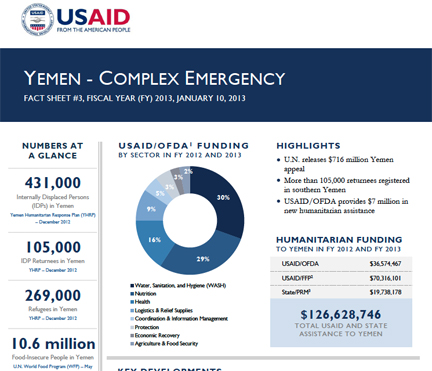
The drones capture the headlines when Yemen makes the news. The development arm of the U.S. State Department, USAID, also works in Yemen, although its activities have been greatly curtailed since the old days when I worked as a consultant on a number of USAID projects, starting in 1982 on the Agricultural Sector Assessment of Yemen of that year. For information on USAID’s current programs in Yemen, check out the relevant website. USAID provides a recent (January) fact sheet on the development situation in Yemen.


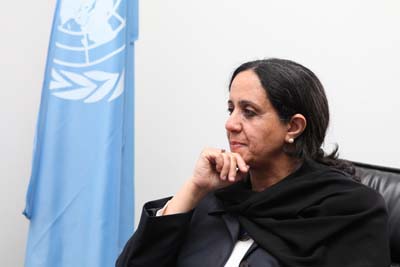
Amat Al Alim Alsoswa on the Yemeni National Dialogue


ROUNDTABLE DISCUSSION;
YEMENI COMPREHENSIVE NATIONAL DIALOGUE: CHALLENGES AND PROSPECTS

The International Peace Institute (IPI) is pleased to host a roundtable discussion on the Yemeni Dialogue with Ms. Amat Al Alim Alsoswa, former Assistant Secretary-General, Assistant Administrator and Director of the Regional Bureau for Arab States, United Nations Development Program on Wednesday, February 13, 2013, from 1:00pm–2:45pm at IPI’s Trygve Lie Center for Peace, Security & Development on the 12th floor, located at 777 United Nations Plaza.

Yemen’s transition began on November 23, 2011, when an agreement was brokered by the Gulf Cooperation Council (GCC) creating a two-year transitional government led by President (and former Vice-President) Abdu Rabu Mansour Hadi. The agreement mandates holding a National Dialogue to decide the formation of the new movement and address other pressing national issues. According to the GCC agreement, the National Dialogue conference must include “all forces and political actors, including youth, the Southern Movement, the Houthis, other political parties, civil society representatives and women.” Continue reading Amat Al Alim Alsoswa on the Yemeni National Dialogue