By James M. Dorsey, The Turbulent World of Middle East Soccer, June 2, 2013
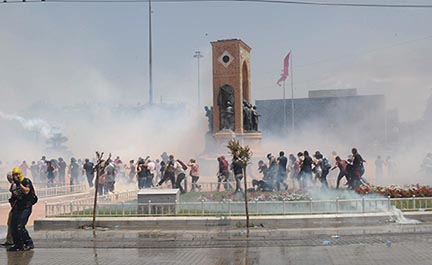
Almost a week of countrywide protests in Turkey have left an indelible mark on the country’s political landscape: broad discontent with the policies of Prime Minister Recep Tayyip Erdogan’s policies and increasing haughtiness bubbled to the surface; militant soccer fans thousands of whom joined the Taksim Square protests united and were politicized; and the role police force plays in solidifying opposition groups and resolve was highlighted.
Mr. Erdogan’s intransigence and hard-handed police attempts to suppress the protest with tear gas and water cannons swelled the ranks of the demonstrators and turned a demand for perseverance of a 75-year old Istanbul park into a massive call for the prime minister’s resignation. Thousands of militant fans of Istanbul’s three rival soccer clubs led by the left-wing, most politicized of the support groups Carsi, the ultras’ of Besiktas JK, joined forces for the first time in 30 years as they march to Taksim Square. So did rival soccer fans in other cities.
Comparisons between Taksim and Cairo’s Tahrir Square that has come to symbolize the ability of the street to topple a government are tempting. To be sure, there are superficial similarities but these are outstripped by the differences. The two square share the unification of rival soccer fans with a history of fighting one another; the occupation of a main city square; the protesters’ slogan: Erdogan, istifa! or Erdogan resign in imitation of Egypt’s Mubarak irhal! or Mubarak leave!; the violent police crackdown; and the ultimate at least partial government backdown.
But unlike mass demonstrations that toppled leaders in North African nations, the protests in Turkey are against a democratically elected leader who has won three elections with a respectable majority, presided over a period of significant economic growth and repositioned his country as a regional power with global ambitions. They also occurred in contrast to Arab countries in a country that despite all its warts is democratic and has a strongly developed, vociferous civil society. Continue reading Taksim is not (yet) Tahrir
 Art from