Category Archives: “Arab Spring”

Hailing Hellfires


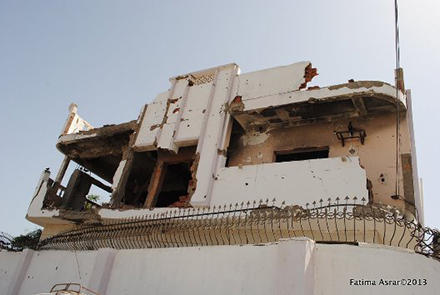
A destroyed building as a result of fighting between AQAP and the Yemeni government in 2012, taken in June 2013. (Photo: Fatima Abo Alasrar)

by Fatima Abo Alasrar, Atlantic Council, October 30, 2013

Apart from the Yemeni National Dialogue Conference that has been generating good news in the press, the country is on a rapidly deteriorating course toward uncertainty. On October 18, al-Qaeda in the Arabian Peninsula (AQAP) launched a suicide attack targeting a military installation in al-Ahwar district of Abyan governorate which killed twelve soldiers and left several others wounded. This was the same governorate that fell under control of the terrorist group of Ansar al-Sharia during the Arab Spring uprising in 2011. Despite the liberation of Abyan from the terrorist occupation, the group still conducts terrorist acts, through planting land mines in schools, kidnapping aid workers, in addition to their usual suicide tactics against military installations and local popular committees that guard the city.

The danger of AQAP in Yemen is real, but so are the drone attacks which intensified during the Obama administration. The weapon meant to target terrorists caused great harm to Yemen in a number of ways. Human Rights Watch issued a report on October 22 highlighting the devastating effects of air strikes. The report examined six drone strikes since 2009. Although the number of investigated cases is not a representative quantitive sample on the drone strikes in Yemen (various sources document an estimated eighty-two to ninety-two drones attacks during this period), the qualitative sample made one important point abundantly clear: no matter how precise the drones, they still generate civilian casualties, destruction, fear, trauma, motherless children, loss of income, and increasing rage towards the United States. Continue reading Hailing Hellfires

Politics and the Evolution of Takfeer in Yemen

By Sama’a Al-Hamdani and Afrah Nasser for The Atlantic Post, Yemeniati, October 12, 2013

I was declared an apostate at the end of April 2013 because of a political seminar on women’s empowerment hosted at my college in Taiz. In this gathering, I stated that Islam’s most stringent provisions – whether in the Qur’an or the Sunnah – are meant to refine rather than to terrorize. A radical cleric twisted my words and said that I called the Prophet Mohammed a liar and based on it, I was labeled a Kafir (apostate). – Sally Adeeb, age 21, law school student.

Since the overthrow in Yemen of former president Ali Abdullah Saleh in 2011, 11 people have been accused of apostasy (see chart 1 below) in the practice referred to as Takfeer. One of them, Jamal al-Junid, was detained by the police in May 2013 for 15 days and finally was released after the staging of several protests. Another accused “apostate” is Ahmed Al-Arami, a literature and arts lecturer who was labeled a “secularist” in April 2013 and subsequently fled the country because of serious threats and the possibility that he might be executed. The sensitivity of offending religion is a stumbling block in the quest to return Yemen to stability.

NDC and the Evolution of Takfeer

Yemen’s National Dialogue Conference (NDC), which was launched in March 2013 and is part of a Gulf Cooperation Council plan for a negotiated transition for Yemen, has been targeted for accusations of apostasy by one of the country’s leading clerics. Abdul Majeed Al-Zindani, Yemen’s influential Muslim Brotherhood/Wahhabist cleric who is also listed as a “specially designated global terrorist” by the United States Treasury Department in 2004, recently released a YouTube video in which he condemned the current NDC political process. The video presentation discussed the framing of the state’s legislation being managed by “the State Building Committee” and claimed that the majority of the committee’s members had voted that Islam is “the state’s main source of legislation” instead of “the state’s only source of legislation.” Continue reading Politics and the Evolution of Takfeer in Yemen

The Damning of Dammaj


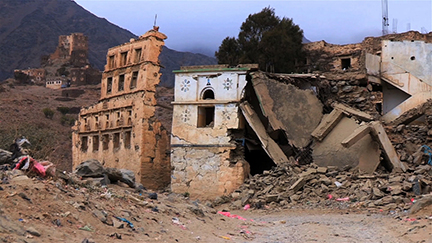
Destruction in northern Yemen caused by the civil wars with the Houthis, 2004-10 ; Photo: Mike Healy/IRIN


“Catastrophic” humanitarian situation in Yemen’s Dammaj

DUBAI, 6 November 2013 (IRIN) – A fresh outbreak of sectarian fighting in northern Yemen between militants of the Houthi-led Shia movement and (Sunni) Salafists has entered a second week with at least 50 people killed, according to a senior government health official, and aid workers getting little access to the besieged village of Dammaj, a Salafist stronghold.

Humanitarians are concerned that thousands of vulnerable civilians, some of them injured and sick, are unable to flee as Houthi forces continue to bombard the village from surrounding hills. In a statement last week the Houthis said a Salafi religious centre in Dammaj, Sa’dah Governorate, was being used to recruit Sunni fighters.

Attempts at a ceasefire on 5 November failed, and a further six people were reported killed overnight, with further fighting today, according to the government hospital in Dammaj.

“The humanitarian situation is catastrophic. There is no food, no medicine, no fuel, artillery shelling is non-stop and they are using all kinds of arms,” said Ahmad al-Wade’i, director of the hospital. “Diseases are spreading in a catastrophic way. Every day that passes the suffering of the people increases.”

The fresh fighting puts at risk a fragile truce that ended the civil war in the north in 2010. An escalation of the conflict around Dammaj could spill over to the neighbouring governorates of Hajjah, Amran and Al Jawf. Continue reading The Damning of Dammaj

Democracy … the West … and Islam: Part Two


By Samira Ali BinDaair, Sanaa, Republic of Yemen

[for Part One of this essay, click here]

Islam and Democracy

“Al-adala” (Justice) is a keyword in Islam, and Islam like the great religions preceding it came to regulate man’s life on earth and Allah sent many prophets to admonish the people who had gone to excesses and violated “Nawamis al-kawn” (Allah’s laws governing human interaction with the cosmos). Islam came to complete all the preceding messages in its being comprehensive, encompassing both the spiritual and material. When it is said in the Holy Quran that Allah has created man and jinn to worship Him, obedience to Allah’s laws of how man is to conduct himself on earth is part of that process of worship. In reading the Hadith literature (sayings of the Prophet PBH) and the Sira (biography of the Prophet,PBH), one can see how Islamic teachings were operationalized and exemplified, and what stands out is the absolute sense of justice in Islam.

The way Islamic affairs are to be conducted is through a consultative process (Shura) and in fact the concept of Shura is so important in Islam that a whole Sura (chapter) has been devoted to Shura. In Surat al Shura (ayya 38), it says: “Those who hearken to their Lord and establish regular prayer ….. who conduct their affairs by mutual consultation”. In choosing their leaders, Muslims should undertake the “Mubaya” ( declaring allegiance through the process of “Ijmaa” ( general consensus). No one practiced Shura more than the Prophet (PBH) himself. He always consulted with young and old on all matters. He consulted with Um Salama and Zainab bint Gahsh (wives of the Prophet) and respected their opinions. When the message was first revealed to him, he consulted with Khadija (his first wife) who reassured him and allayed his fears and consulted with her couisin Waraka ibn Nofal Christian monk at the time) who in turn reassured him that it was the angel Gabriel who had also been sent to prophets before him. During the battle of the “Khandak” (trenches) Salman Al-Farisi had informed the Prophet(PBH) about building trenches in battles as practiced in Persia where he came from; this was then adopted by the Muslims. The Prophet(PBH) was not autocratic and left some worldly matters to others who knew better than him. When when farmers in Medina asked him about cross pollination in date planting, his answer was:”You know better about these affairs”. Continue reading Democracy … the West … and Islam: Part Two

Democracy … the West … and Islam: Part One


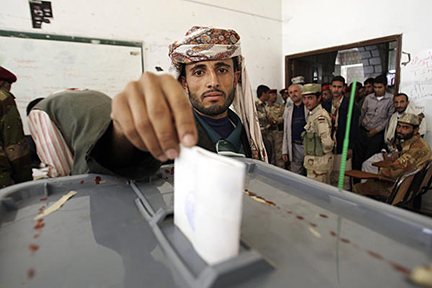
Yemeni man voting; photo by Hani Mohammed/AP

By Samira Ali BinDaair, Sanaa, Republic of Yemen

This essay is an attempt at shedding some light on the relationship between democracy, Islam and the Western world and in the process dispelling some of the misconceptions about the chasm between Islam and democracy. It is nowhere easy for the entire society to have unanimity on any given issue let alone such a complex one as what constitutes good governance and the best political system to be adopted. The Arab world has tried it all but I would like to point out that any system when transplanted and adopted without the necessary conditions for its success is bound to fail, leading to the condemnation of the system rather than analysis of the causes of failure in implementation.
Democracy as a pure concept

I would like to start with the concept of democracy which some Muslims have rejected on the basis of its emanating from the West within secular governments and secular ideas. However, if one examines the concept in its pure form it simply means rule of the people by the people for the people. To demystify it further, what it simply boils down to is that people have a voice in national affairs and choice of their leader and by virtue of the same fact are able to remove the leader through general consensus and legal means if the leader proves to be incapable of living up to the responsibilities entrusted to him/her. Continue reading Democracy … the West … and Islam: Part One

Islamism as Anti-Politics

by Faisal Devji, Political Theology Today, August 2, 2013

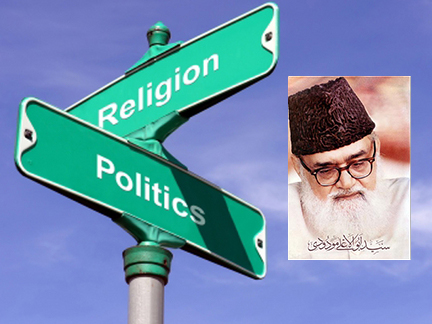
I want to argue here that the term “political Islam” is in many ways a misnomer, because the Islamism that is meant to instantiate it has been unable to appropriate politics as a way of dealing with antagonism either institutionally or even in the realm of thought. Looking in particular at the form Islamism took with one of its founding figures, the twentieth century writer, and founder of the Jamaat-e Islami in both India and Pakistan, Sayyid Abul a’la Maududi. I shall claim that it is marked by the absence of politics, or rather by a failure to theorize and absorb it. And this failure, I think, results in actions by parties like the Jamaat that are merely, and sometimes violently, unprincipled or opportunistic, because in them theology always stands apart from the political, however much it may want to embrace the latter. Although the development of this kind of anti-politics is rooted in the history of colonialism and the reactions thereto by Islamist thinkers, here I discuss the paradoxical consequences of such an effort, dealing specifically with Maududi’s conception of sovereignty, in which he comes closest to advocating a “political theology”.

Having examined the legal doctrine of European sovereignty, with all its extraordinary powers, Maududi asks, “Does such sovereignty really exist within the bounds of humanity? If so, where? And who can be construed and treated as being invested with it?”[1] Sovereignty, he recognizes, can never be fully manifested in political life because it presumes a power too great to be realized, which is to say the mastery of an entire society. In fact if such a power were to be instantiated it could only lead to tyranny. The sovereign, whether king or president, was therefore unable in actuality to exercise the power vested in him, and this difference between what political theory called for and what really was the case could only result in corruption and violence, as “he who is really not sovereign, and has no right to be sovereign, whenever made so artificially cannot but use his powers unjustly.”[2] Sovereignty, then, properly belongs to God alone, who has sole decision over life and death, since to give such powers to mortals would be to create the possibility of a dictatorship. But “There is no place for any dictator in Islam. It is only before God’s command that mankind must bow without whys and wherefores.”[3] In an effort to prevent dictatorship of an individual as well as popular kind, Maududi embodies the people’s will in God while at the same times annulling it. For God here is not sovereign in any traditional ways, for instance as the “unmoved mover”, but solely as a displacement for the will of the people, which can only manifest itself by identifying with the divine will, and in doing so to un-will itself. In the Islamic state, in other words, Muslims must destroy their particularity by identifying with God’s universality. And even though Maududi never achieved his Islamic state, it was largely because of his doing that Pakistan’s constitution reserves sovereignty for God.[4] Continue reading Islamism as Anti-Politics

Please tell me, Mr President, why a US drone assassinated my mother

by Rafiq ur Rehman, theguardian.com, October 25, 2013

The last time I saw my mother, Momina Bibi, was the evening before Eid al-Adha. She was preparing my children’s clothing and showing them how to make sewaiyaan, a traditional sweet made of milk. She always used to say: the joy of Eid is the excitement it brings to the children.

Last year, she never had that experience. The next day, 24 October 2012, she was dead, killed by a US drone that rained fire down upon her as she tended her garden.

Nobody has ever told me why my mother was targeted that day. The media reported that the attack was on a car, but there is no road alongside my mother’s house. Several reported the attack was on a house. But the missiles hit a nearby field, not a house. All reported that five militants were killed. Only one person was killed – a 67-year-old grandmother of nine.

My three children – 13-year-old Zubair, nine-year-old Nabila and five-year-old Asma – were playing nearby when their grandmother was killed. All of them were injured and rushed to hospitals. Were these children the “militants” the news reports spoke of? Or perhaps, it was my brother’s children? They, too, were there. They are aged three, seven, 12, 14, 15 and 17 years old. The eldest four had just returned from a day at school, not long before the missile struck.

But the United States and its citizens probably do not know this. Continue reading Please tell me, Mr President, why a US drone assassinated my mother

Amat al-Alim al-Soswa at Hofstra

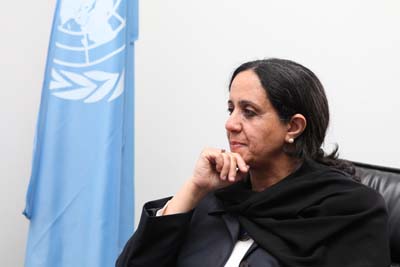
The Middle Eastern and Central Asian Studies Program of Hofstra University is pleased to announce a public talk by the Yemeni diplomat Amat al-Alim al-Soswa, who will be speaking about her recent work on Yemen’s National Dialogue. Details are provided here. This will take place on campus in 101 Barnard Hall on Thursday, October 24 from 2:20-3:45. For more information, please contact me at daniel.m.varisco@hofstra.edu.

Since March 2013 , Amat Al-Alim Alsoswa has been a member of the Yemen National Dialogue Conference and a member of its State Building Team. She also chaired a subcommittee to prepare and suggest the criteria and term of reference for the constitutional drafting committee.

She was appointed in December 2005 by United Nations Secretary-General Kofi Annan as Assistant Secretary-General, Assistant Administrator of the United Nations Development Programme and Director of its Regional Bureau for Arab States. In this post, Alsoswa has led UNDP’s 18 programme offices in the Arab region in their efforts to develop national capacities for poverty reduction, democratic governance, sustainable development, crisis prevention and recovery, and women’s empowerment. She has also provided regional thought leadership through the launching of two editions of the Arab Human Development Report, in 2006 and 2009, and in the preparation of the for the 2012 edition. Continue reading Amat al-Alim al-Soswa at Hofstra