For anyone interested in following the rapidly situation on the ground in Syria, check out the blog “Syria in Crisis” by Aron Lund at the Carnegie Endowment for International Peace.
For anyone interested in following the rapidly situation on the ground in Syria, check out the blog “Syria in Crisis” by Aron Lund at the Carnegie Endowment for International Peace.
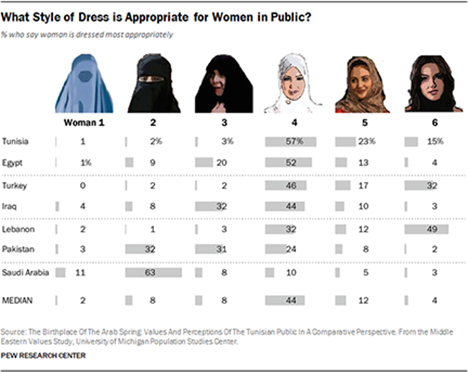
How people in Muslim countries prefer women to dress in public
By Jacob Poushter, Pew Research Center, January 8, 2014
An important issue in the Muslim world is how women should dress in public. A recent survey from the University of Michigan’s Institute for Social Research conducted in seven Muslim-majority countries (Tunisia, Egypt, Iraq, Lebanon, Pakistan, Saudi Arabia and Turkey), finds that most people prefer that a woman completely cover her hair, but not necessarily her face. Only in Turkey and Lebanon do more than one-in-four think it is appropriate for a woman to not cover her head at all in public.
The survey treated the question of women’s dress as a visual preference. Each respondent was given a card depicting six styles of women’s headdress and asked to choose the woman most appropriately outfitted for a public place. Although no labels were included on the card, the styles ranged from a fully-hooded burqa (woman #1) and niqab (#2) to the less conservative hijab (women #4 and #5). There was also the option of a woman wearing no head covering of any type. Continue reading Veiling Styles

The latest issue of CyberOrient (Vol. 7, Iss. 2, 2013) is now available online as open access. Here are the contents:
Editorial
Orchestrating Hip-hop Culture Online: Within and Beyond the Middle East
Anders Ackfeldt
Articles
Muslimhiphop.com: Constructing Muslim Hip Hop Identities on the Internet
Inka Rantakallio
Hanouneh style resistance. Becoming hip-hop authentic by balancing
skills and painful lived experiences
Andrea Dankic
“I Am Malcolm X†– Islamic Themes in Hip-hop Video Clips Online
Anders Ackfeldt Continue reading New CyberOrient issue is out
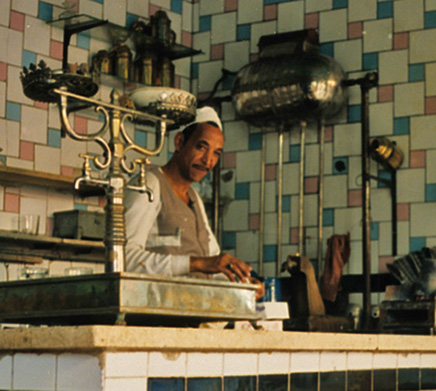
Egyptian drink seller near al-Azhar in 1983; photography by Daniel Martin Varisco
Egypt faces an ethical dilemma, one that affects anyone who has ever visited or carried out research in the country. My first experience in Egypt was in early 1981 when I conducted research in Asyut on rural sanitation for a USAID project, my first development assignment. This was still Sadat’s Egypt, open to American aid and seeking to end the bitter taste of unwinnable war with Israel. I felt safe no matter where I traveled. The only time I winced was when I visited the Pharaonic ruins in Luxor and stayed in one of the lesser hotels. Striking up a conversation with the young man at the hotel desk, he asked me if I could tell the nationality of another guest’s passport. The passport was in Hebrew and the guest was the Israeli consul. I calmly explained this to the clerk, who took it in stride – another paying customer. In 1983 I was able to spend a year in Cairo studying Islamic manuscripts at Dar al-Kutub, the Egyptian National Library. I could walk from my apartment in Zamalek on Ahmet Hishmet Street across the kubri to the library with my only fear being how to dodge the insane traffic crossing the corniche. I literally walked everywhere, enjoying the kebab, falafel and Groppi sweets. And everywhere I was welcomed with a hospitality and humor that anyone who has lived in Egypt can attest. This is the Egypt I have fond memories of, but this is now the Egypt that is exploding from within.
Egypt’s problems have always been forced upon the people by conquest after conquest from the Hyksos to the Greeks to the Arabs to the French to the British. The Arab Spring that seemed to bring the modern era of pseudo-Mamluk dictators to a close was heralded as a new beginning. The election, despite doubts of its validity, of Ibrahim Morsy as president with the obvious blessing at the time of the military was seen by many pundits as a hopeful sign. Would the Muslim Brotherhood, long in opposition but with a wide following, manage to meld their Islamic fervor with a stable and tolerant democracy? Whether this experiment might eventually have worked is now a moot point. The military coup that deposed Morsy last summer has now declared the Muslim Brotherhood a terrorist organization. Continue reading Brotherhood, Brotherly Hate, Brotherly Love
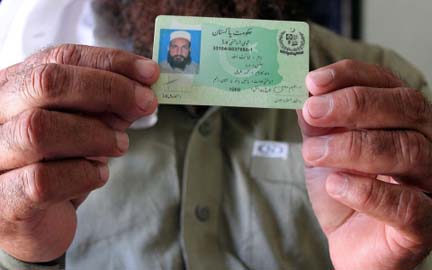
This photograph taken on May 2, 2013 shows Pakistan man, Abdul Razzaq holding the national identity card of his brother Amanatullah Ali, who has been detained for the last nine years in Bagram jail in Afghanistan, in Faisalabad. Guillaume Lavallee/AFP/Getty Images
Abu Zubaydah and the banality of ‘jihadism’
by Terry McDermott, al-Jazeera,December 19, 2013
The world is full of dangerous goofballs, but we can’t treat them all as threats to civilization
The Abu Zubaydah diaries recently made available to the public by Al Jazeera America might seem interesting only to security officials or 9/11 obsessives. To regard them as such would be a mistake, for they contain the most detailed portrait of the interior life of a dedicated jihadi that we have ever seen, and that we might ever see. They also help substantiate what should by now be clear: The U.S. has made significant, basic errors in its response to 9/11 and the threat of radical Islam.
Zubaydah, born in Palestine and raised in middle-class comfort in Saudi Arabia, rose through the 1990s — by what abilities it is not clear — to a position of some stature within radical Islam. He recorded his rise in hundreds of diary entries addressed to his future self. Written over two decades, the diaries track him from an early adulthood spent studying computer programming at a technical college in India through early 2002. Further diaries, written while he has been in U.S. custody, including at Guantánamo, have yet to be revealed.
Zubaydah was captured in the spring of 2002, the first significant Al-Qaeda-linked terrorist to be caught after 9/11. It turned out the link to Al-Qaeda was more tenuous than the U.S. government had imagined. For years, the U.S. government had viewed him as a major figure within the group, at one point even elevating him to the No. 3 position on what turned out to be a fanciful Al-Qaeda organizational chart. Continue reading The Banality of ‘Jihadism’
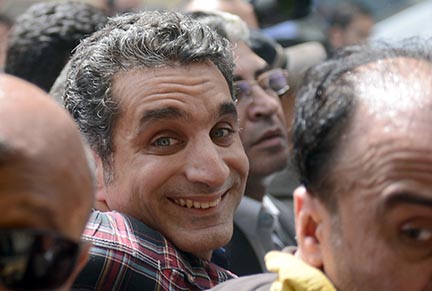
Egyptian satirist and television host Bassem Youssef is surrounded by his supporters upon he arrival at the public prosecutor’s office in the high court in Cairo
(AFP Photo)
by Bassem Youseef, al-Arabiya, December 13, 2013
In some sort of excessive selfishness, Egyptians are tending to see as victims only those with whom they sympathize. For example, if you voice your anger over the verdict to imprison the Alexandria Girls (they were later acquitted), a friend will send you a photo of the Kardasa soldiers who were unjustly killed and tell you: “If you’re sad over this verdict, then remember those soldiers.â€
If you express your grief over the killing of soldiers in Sinai, Muslim Brotherhood pages on social networking websites will publish photos of the dispersal of the Rabia sit-in and tell you: “If you’re sad over those soldiers, remember the protestors who were killed first.â€
National security officer Mohammed Mabrouk gets killed in a terrorist ambush, and instead of praying for mercy over his soul – since he is a human being – some rush to publish photos and names of those killed by Interior Ministry gunfire. It is as if Mabrouk is responsible for all those martyrs. Continue reading In Egypt, your empathy alone is enough
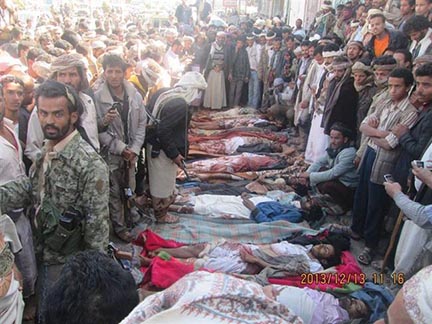
Bodies of Yemenis killed by a drone attack last Thursday
The use of drones in Yemen has received a lot of attention this year, even though there has appeared to be a lull in their use since the summer. It is reported in Yemen Press that an American drone killed 8 Al-Qaida suspects in Ahwar Abyan. No details are given in the article. Nashwan News, quoting sources from Yemen’s security forces, describes a different strike the same day in al-Bayda’ in which a top al-Qa’ida figure is said to have been killed. Or was it really a wedding procession, as reported in Al-Masdar Online, which describes a drone (known in Arabic as a ta’ira bidun tiyar) that killed 13 and wounded 30 others in hitting cars in a wedding procession (zifaf). Aden Online reports the number of dead as 17 and 32 wounded. Another source gives a range of 12 dead and wounded. The province of al-Bayda’ has seen a lot of resistance to the government. The drone struck at 4:30 pm on Thursday, hitting cars carrying men from two tribes. Two prominent tribal shaykhs were said to be wounded in the process.
The stories differ because the sources differ, some eager to justify any drone attack as effective and others unwilling to admit that the strike was successful in eliminating a terrorist. Clearly, however, as the horrendous photograph of the dead documents, whether or not al-Qa’ida lost a leader, there were quite a few other people who were killed. Even if the government thought it legitimate to go after one man, is it worth depriving so many citizens of life and limb? Once again drones serve as the best recruiting tool for terrorists in Yemen and drag the name of the United States even further into the muck. Continue reading Of Drones and Reporting
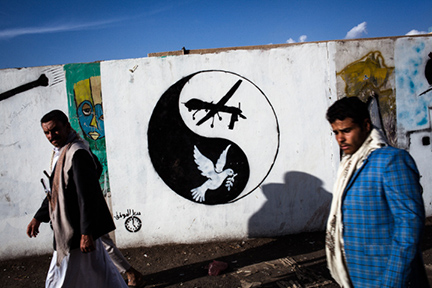
Men walk past anti-drone mural in Sanaa, Yemen, Nov. 25, 2013; photography by Juan Herrerro
Yemen’s New Ways of Protesting Drone Strikes: Graffiti and Poetry
by Tik Root, Time Magazine, November 30, 2013
An American drone hovers along a main thoroughfare in the Yemeni capital, Sana’a. Not a real drone, but rather a 7 foot-long rendition of an unmanned aircraft spray-painted near the top of a whitewashed city wall. Below it, a stenciled-on child is writing: “Why did you kill my family?†in blood-red English and Arabic script.
Painted by Yemeni artist Murad Subay, the Banksy-esque mural sits beside three others also admonishing the United States’ use of drones in Yemen to track and kill terrorism suspects. This drone art is part of Subay’s latest campaign, “12 Hoursâ€, which aims to raise awareness about twelve problems facing Yemen, including weapons proliferation, sectarianism, kidnapping and poverty. Drones are the fifth and arguably most striking “hour†yet completed.
“Graffiti in Yemen, or street art, is a new device to communicate with the people,†says Subay, 26, who after taking up street art two years ago in the wake of Yemen’s Arab Spring revolution has almost single-handedly sparked the growing Yemeni graffiti movement. “In one second, you can send a message.â€
The anti-drone chorus in Yemen has grown louder since the Obama Administration took office in 2009. All but one of the dozens of reported drone strikes in Yemen have been carried out since Obama came to office (although strikes here and in Pakistan have been more sporadic in recent months). Operations are rarely acknowledged by American officials but have nonetheless stirred a global debate about the strikes’ legality, morality and effectiveness. Continue reading Yin and Yang over Yemen’s Drones