Category Archives: Conferences and Talks

The Quran in an Historical Context


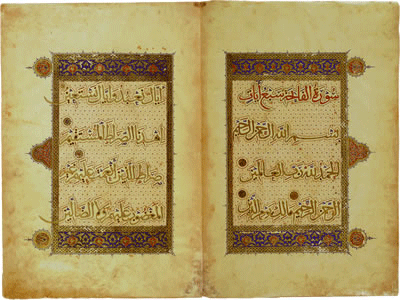
Sultan Baybars’ Qur’an Text

Alwan for the Arts Presents

The Quran in an Historical Context by Nasr Hamid Abu Zayed
Friday, April 24, 2009 6:30 P.M.
Free and Open to the Public

Religious texts are understandably ubiquitous and take on a life of their own, above and beyond the quotidian, above and beyond history, and are endowed with a sacred halo of omnipotence and omnipresence. However subjecting sacred texts to innovative forms of historical, hermeneutical or allegorical readings can be an immensely rich exercise in bringing out the multidimensional view inherent in the text and in our reception of its meaning. In this lecture, Nasr Hamid Abu Zayed will offer a survey of the most recent theories, controversies and discoveries in the field of Quranic studies as well as address by way of a historical and comparative reading the circumstances in which the Quran was formed and its relationship to the Bible. Continue reading The Quran in an Historical Context
Forensic Scriptures: Down by the Riverside

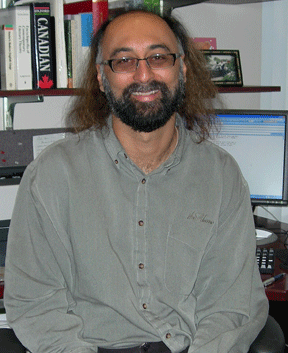
The following information is about a conference at the Riverside Church in Manhattan on May 15-17, 2009. Tabsir commentator and newly tenured professor Amir Hussein (pictured above) will be giving a presentation on Saturday, as noted below. Note that unlocking the key to these Forensic Scriptures is not free, but requires registration.

Forensic Scriptures presents the Qur’an as a sacred resource increasingly accessible to Jewish and Christian scholars and students of the Scriptures. It is a template of scriptural production from the last major culture to spring from the ancient Middle East, in which reliable information about scriptural development has never disappeared from view. To illustrate the model, Muslims believe Muhammad was illiterate and that nearly all Surahs of the Qur’an may have been written down by the women of his household, lead by Hafsah, who was entrusted with preservation of the Qur’an and transmission of it to the world. The Hadith presents conversations and actions of the Prophet as recorded by his Companions, male and female, including another wife, Ayisha. Recognition that such materials were penned by women does not rely on secondary sources or conjecture. Islamic primary sources, under rigorous re-evaluation by Islamic scholars today, have a potential to reveal whole new paradigms that may now be applied to Biblical texts, beginning with these historic Riverside symposia, supported by surrounding seminaries and by noted scholars. Continue reading Forensic Scriptures: Down by the Riverside

Rethinking Jihad conference

International Conference
“Rethinking Jihad: Ideas, Politics and Conflict In the Arab World and Beyond”

The University of Edinburgh, 7-9 September 2009

Especially since 11 September 2001, the notion of ‘jihad’ has assumed
centre-stage in public and academic discourses on Islam, Muslims, and the
Arab world, particularly as a byword for terrorism and violence. But
clearly jihad has meant different things to different people at different
times, whether as theory, as action or as metaphor. As a timely exploration
of this diversity, the Centre for the Advanced Study of the Arab World
(CASAW) is convening a major international conference on the subject of
jihad in its multiple dimensions. The conference has three overarching
goals. The first is to bring together academics and others from a variety
of disciplines and specialisations to generate an in-depth discussion of
jihad in its practical, theoretical, historical, juridical and symbolic
dimensions. It is hoped that by drawing on a diversity of perspectives
(methodological, historical and geographical) the conference will contribute
to a deeper and more critical understanding of jihad. The second goal is to
reflect critically on the importance of jihad, however defined, to the study
of the Arab and Islamic worlds: to what extent is jihad a useful analytical
concept? Have students of Islam and the Arab world minimised or overstated
its importance? How should jihad be located in future research agendas?
Finally, the conference will seek to engage with the broader knowledge
community and explore current understandings and representations of jihad
within policy and media circles internationally. It will critique these
representations, as well as explore ways in which academics might contribute
to an improved understanding and contextualisation of jihad in public
discourse. Continue reading Rethinking Jihad conference

African and Arab Media Conference

The Arab Media Centre is pleased to inform you that its next conference will take place on 30-31 March, 2009 at the University of Westminster in London.

CALL FOR PAPERS
African and Arab Media Audiences:
Shared Agendas for Research

Conference jointly organised by the Africa Media Series, Arab Media Centre and Audiences Group, Communication and Media Research Institute (CAMRI), University of Westminster

Dates: 30-31 March, 2009

Venue: University of Westminster, New Cavendish Campus,
115 New Cavendish Street, London W1

THE TOPIC

Media research to date has largely neglected the fast growing and diverse media audiences in African and Arab countries. These countries share painful histories of colonization and broadly comparable experiences of post-independence media development. Today they share the challenge of adjusting to global trade and investment regimes that affect local media production and distribution systems but are crafted elsewhere. Yet when we speak of media reception in the Global South, we tend to think in terms of isolated geographies: of ‘Latin America’, ‘Africa’, or the ‘Middle East’. By contextualizing primarily in terms of place, we overlook memories, issues and features that media users in different regions have in common. We foster artificial boundaries and separate research agendas. As a result, opportunities for productive joint debates about Arab and African media consumption are missed. Continue reading African and Arab Media Conference