Category Archives: Conferences and Talks

Horn Talk in Lamu


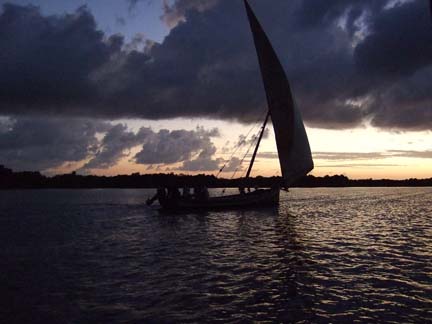
Dhow near Lamu at sunset

I am writing this from the exquisite Island of Lamu in Kenya. As someone who has spent over thirty years rambling around Yemen, across the Gulf of Aden, it is quite eye-opening to take a look up at the southern part of the Arabian Peninsula from an African perspective, especially a view that has been influenced in many ways by earlier generations of migrants from Yemen. It would be nice if I was here only because it is such a beautiful tourist spot with a rich cultural heritage, and indeed all this is nice, but I am actually attending an annual seminar on the Horn of Africa hosted by the Rift Valley Institute. The organizers recognized that cultural history and contemporary politics in the Horn can hardly be separated from Yemen, which lies so close across the Red Sea and Gulf of Aden. Hence I was invited to contribute on the links between Yemen and the Horn and also to discuss the relevance of Islam and the contentious issue of “Islamism.” Continue reading Horn Talk in Lamu

Mearsheimer at The Jerusalem Fund

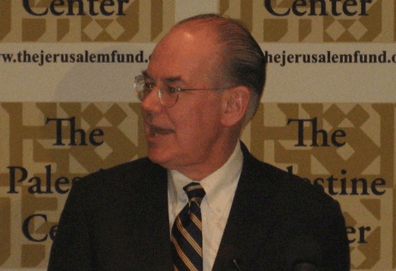
Edited Transcript of Remarks by Professor John J. Mearsheimer
Transcript No. 327 (29 April 2010)

To view the video of this briefing online, go to
http://www.palestinecenter.org

The Palestine Center
Washington, D.C.
29 April 2010

Professor John Mearsheimer:

It is a great honor to be here at the Palestine Center to give the Sharabi Memorial Lecture. I would like to thank Yousef Munayyer, the executive director of the Jerusalem Fund, for inviting me, and all of you for coming out to hear me speak this afternoon.

My topic is the future of Palestine, and by that I mean the future of the land between the Jordan River and the Mediterranean Sea, or what was long ago called Mandatory Palestine. As you all know, that land is now broken into two parts: Israel proper or what is sometime called “Green Line” Israel and the Occupied Territories, which include the West Bank and Gaza. In essence, my talk is about the future relationship between Israel and the Occupied Territories.

Of course, I am not just talking about the fate of those lands; I am also talking about the future of the people who live there. I am talking about the future of the Jews and the Palestinians who are Israeli citizens, as well as the Palestinians who live in the Occupied Territories.

The story I will tell is straightforward. Contrary to the wishes of the Obama administration and most Americans – to include many American Jews – Israel is not going to allow the Palestinians to have a viable state of their own in Gaza and the West Bank. Regrettably, the two-state solution is now a fantasy. Instead, those territories will be incorporated into a “Greater Israel,” which will be an apartheid state bearing a marked resemblance to white-ruled South Africa. Nevertheless, a Jewish apartheid state is not politically viable over the long term. In the end, it will become a democratic bi-national state, whose politics will be dominated by its Palestinian citizens. In other words, it will cease being a Jewish state, which will mean the end of the Zionist dream. Continue reading Mearsheimer at The Jerusalem Fund

Female Islamic Leadership Research Network

Female Islamic Leadership Research Network

WHO SHOULD JOIN
Academics interested in any aspect of female religious authority or leadership in Islamic communities worldwide – historical or contemporary – should join this network. The goal of the list is to enable academics spread across a wide variety of disciplines to pass along relevant information and resources, and to discuss topics of interest.

WHY THIS NETWORK
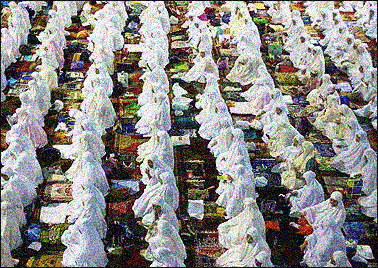
This research network is an outgrowth of a conference held in October 2009 at St Antony’s College, University of Oxford on contemporary female Islamic authority, Women, Leadership and Mosques: Changes in Contemporary Islamic Authority. The conference focused on the growing number of women active teaching, preaching, interpreting scriptures, or leading prayer in mosques or madrasas around the world.

The large response to the call for papers for this conference made it clear that academic interest in this topic is high and increasing, and also that academics working on this topic are divided by an unusually large number of disciplinary boundaries. A virtual network with a mailing list is an ideal way to connect scholars interested in this topic.

The network is open to scholars studying any aspects of female religious leadership in Islam, and therefore includes topics outside the conference’s purview, for instance, the reinterpretation of Islamic scriptures by women who are primarily active outside of mosques and madrasas. Continue reading Female Islamic Leadership Research Network

Yosef Tobi at Hofstra

Professor Yosef Tobi of Haifa University will be presenting a talk entitled “The Legal Status of the Jews in Muslim Yemen, 897-1948” at Hofstra University on Tuesday, April 27 at 9:35 am in 201 Barnard Hall. This lecture is sponsored by the Middle Eastern and Central Asian Studies Program and the program in Jewish Studies at Hofstra. Dr. Tobi is one of the leading experts on the history of Yemenite Jews and has written several important books on the topic, including The Jews of Yemen: Studies in their History and Culture (1999).

For a review of Dr. Tobi’s The Jews of Yemen, click here.

For an article by Dr. Tobi entitled “THE CONTRIBUTION OF YEMENITE
JEWISH WRITINGS TO YEMENITE HISTORY” click here.

ON MILITANCY AND THE ART OF THE EGG

The Colloquium for Unpopular Culture and NYU’s Program for Asian/ Pacific/ American Studies present a new series: AUSCULTATIONS: sound, noise, (nervous heart)beats

FLAGG MILLER (University of California at Davis)
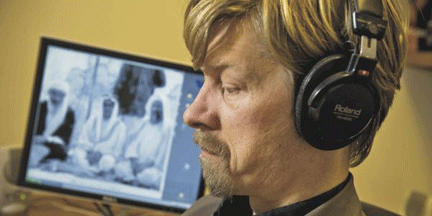
ON MILITANCY AND THE ART OF THE EGG: THEOLOGICAL LESSONS FROM THE OSAMA BIN LADEN AUDIOCASSETTE COLLECTION

Cosponsored by NYU’s Hagop Kevorkian Center for Near Eastern Studies

When: Monday 19 April 2010, 12:30pm
Where: Room 471, 20 Cooper Square (East 5th and Bowery)
Free and open to the public

The alleged fantasies of Islamic militants provide Western audiences with an ample repertoire not only for stereotyping Muslims but also for severing acts of terror from realms of human experience. With the aim of bringing Muslim militants’ narratives of violence back to the complexities of situated cultural interaction, Flagg Miller will investigate the ways in which militancy is conceptualized through audiocassette-mediated sound production. In the winter of 2002, over 1500 audiocassettes from Osama Bin Laden’s former compound in Qandahar, Afghanistan were acquired by Cable News Networks. Miller will focus on one cassette entitled “With the mujahidin” (ma` al-mujahidin) that features participants cooking breakfast in a makeshift Afghan Arab kitchen. Continue reading ON MILITANCY AND THE ART OF THE EGG

Iranian and Central Asian Numismatics


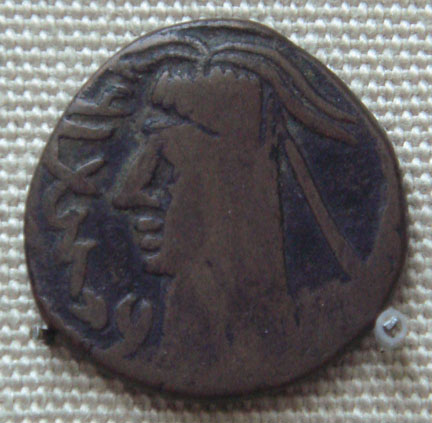
Sogdian coin, 6th century AD, British Museum


The Middle Eastern and Central Asian Studies Program
at Hofstra University will be hosting a day-long workshop on “Early Iranian and Central Asia Numismatics: In Memoriam Boris Kochnev (1940-2002).” The program will be held in CV Starr Hall, room 109 on Sunday, April 18 from 11:00 am – 5:00 pm. Details of the program are provided below. For more information, please contact Prof. Aleksandr Naymark .

Preliminary program

Session I
11:00 am – 12:30 pm

Michael Bates
(American Numismatic Society, New York, USA)
Surprises from Arab/Sasanian Fars, 640-710

Stefan Heidemann
(Jena University, Germany – Bard College Graduate Center, New York, USA)
A New Iranian Mint for Drahm in Sasanian Style: Isbahan

Konstantin Kravtsov
(Hermitage Museum, Sankt-Petersburg, Russia)
Semidrachms of Farrukhan the Great in the Collection of the State Hermitage Museum Continue reading Iranian and Central Asian Numismatics

Picturing Palestine


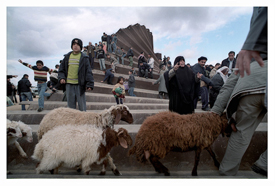
Escape from Gaza by Karim Ben Khelifa

On Tuesday, April 13, photojournalist Karim Ben Khelifa will be speaking at Hofstra University on “Picturing Palestine: Gaza and the West Bank.” This will be held in 201 Barnard Hall from 9:35-11 am. The event is sponsored by the Middle Eastern and Central Asian Studies Program at Hofstra.

For more information, contact Professor Varisco at daniel.m.varisco@hofstra.edu.