Category Archives: Humor and Satire

Right along with the Bible”: Innocents Abroad


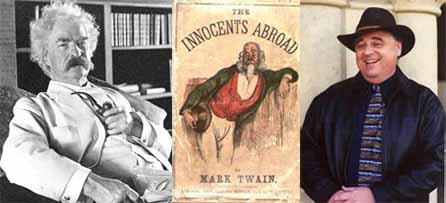
[Mark Twain, left; early cover of ‘Innocents Abroad’, center; Hilton Obenzinger, right]

by Hilton Obenzinger, Stanford University

Innocents Abroad’s manufacture of “Mark Twain” as the surrogate for the reader’s “own eyes” was immensely popular. The travel book, whose sales reached 100,000 even before the second anniversary of its publication, launched, even more than his celebrated jumping frog, Mark Twain’s national career. “Popular as are Mark Twain’s books at home,” an unidentified correspondent for the Hartford Courant reported in 1872, Innocents Abroad is “still more so abroad.”

“It sells right along just like the Bible,” Mark Twain remarked to William Dean Howells. Indeed, half a million copies had been sold by Twain’s death in 1910, at which time Innocents Abroad, with its central organizing principle of “Mark Twain” as “one of the boys” joined Adventures of Huckleberry Finn and The Adventures of Tom Sawyer as the titles (and two other boys) most commonly worked into political cartoons memorializing the author in the press. Today Innocents Abroad, still a pleasure to read despite the complications and vexations of history, remains durable, continuing to be hailed as “the most popular book of foreign travel ever written by any American.” Continue reading Right along with the Bible”: Innocents Abroad

Another Debate (Debate?)

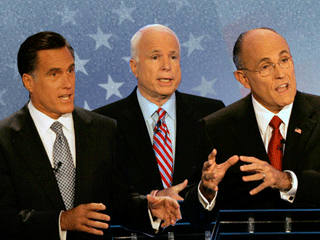
Watching the Fox News comedy-not-so-central Republican debate last night, it seemed to me that the gentlemen (and they were, of course, only men) behind the podiums were more intent on smiling through their election-year platitudes than engaging with the messy realities of the government each seeks to head. Apart from Ron Paul, the interloping libertarian, each candidate apparently (a word that John McCain stubbornly refuses to use in his vocabulary) hoped that supporting the troop surge would lead to a surge (even a blip for those hanging on only by their televised sound bites) in their respective pre-season ratings. There was a lot of puffing and fluffing about family values, with Hizzoner begging (the question) to have his private life left private (‘fat chance’, as they say in the Big Apple) and another don’t-remember-the-name tossed out the Pottery-Barnyard we-broke-it-so-we-gotta-fix-it mantra that treats premature evacuation (Iraqis Interruptus) as one of the seven deadly sins. Mercifully, there was no gay bashing and one candidate (does it really matter who said what at this stage?) insisted that Republicans or better than Democrats because they ‘come clean’ and resign after a scandal. I wonder if Larry Craig was taking notes. Fox News should have stationed an embedded reporter in a stall in the Minneapolis airport just to be on the safe side. Continue reading Another Debate (Debate?)

Sahara, My, My but it’s Dry

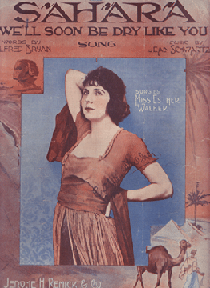
Vaudeville loved Orientalism. By the time Valentino played The Sheik, images of Middle Eastern scenes were well represented on stage and in music. Some of the lyrics from this time period are very clever. My personal favorite is a prohibition song from 1920 called “Sahara, We’ll Soon Be Dry Like You,” sung by the great comic singer Billy Murray. To hear this original Edison Diamond Disk recording in a digital format, click here.

Here are the words. Why not click above and sing along…


Sahara (We’ll Soon Be Dry Like You)

Words by Alfred Bryan, Music by Jean Schwartz

Verse 1: King Rameses went to pieces seven thousand years ago,
And pass’d a law that Egypt must go dry.
He took the liquors from the “shickers” all the way to Jericho,
But kept his little toddy on the sly.
The desert of Sahara flow’d with honey so they say,
Till prohibition came along and dried it up one day. Continue reading Sahara, My, My but it’s Dry

Revenue Sharing, but not Drug-free


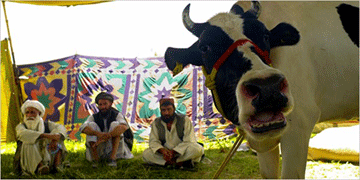
[The American plan to convince Afghan farmers not to grow poppies: some good old cow dung smothered in politically expedient B.S. Photo from the New York Times.]

In the old days (before 9/11, the posters for Osama dead or alive, the seeming fall of the Taliban, Operation Shock and Awe, etc.) before terrorism merited an all-out war, there were more socially-minded wars on the American political scene. An earlier Texan (so early he was Democratic) named Lyndon Johnson started a War on Poverty. The wealth of Bill Gates shows how well that succeeded. Then Betty Ford helped launch a War on Drugs. Casualty figures for this have been withheld by the government for insecurity reasons. Indeed, today’s New York Times has an article that suggests the War on Drugs has fused with the War on Terrorism and we are losing on both fronts. “Afghanistan produced record levels of opium in 2007 for the second straight year, led by a staggering 45 percent increase in the Taliban stronghold of Helmand Province, according to a new United Nations survey to be released Monday.” writes David Rohde in his article “Taliban Raise Poppy Production to a Record Again.” He adds, “Here in Helmand, the breadth of the poppy trade is staggering. A sparsely populated desert province twice the size of Maryland, Helmand produces more narcotics than any country on earth, including Myanmar, Morocco and Colombia. Rampant poverty, corruption among local officials, a Taliban resurgence and spreading lawlessness have turned the province into a narcotics juggernaut.” Continue reading Revenue Sharing, but not Drug-free

Little Mosque on the Prairie

It started with Little Joe on Bonanza; you’ve seen the reruns and you’ve hummed the theme song. Then Little Joe went family fare and moved into a Little House on the Prairie. This is the television icon of conservative, what-a-wonderful-life-we-all-had-in-the-good-old-days Americana, if ever there was. I have watched a seemingly infinite number of reruns of both programs, but to my knowledge the only Orientals in sight were Chinese; no Muslims crossed the prairie.

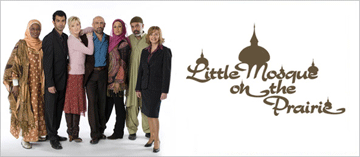
So it is certainly time for a Little Mosque on the Prairie, even if it debuts in Canada rather than Kansas. Yes, fellow Americans, Muslims can be funny and not just the butt of Islamophobic jokes. It may not be surprising that nearly 2 million viewers tuned into the premier of the new television series on CBC. Continue reading Little Mosque on the Prairie

Famous General Supports Iraq War

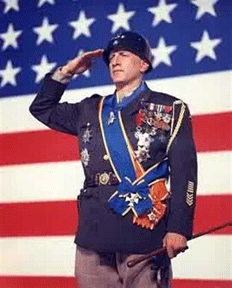
America has a number of famous generals who now serve as icons of our legendary military prowess. General Washington beat the red pants off of Lord Cornwallis. General William Tecumseh Sherman put the heat on those good old southern white boys down in Georgia. General Custer died with his boots on, as did all the men he led into battle. Then there were the heroes of World War II, the most cinematic being General George C. Scott, I mean General George S. Patton. It turns out that General Patton, like all superheroes, has risen from the grave and returned to tell it like it should be (since “like it is” is not going so well) in the War on Terror and Iraq. If you would like his revamped take, then all you need to do is go to YouTube and see him read the Patriot Riot Act, courtesy of a 21st century impersonator and vintage 20th Century Fox (no relation to Fox News this time) footage.

If you are disappointed that the footage here is from the movie, then rest assured that General Patton has indeed been seen, though not as many times as Elvis. Just ask Don Imus.

Luke R. Publican

Laughter that Lasts 12 Centuries

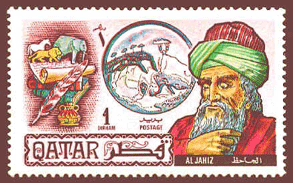
The honor of being the greatest writer in Arabic prose, at least in the eyes of numerous Arab literati for the last millennium, belongs to the Iraqi Abu ‘Uthman ‘Amr ibn Bahr al-Jahiz. Born in Basra in 776 C.E., a full millennium before our own nation was founded, Jahiz lived most of his life between the recently founded Baghdad and Samarra. He is the acknowledged master of Arabic adab literature, an eclectic form both entertaining and instructive. The elegance of his writing is matched by the grounding of his reflections on the ordinary and the lowest parts of the social order.

One of his most entertaining works that survives is a satirical look at misers and the nature of avarice. In a culture that idealized hospitality from the poor Bedouin’s goat-hair tent to the sumptuous silk cushions of the sultan’s palace, this is a telling admission that not everyone abides by the social norms. Continue reading Laughter that Lasts 12 Centuries

What Went Wrong: A Top-Ten Review

What went wrong in Iraq? It seems as though it might make more sense to ask why didn’t anything go right. When Operation Iraqi Freedom began, the good news was that a brutal tyrant named Saddam Hussein had been ousted from power. For the billions of dollars thrown at modern Mesopotamia, the result is now in painful hindsight a bloody (and I do not simply mean the British expletive) mess with no good in realistic sight. The litany of bad news has morphed into a politically untenable tsunami, destroying all good intentions in its wake. One of the top stories in today’s news is the alarming rate of deaths among contractors working alongside the American military in Iraq. In the first three months of 2007 almost 150 were killed, often because they tend to be “soft targets,” but increasingly because U.S. troops are stretched thin outside the surge-happy capital. Even Chatham House, hardly a left-leaning lean-to in British politics, has neon-lighted the handwriting on the Babylonian wall with a recent report by Gareth Stansfield, who argues in a paper released Thursday that “Iraq is on the verge of being a failed state which faces the distinct possibility of collapse and fragmentation.” You know things are really bad when the U.S. military creates its own shared channel on You-Tube.

The reasons are so obvious four years after the patriotic fever orchestrated by the Bush-Cheney-Rumsfeld-Wolfowitz gang of neocons that it almost seems trivial to keep repeating them, so perhaps the best thing is a Letterman-like line-up of the top ten real stupid mistakes made so far (it ain’t over until the fatuous voter sings) by recent U.S. foreign policy in Iraq: Continue reading What Went Wrong: A Top-Ten Review