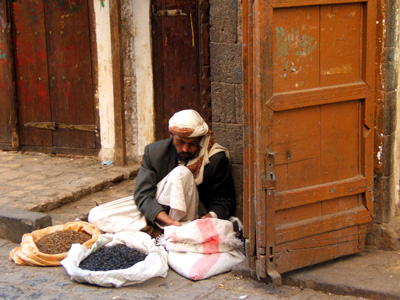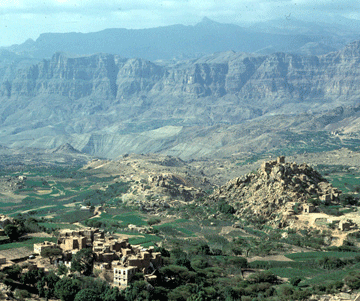
Highland valley of al-Ahjur in central Yemen
The following report was recently published online by dvv international at the Institut für Zusammenarbeit des Deutschen Volkshochschul-Verbandes. It can be read in English, French or Spanish. The report describes an innovative World Bank-funded literacy project coordinated in Yemen by anthropologist Najwa Adra in 2002/2003.
Learning through Heritage, Literacy through Poetry
by Najwa Adra
I have just read Henrik Zipsane’s fascinating article on heritage learning (Zipsane 2007) in the latest issue of this journal. Zipsane describes several highly effective programs for lifelong learning provided by Jamtli Open Air Museum in Sweden. He argues that each person’s heritage includes “many coexisting histories” and that there is a need to provide diverse learning experiences. He suggests that one can learn “through cultural heritage” and not only about this heritage. In a part of the world far from Sweden, geographically and culturally, I too have found that heritage can be an effective learning tool “in the present” and not just an interesting artifact of the past.
The Project
In 2002-2003, I piloted a literacy project for adults in Yemen, on the SW corner of the Arabian Peninsula, in which learners created their own texts through their stories, poems and rhyming proverbs (Adra 2004). 2 Classes began with a discussion of a photograph of a scene familiar to the students or a topic of their choice. Students were encouraged to insert poetry and proverbs into their discussion, as is their custom when discussing issues of importance to them. With the teacher’s help, the class developed a short story based on the discussion. This story, which was written on large paper taped to the wall, along with poems and proverbs generated by the discussion, became the text through which students learned to recognize and read phrases, words and letters of the alphabet. In order to reinforce letter and word recognition, texts often focused on particular letters, words or syllables. Continue reading Literacy through Poetry →