Category Archives: Development

Islam and Contemporary Issues

By Asghar Ali Engineer, April, 2009

A few days ago I was invited to speak in a Prophet Day’s function. There were other speakers as well. As usual the speakers before me indulged in rhetoric ‘Islam is the solution’ and also said the world economy has failed and slowed down as it is based on gambling and interest. Another person said Islam declared human rights 14 hundred years ago whereas UNO declared it only sixty years ago. Yet another speaker said Islam has given equal rights to women and made it obligatory for them to seek education. Also it was emphasized that Islam is religion of peace.

All this provoked me to say all this is true and I can add much more to it but have we ever seriously reflected why Islamic world is in such turmoil today. Why Muslims have totally failed to adopt these teachings in practice. I said if one caste a critical glance at Islamic world today one finds exactly opposite of what Qur’an teaches. If Qur’an lays great emphasis on knowledge, Islamic world from Indonesia to Algeria has more illiterates than any other community. Continue reading Islam and Contemporary Issues
Emirati Youth in a Rapidly Changing Society

by el-Sayed el-Aswad, United Arab Emirates University

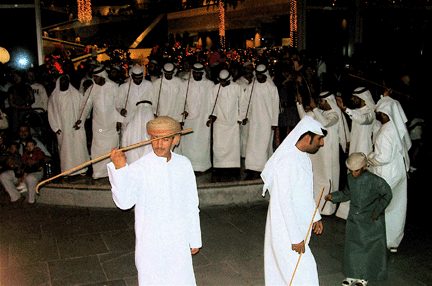
The UAE has developed amenable ways of synchronizing localism with globalism. It is hard to erase specificities that create a misleading portrait of a single global culture. However, Emirati local culture transforms and appropriates aspects of the global into a unique system of local social meaning. The young generations of the Emirates, for instance, have succeeded in assimilating outside influences without deserting their heritage. They have expressed their pride generated by their ability to combine both local culture and modern, global ways of life. They speak Arabic with Emirati dialects, eat indigenous food, use incense and wear traditional costumes (including veils for women) so as to symbolically identify themselves with their traditional society, but, at the same time, they speak English and employ symbols signifying western ‘global’ modernity, such as using computers, eating Western fast food, consuming expensive perfumes, and driving extravagant four wheel-drive cars. However, it can be argued that symbols of modernity do not fundamentally alter people’s beliefs, values, or culture. Continue reading Emirati Youth in a Rapidly Changing Society

Iraq Study Day at Hofstra

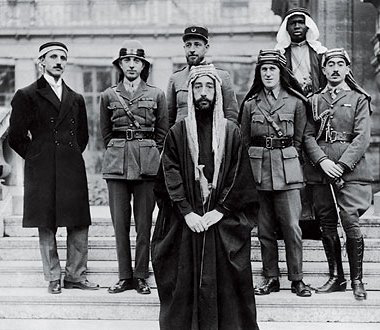
The Middle Eastern and Central Asian Studies (MECA) Program at Hofstra University is hosting a day-long “Iraq Study Day” on Monday, April 27, 2009. The purpose of the program is to bring several distinguished scholars to campus to speak to the Hofstra community and general public about the making of modern Iraq and the ongoing occupation by American military forces. Although information on the current crisis is widely available in the media, students, faculty and the general public need to understand the historical context for the making of modern Iraq in the 20th century.

A general forum for the public will be held on the theme “Iraq: How the Past Shapes the Future” on Monday, April 27, 3-4:30 p.m., in the Monroe Lecture Center Theater, California Avenue, South Campus of Hofstra University. Directions to Hofstra are available here.

The participants in the panel are:

• Nida al-Ahmad, Political Science, New School for Social Research: “State Power in Ba’thist Iraq”
• Dr. Magnus Bernhardsson, History, Williams College (author of “Reclaiming a Plundered Past: Archaeology and Nation Building in Modern Iraq,” 2006)
• Dr. Eric Davis, Political Science, Rutgers University (author of “Memories of State: Politics, History and Collective Identity in Modern Iraq,” 2005)
• Dr. Reeva Simon, History, Yeshiva University (author of “The Creation of Iraq, 1914-1921,” 2004
• Dr. Bassam Yousif, Economics, Indiana State University (author of “The Paradox of Development under Dictatorship: Iraq 1950-2003,” 2006)

Continue reading Iraq Study Day at Hofstra

Reforming Islamic family law

Reforming Islamic family law within the religious framework: the « best practices » strategy
by Khalid Chraibi

Many people in the Muslim world believe, wrongly, that shari’ah is a compilation of legal rules which are uniformly applied in all Muslim countries. But, the facts are otherwise: these rules vary significantly from one country to another, as well as over time. As a result, the status of women in Muslim countries, which is ruled by shari’ah, differs in many ways from one country to another. On any given issue, some national “personal status codes” grant more rights to women or better protect their interests than other codes.

According to feminine NGOs working in the field of Muslim women’s rights, if Governments accepted to apply the more favourable rules on any Islamic family law issue (designated as the “best practices”), this would contribute significantly to the reform of family law “within the religious framework”, bringing it closer to contemporary international standards. Continue reading Reforming Islamic family law

Towards Theocracy?


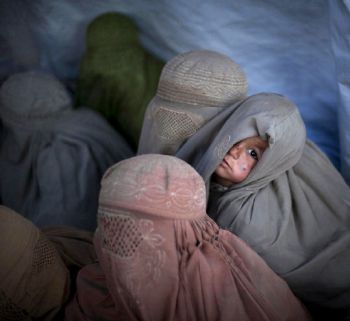
Women in burqas and children from the Bajaur and Mohmand agency areas wait to be registered at a refugee camp near Peshawar in January. Today a full-scale war is being fought in FATA, Swat and other “wild” areas of Pakistan, with thousands dying and hundreds of thousands of displaced people streaming into cities and towns. Photo by Emilio Morenatti/AP.


Towards Theocracy? State and society in Pakistan today.

by PERVEZ AMIRALI HOODBHOY, Frontline, March 14-27, 2009

FOR 20 years or more, a few of us in Pakistan have been desperately sending out SOS messages, warning of terrible times to come. Nevertheless, none anticipated how quickly and accurately our dire predictions would come true. It is a small matter that the flames of terrorism set Mumbai on fire and, more recently, destroyed Pakistan’s cricketing future. A much more important and brutal fight lies ahead as Pakistan, a nation of 175 million, struggles for its very survival. The implications for the future of South Asia are enormous. Continue reading Towards Theocracy?

Iraqi Women’s Minister Resigns, Draws Support


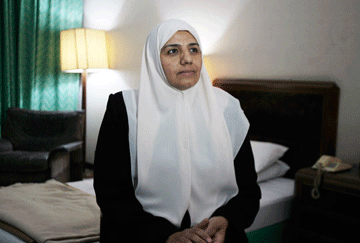
Nawal al-Samarraie, Photo by Karim Kadim

Iraqi Women’s Minister Resigns, Draws Support

by Corey Flintoff, NPR, February 12, 2009

Women in Iraq’s parliament have rallied behind the country’s minister for women’s affairs, who resigned earlier this week saying she was frustrated by a lack of support from the government.

The resignation highlights the plight of many Iraqi women, especially widows created by the country’s decades of war.

Nawal al-Samarraie had served as Iraq’s minister for women’s affairs for less than six months when she created a stir by turning in her resignation. She complained she had never received support from the government of Prime Minister Nouri al-Maliki, and that her budget for projects had been slashed from about $7,500 a month to around $1,500.

“I think it is wrong to stay as a minister without doing anything for my people, especially in this time and in this situation of Iraqi women — we have an army of widows, violated women, detainees, illiteracy and unemployment — many, many problems. I had to resign,” she said. Continue reading Iraqi Women’s Minister Resigns, Draws Support

Unveiling Traditions


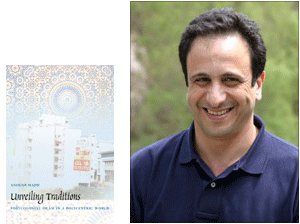
Anouar Majid

Unveiling Traditions

By Anouar Majid

Manufactured cultural biases and antagonisms deflect people’s attention from the more pressing issues facing humanity as a whole and energize the real powers undermining world cultures and ‘imagined communities.’ Although power relations and configurations have shifted dramatically in the last few decades, the languages of politics and scholarship still operate on dated assumptions whose effect is to freeze live histories into immutable and misleading stereotypes. One can understand how people without sufficient access to academic scholarship continue to believe that nations and cultures as they imagine them are real; but how does one account for the persistence of such beliefs in whole fields of academic study, despite a continuous barrage of information telling us that the world is being dramatically reconfigured by the rising powers of multinational organizations and extraterritorial bodies and laws? Continue reading Unveiling Traditions

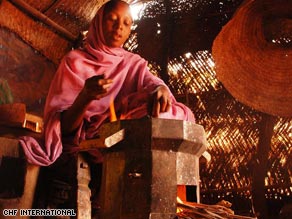
Stoves for Darfur


The $30 stoves help keep Darfur’s women safe
by reducing their time away from the refugee camps
.

Stoves help keep Darfur’s women out of harm’s way
Larry Lazo, CNN

In Sudan’s Darfur region, where violence and genocide are rampant, women risk their lives every day performing tasks as seemingly mundane as seeking out firewood.

But, from his suburban home, one Maryland teen has dedicated himself to making life a little safer for those women. Continue reading Stoves for Darfur