Category Archives: Development

Surfing in Sanaa

Internet cafes offer more to Yemen’s youth
by Teresa Gedi, Yemen Observer, April 3, 2010

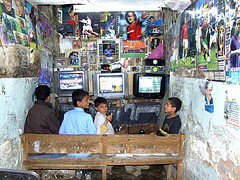
Al-Mortazah internet cafe, located at the foot of the Friendship Bridge near Tahrir square, takes the meaning of internet café to another level. In addition to its 20 computer stations, it has a full service sheesha bar and cafe from which I enjoyed a glass of fresh mango juice courtesy of the soft-spoken poet and journalist Abdul Rahman Ghelan.

Mr. Ghelan, age 30, has frequented the café since his personal computer broke down some months ago. As the place is close to his home and affordable (1 riyal per minute), he takes his time exploring various literary and journalistic websites across the Arab world. Being a poet, Ghelan finds the web to be an effective means of spreading his work and developing it through feedback from the online literary community. Feeling I had stumbled on a budding international artist, I listened intently as he humbly explained his work which focuses largely on politics, women and children. “My poetry has benefited greatly from web exposure in both the Arab world and outside. Literary personalities in Europe for example have contacted me requesting to translate my work into other languages, specifically, French and Italian.” Ghelan is also currently working on a translation of a book into English entitled “Memoirs of the Victim,” the victim being women in Yemen. Another poem “hams al-abir” or “The Whisper of Perfume” has caused quite a stir in the online Arabic poetry community. “I am amazed by the support I receive online,” says Ghelan. “As long as you are appropriate and respectful, it feels like people are right next to you supporting you.” Continue reading Surfing in Sanaa
Ann Dunham and Indonesia

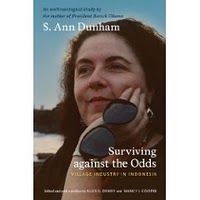
Last fall Duke University Press published the Ph.D. thesis of S. Ann Dunham, President Obama’s mother, who just happened to be an anthropologist. I can certainly sympathize with the editors, as my own dissertation also bordered on the 700 page level (which may be one reason it was never published as a book). Details on the book can be found at Duke University Press. But I attach here a valuable account by Michael Dove for the New York Times last August.

Dreams From His Mother

By Michael R. Dove, The New York Times, August 10, 2009

PRESIDENT OBAMA’s late mother, Ann Dunham Soetoro, was famous for the good cheer and optimism that she preserved in the face of a complex and challenging world. Her personality went hand-in-hand with her career as an anthropologist in Indonesia and Pakistan, where she studied and worked with village craftsmen, slum-dwellers and countless others. I knew Dr. Soetoro as a friend and colleague for many years before her death from cancer in 1995. Though I only met her son once, briefly at her memorial service, I’ve watched him as he’s taken on the hardest job in the world, and often found myself wondering how her worldview might have shaped him. Continue reading Ann Dunham and Indonesia

Human Rights Report on Yemen released

On March 11, 2010 the Bureau of Democracy, Human Rights, and Labor in the U.S. Department of State released its 2009 Country Report on Human Rights Practices for Yemen. The full report can be accessed online here, but I include below the preliminary paragraphs:

Yemen, with a population of approximately 23 million, is a republic whose law provides for presidential election by popular vote from among at least two candidates endorsed by parliament. In 2006 citizens reelected President Ali Abdullah Saleh to another seven-year term in a generally open and competitive election, characterized by multiple problems with the voting process and the use of state resources on behalf of the ruling party. Saleh has led the country since 1978. The president appoints the prime minister, who is the head of government. The prime minister, in consultation with the president, selects the council of ministers. Although there are a number of parties, President Saleh’s General People’s Congress (GPC) party dominated the government. Civilian authorities generally maintained effective control of the security forces, although there were instances in which security forces acted independently of government authority. Continue reading Human Rights Report on Yemen released

Understanding Islamic Feminism: Interview with Ziba Mir-Hosseini

Understanding Islamic Feminism: Interview with Ziba Mir-Hosseini

Yoginder Sikand, Madrasa Reforms in India, February 7, 2010

Born in Iran and now based in London, Ziba Mir Hosseini, an anthropologist by training, is one of the most well-known scholars of Islamic Feminism. She is the author of numerous books on the subject, including Marriage on Trial: A Study of Family Law in Iran and Morrocco (l.B.Tauris, 1993) and Islam and Gender, the Religious Debate in Contemporary Islam (Princeton, 1999). She is presently associated with the Centre for Islamic and Middle Eastern Law at the School of Oriental and African Studies, London.

In this interview with Yoginder Sikand she talks about the origins and prospects of Islamic feminism as an emancipatory project for Muslim women and as a new, contextually-relevant way of understanding Islam.

Q: In recent years, a number of Muslim women’s groups have emerged across the world, struggling for gender equality and justice using Islamic arguments. Most of them are led by women who come from elitist or, at least middle class, backgrounds. Many of them seem to lack a strong popular base. How do you account for this?

A: I think the majority of the women who are writing and publishing about what is popularly called ‘Islamic feminism’ are definitely from the elite or the middle class. But then, globally speaking, feminism has always had to do with the middle class, at least in terms of its key articulators and leaders. I believe that Islamic feminism is, in a sense, the unwanted child of ‘political Islam’. It was ‘political Islam’ that actually politicized the whole issue of gender and Muslim women’s rights. The slogan ‘back to the shariah’ so forcefully pressed by advocates of ‘political Islam’ in practice meant seeking to return to the classical texts on fiqh or Muslim jurisprudence and doing away with various laws advantageous to women that had no sanction in the Islamists’ literalist understanding of Islam. Translated into practice, law and public policy, this meant going back to pre-modern interpretations of shariah, with all their restrictive laws about and for women. It was this that led, as a reaction, to the emergence of Islamic feminism, critiquing the Islamists for conflating Islam and the shariah with undistilled patriarchy and for claiming that patriarchal rule was divinely mandated. These Muslim women were confronted with horrific laws that Islamists sought to impose in the name of Islam, and so began asking where in all of this was the justice and equality that their own understanding of the Quran led them to believe was central to Islam. These gender activists, using Islamic arguments to critique and challenge the Islamists, brought classical fiqh and tafsir texts to public scrutiny and made them a subject of public debate and discussion, articulating alternative, gender-friendly understandings, indeed visions, of Islam. That marked the broadening, in terms of class, of the fledgling Islamic feminist movement. Continue reading Understanding Islamic Feminism: Interview with Ziba Mir-Hosseini

Teaching at the margins

[Webshaykh’s note: Dr. Omar Dewachi, a recent graduate in anthropology from Harvard University, writes about his experiences teaching medical anthropology in Beirut. Here is the first paragraph of his essay, which can be uploaded in full as a pdf at http://www.alterites.ca/dernier.html.]

Teaching at the Margins: Experiences of Anthropology and Medicine in a Middle Eastern Setting

by Omar Dewachi, Altérités 6(2):129-135, 2009

For the last four years I have been teaching the Social Preventive Medicine (SPM) course to first year medical students at the American University of Beirut (AUB) in Lebanon. Around eighty students attend this core course, which is part of the teachin of public health within the medical curriculum. During the course of these years I have attempted to use the SPM as a platform to introduce theories and methods in medical anthropology to medical students. As both a medical doctor trained in Iraq – and an anthropologist – trained in the United States – this task has presented me with many challenges, as well as, offered me insights into tensions between the two fields. These experiences are the subject of this essay, which attempts to explore teaching at the margins of anthropology and medicine in a Middle Eastern setting. While situated at different margins, I reflect on how this course became an interesting site for exploring the complex task of teaching medical anthropology in a non-western context, while, at the same time, raising a set of paradoxes that are particular to teaching medical anthropology in a post-colonial setting. My attempt here is not to generalize my experiences or to reify the dichotomy of East and West; rather it is to situate them within their social-political, economic and historical realities.

To read the entire article in pdf, click here.

Ignorance is no Excuse


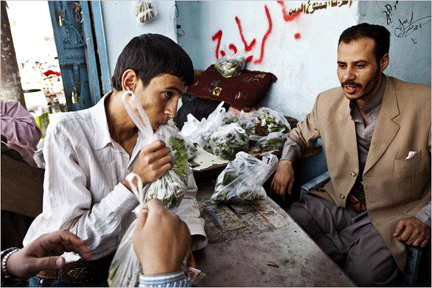
Selling qât in Sanaa, Yemen’s capital. Photo: Bryan Denton

These days if you run across an article on Yemen, it will no doubt feature a scenario of gun-toting tribesmen swearing allegiance to Al-Qaeda, the latest German tourist hijackings or feigned shock at the terrible, terrible addictive drug called qât. At least this was the case in Sunday’s New York Times in another piece of mixed journalistic pablum by roving reporter Robert Worth. Entitling the article “Thirsty Plant Dries Out Yemen,”, the author seems unaware that the site of his posting (Jahiliya) is in fact the Arabic term for the time of “Ignorance” before the rise of Islam. I doubt this reporter stepped out of a Queen-of-Sheba-era time machine and interviewed Abraha about his recent defeat at the “Battle of the Elephant” before Mecca. So where exactly is the fabled posting site of Jahiliya? Ironically, it is part of a World Bank irrigation project. I will leave the irony about IMF money being poured into Jahiliya in the strict sense to the imagination of the reader. And I strongly suspect the posting was made from a fancy hotel in the capital Sanaa and not from a rural internet cafe, while sipping qishr. But for a front page article on a major newspaper, ignorance is no excuse. Continue reading Ignorance is no Excuse

Waking from its sleep

[Webshaykh’s Note: This week’s Economist has a special section on the Arab World that is well worth reading. Here is the teaser online.]

from The Economist print edition, July 23, 2009

WHAT ails the Arabs? The United Nations Development Programme (UNDP) this week published the fifth in a series of hard-hitting reports on the state of the Arab world. It makes depressing reading. The Arabs are a dynamic and inventive people whose long and proud history includes fabulous contributions to art, culture, science and, of course, religion. The score of modern Arab states, on the other hand, have been impressive mainly for their consistent record of failure.

They have, for a start, failed to make their people free: six Arab countries have an outright ban on political parties and the rest restrict them slyly. They have failed to make their people rich: despite their oil, the UN reports that about two out of five people in the Arab world live on $2 or less a day. They have failed to keep their people safe: the report argues that overpowerful internal security forces often turn the Arab state into a menace to its own people. And they are about to fail their young people. The UNDP reckons the Arab world must create 50m new jobs by 2020 to accommodate a growing, youthful workforce—virtually impossible on present trends. Continue reading Waking from its sleep

Smoke Rises in the Middle East


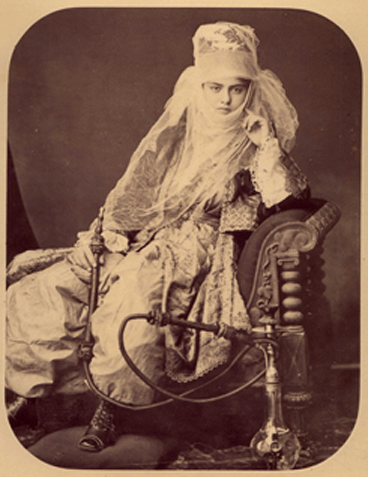
Hooked on Hookah, 1909

No, this is not another post about terrorism, nor the violent protests following the recent Iranian election, nor more reports of suicide bombs in hotel lobbies. The smoke from these tragedies is not about to disappear any time soon. The smoke I am talking about is from the tobacco industry. Newsweek (July 27 issue) provides a breakdown of smokers worldwide. While China leads all populations with almost 334 million smokers (32% of the overall population), they are actually lower percentage wise than Turkey with its 19 million users, accounting for 36% of the population. Other Middle Eastern countries surveyed fare a bit better than the United States (24% of the population) with 21% (28 million users) in Pakistan, 17.6% (9 million users) in Iran and only 14.2% (2.4 million users) in Iraq. I suspect even these numbers are under reported, given the ubiquity of cigarettes in the region. Health warnings or not, tobacco is still sultan in the Middle East and indeed the entire world. Continue reading Smoke Rises in the Middle East