Category Archives: Development

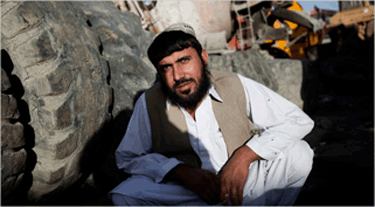
Payback for No Pay


Haji Layeq says an American company failed to pay a construction company he has ties to; photo by Adam Ferguson for The New York Times

Much of the world, despite what many Americans think, does not trust the United States intentions in either Afghanistan or Iraq. Both countries have seen corruption and favoritism at the highest levels. In theory “America” stands for citizens’ rights and equal treatment under the law, but in practice such principles may conveniently be ignored in war zones. Such a case was reported on yesterday in The New York Times by Carlotta Gall. She writes:

The failure of American companies to pay for contracted work has left hundreds of Afghan workers unpaid in southern Afghanistan, and dozens of factories and small businesses so deep in debt that Afghan and foreign officials fear the fallout will undermine the United States-led counterinsurgency effort to win the support of the Afghan people.

Continue reading Payback for No Pay

Horn Talk in Lamu


Dhow near Lamu at sunset

I am writing this from the exquisite Island of Lamu in Kenya. As someone who has spent over thirty years rambling around Yemen, across the Gulf of Aden, it is quite eye-opening to take a look up at the southern part of the Arabian Peninsula from an African perspective, especially a view that has been influenced in many ways by earlier generations of migrants from Yemen. It would be nice if I was here only because it is such a beautiful tourist spot with a rich cultural heritage, and indeed all this is nice, but I am actually attending an annual seminar on the Horn of Africa hosted by the Rift Valley Institute. The organizers recognized that cultural history and contemporary politics in the Horn can hardly be separated from Yemen, which lies so close across the Red Sea and Gulf of Aden. Hence I was invited to contribute on the links between Yemen and the Horn and also to discuss the relevance of Islam and the contentious issue of “Islamism.” Continue reading Horn Talk in Lamu

Iraqi Student Project


Iraqi students on road trip to Niagara Falls

[Editor’s Note: Below is information about an organization devoted to helping Iraqi students. Details are at http://iraqistudentproject.org/]

Iraq: A Cradle of Civilization in Ruins

Iraq’s people were among the first to learn irrigation, to invent the system of writing sounds that is key to our own alphabet, to create a legal system that is the foundation of modern law. During the early Islamic centuries Iraq was a center where ancient learning was translated and preserved, where poetry and music and medicine flourished. In modern times Iraqis have built a thriving system of higher education and have sent thousands of students to study all over the world, returning to teach and work in Iraq. Western institutions of higher learning benefit from the contributions to scholarship and human development that have taken place across the centuries in Iraq. Continue reading Iraqi Student Project

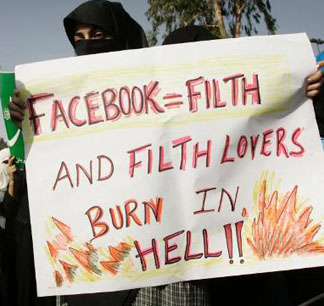
Facebook vs. the Holy Book

The news out of Pakistan teeters between bad and worse. First, there are the drones targeting Taliban leaders and often taking out civilians as long-range missile attacks tend to do. Then there is the lingering concern about the government’s stability, especially given the fact that Pakistan has nuclear weapons. Throw in the claim that as many as a quarter of the population is below the poverty line and it is hard to see a silver lining in all the doom and gloom statistics. But this is the Internet Era, so virtual reality is not out of touch with reality in contemporary Pakistan. Now it seems that virtual reality has become more important than the price of bread, perhaps in part because of the price of bread. In recent days the government of Pakistan has started blocking both Facebook and Google.

The problem with Facebook is with a group that launched an “Everybody Draw Muhammad Day,” a group that most professional political cartoonists see as “shock for shock’s sake.” Continue reading Facebook vs. the Holy Book

Nutrition in Colonial Aden, #2

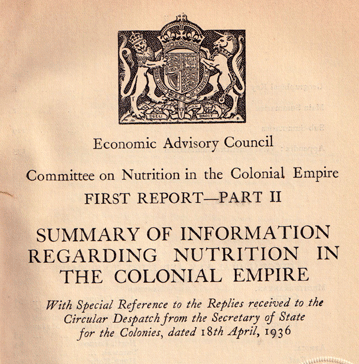
Say what you will about colonial empires, but at least they generate reports. I recently came across a British report to Parliament in 1939 entitled “Summary of Information Regarding Nutrition in the Colonial Empire.” Four pages are devoted to Aden Colony, which is said to have an area of 75 square miles, a population in 1931 of 45,992, a birthrate in 1937 of 32.07 per 1,000, an infant mortality rate in 1937 of 196.61 per 1,000, and a death rate in 1937 of 31.72 per 1,000. For part 1, click here. I attach more excerpts below:

3. Diet and Health (deficiency diseases and other relevant considerations). – On the whole, Aden can boast a high standard of public health. The greatest drawback is overcrowding. Large families occupy inadequate and ill-ventilated accommodations in which, as often as not, the domestic goat also claims a quota of space. In consequence of these conditions, respiratory and alimentary diseases are all too common. Diseases directly attributable to qualitative dietary deficiency are not a prominent feature of hospital returns in Aden and the more classical of the tropical diseases – beriberi, scurvy and pellagra – do not occur. Evidence of qualitative deficiency is found, however, in the incidence of rickets among children and of certain eye infections. An examination of 527 unselected children (consecutive cases treated in the Civil Hospital) showed that 33, 0r 6.2 per cent, were suffering from rickets. Continue reading Nutrition in Colonial Aden, #2

Food Crisis in Yemen: A Rocky Road


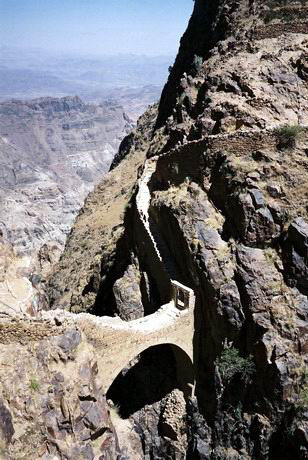
Shahara bridge in northern Yemen

Poverty and famine are old comrades in much of the world. Add to this drastically declining water tables and economic stagnation and you have a sense of Yemen today. But a recent World Bank project makes a virtue out of the rocky road by literally providing jobs for skilled Yemeni stone cutters to build roads. Check out the video on the website by clicking here.

Female Islamic Leadership Research Network

Female Islamic Leadership Research Network

WHO SHOULD JOIN
Academics interested in any aspect of female religious authority or leadership in Islamic communities worldwide – historical or contemporary – should join this network. The goal of the list is to enable academics spread across a wide variety of disciplines to pass along relevant information and resources, and to discuss topics of interest.

WHY THIS NETWORK
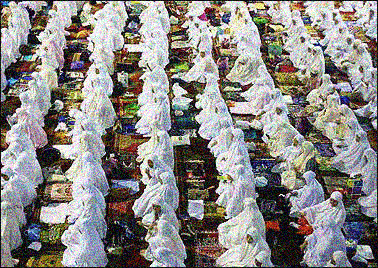
This research network is an outgrowth of a conference held in October 2009 at St Antony’s College, University of Oxford on contemporary female Islamic authority, Women, Leadership and Mosques: Changes in Contemporary Islamic Authority. The conference focused on the growing number of women active teaching, preaching, interpreting scriptures, or leading prayer in mosques or madrasas around the world.

The large response to the call for papers for this conference made it clear that academic interest in this topic is high and increasing, and also that academics working on this topic are divided by an unusually large number of disciplinary boundaries. A virtual network with a mailing list is an ideal way to connect scholars interested in this topic.

The network is open to scholars studying any aspects of female religious leadership in Islam, and therefore includes topics outside the conference’s purview, for instance, the reinterpretation of Islamic scriptures by women who are primarily active outside of mosques and madrasas. Continue reading Female Islamic Leadership Research Network

Nutrition in Colonial Aden, #1

Say what you will about colonial empires, but at least they generate reports. I recently came across a British report to Parliament in 1939 entitled “Summary of Information Regarding Nutrition in the Colonial Empire.” Four pages are devoted to Aden Colony, which is said to have an area of 75 square miles, a population in 1931 of 45,992, a birthrate in 1937 of 32.07 per 1,000, an infant mortality rate in 1937 of 196.61 per 1,000, and a death rate in 1937 of 31.72 per 1,000. I attach excerpts below:

“1. General. – …This survey deals primarily with the 75 square miles of volcanic rock and sand which constitute the Colony of Aden; a detailed review of the nutritional affairs of the Protectorate has been postponed until a later date. The Colony is almost entirely urban and so cosmopolitan in make-up as to complicate the task of reviewing the nutritional conditions as a whole. Arabs, Jews, Somalis and Indians of various races predominate, and a preponderance of males is occasioned by the fact that those who come to Aden for varying periods of time to seek livelihood as coolies or tradesmen leave their womenfolk behind in the interior or in India. The natural division is to classify Arabs, Jews and the poorer classes of Indian Mohammedans as the indigenous population and it is to these, particularly the middle and lower classes, that the present nutritional considerations apply.

2. Composition and Nutritive Value of Dietary. – All the chief articles of diet are, with the exception of fish, imported from overseas or from Arabia. They are: rice, flour, sugar,; fish, mutton, beef, goat’s milk, eggs, ghee; fruits, vegetables, dates, lentils, simsim oil, tea, coffee and spices. Continue reading Nutrition in Colonial Aden, #1