Category Archives: Development

Yemen is Not a Terrorist Factory


Yemen is not a terrorist factory
By Daniel Martin Varisco, Special to CNN, November 8, 2010

Editor’s note: Daniel Martin Varisco is a professor of anthropology at Hofstra University and has visited Yemen over a dozen times for development consulting and research since 1978. He moderates Tabsir, an academic blog on Islam and the Middle East.

(CNN) — Domino theorists love the Middle East. Because of this, a number of media pundits have recently added the little-known country of Yemen as a front in the unsettled aftermath of George W. Bush’s War on Terror.

First came the overthrow of the Taliban in Afghanistan, then a protracted war there and in Iraq. Iran is still in the hawkish gun-sights of conservative pundits, but the focus has now shifted to Yemen, a country most Americans could not find on a map. Is Yemen really the terrorist haven we should fear the most?

For the rest of my post on the CNN blog, click here.

Sudan Open Archive


The Sudan Open Archive offers free digital access to knowledge about all regions of Sudan. It is an expanding, word-searchable, full-text database of historical and contemporary books and documents. The current version, SOA 2.0, incorporates a comprehensive, interactive guide to internet resources on Sudan.

The Sudan Open Archive (SOA) is designed and implemented by the Kenya and UK-based Rift Valley Institute, working with institutional partners in the north and south of Sudan. The Archive was created by DL Consulting using open-source Greenstone archive software developed by the New Zealand Digital Library project at the University of Waikato. It is maintained with support from the J.M. Kaplan Fund. Other partners include UNICEF, UNEP and the Southern Sudan Centre for Census, Statistics and Evaluation.

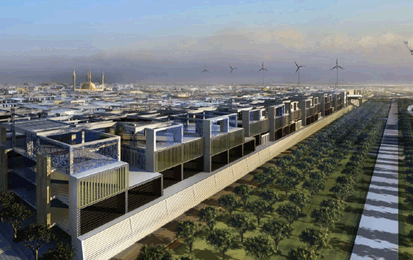
and where is the city of the future?


Take a look at the picture above. This is the recently operationalized city of Masdar, one that seems to come right off the drawing boards of 2001: A Space Odyssey or at least Star Wars. Imagine a city with zero carbon emissions. Imagine a perfectly planned city from top to bottom, fueled by solar power and clean as the pure desert sand. This one happens to have been built on the desert sand, only a short commute by a carbon-emitting vehicle from the city of Abu Dhabi. Forget the Seven Wonders of the Ancient World; here is Futurama out of the Arabian Nights.

Today’s New York Times has a lengthy article about the architectural feat, designed by Foster & Partners. All it takes is money (lots of money) and visionary architects. In this Disney on Sand there are even battery-powered pod vehicles, which operate underground out of sight and take people from place to place without drivers. The author of the article, Nicolai Ouroussouf, mixes praise with a dose of populist realism and rightly so: Continue reading and where is the city of the future?

Message to Muslims: I’m Sorry


Message to Muslims: I’m Sorry
By NICHOLAS D. KRISTOF, The New York Times, September 18, 2010

Many Americans have suggested that more moderate Muslims should stand up to extremists, speak out for tolerance, and apologize for sins committed by their brethren.

That’s reasonable advice, and as a moderate myself, I’m going to take it. (Throat clearing.) I hereby apologize to Muslims for the wave of bigotry and simple nuttiness that has lately been directed at you. The venom on the airwaves, equating Muslims with terrorists, should embarrass us more than you. Muslims are one of the last minorities in the United States that it is still possible to demean openly, and I apologize for the slurs.

I’m inspired by another journalistic apology. The Portland Press Herald in Maine published an innocuous front-page article and photo a week ago about 3,000 local Muslims praying together to mark the end of Ramadan. Readers were upset, because publication coincided with the ninth anniversary of 9/11, and they deluged the paper with protests. Continue reading Message to Muslims: I’m Sorry

The Meaning of Democracy

The Meaning of Democracy

by Roya, Afghan Womens’ Writing Project

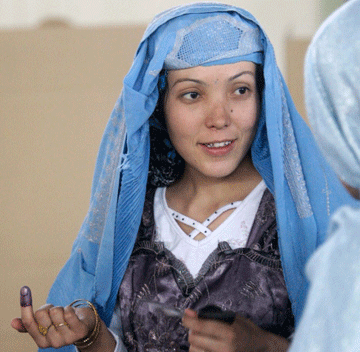
After the Taliban‘s black regime, when houses were cages for women and only the wild Taliban ideology was law, when the burqa was accepted as a symbol of freedom and the real Islamic hijab disappeared unknown—after all this, Afghan women recognized the word for Democracy.

But Democracy is a very young word for the people of our country, very new in our cultural dictionary, and the question is: Do women understand this word? Do they welcome it, or hide under their burqa?

I think Democracy knocked on the doors of only some women in Kabul, Mazar, Herat, only a few of Afghanistan’s 34 provinces. In most areas, Afghans still don’t know this word. Many think it is a word used only by politicians who travel all over the world, live in the tallest buildings and own the latest car models. Democracy, easiest explanation, is government of the people, for the people. But in our country, people think whatever your heart wants, do it, and that is the meaning of democracy. Continue reading The Meaning of Democracy

Go ye into all the war zones


How American Right-Wing Christians Are Waging ‘Spiritual Warfare’ in Northern Iraq
By Michael Reynolds, AlterNet
Posted on July 12, 2010, Printed on July 28, 2010

On a barren hillside outside Sulaymaniyah in southeast Iraqi Kurdistan sits a small compound of buildings clustered behind battered gray and ochre walls. Atop one wall is a large white sign glittering with gold and azure lettering that reads in English and Arabic: Classical School of the Medes. It is one of three new private schools in the region that teach a “Christian worldview,” the handiwork of American evangelicals from Tennessee.

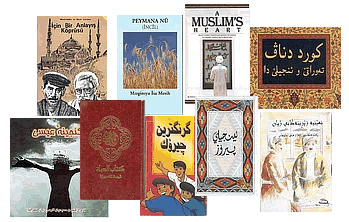
Since the US occupation took hold, American evangelicals have established not only schools, but printing presses, radio stations, women’s centers, bookstores, medical and dental clinics, and churches in northern Iraq, all with the blessings and assistance of the Kurdistan government. Many of these efforts were funded in part by US taxpayer dollars, channeled through Department of Defense construction contracts and State Department grants.

In September 2003, just four months after US forces took down Saddam Hussein’s regime, 350 evangelical pastors and church leaders assembled in Kirkuk, where they were warmly welcomed by Massoud Barzani, president of the Kurdistan Regional Government. At that gathering, George Grant, a leader of Servant Group International, the evangelical organization in Nashville that set up the chain of Christian schools, declared that “Jesus Christ is Lord over all things; He is Lord over every Mullah, every Ayatollah, every Imam, and every Mahdi pretender; He is Lord over the whole of the earth, even Iraq!” Continue reading Go ye into all the war zones

By Air-Cooled Bus from Baghdad


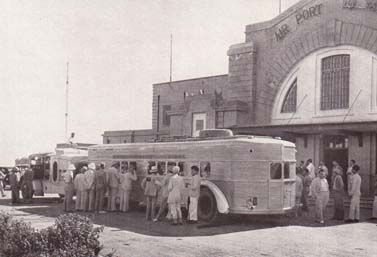
The photograph above, taken by W. Robert Moore, appeared in the National Geographic Magazine December, 1938 issue (p. 732). The caption reads:

THE DESERT-GOING BAGHDAD-DAMASCUS BUS IS AIR-COOLED AND WAS “MADE IN U.S.A.”
Temperature was 111 degrees Fahrenheit when the picture ws taken at Baghdad’s airport, but inside the stainless-steel bus, operated by Nairn Transport Company, it was only 76 degrees. Now, in a few hours, these huge high-speed cars make the trip that once took camels many days.

Worth a Response: Why Yemen is not Afghanistan


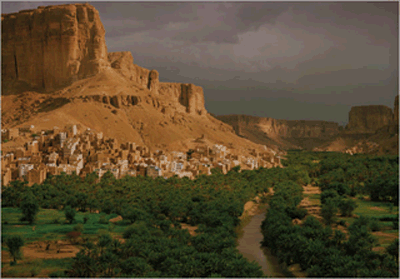
“The village of Rihab in Wadi Dawan, a valley that is the ancestral home of Bin Laden”; Simon Norfolk/Institute, for The New York Times

Yemen hardly ever makes the news unless a journalist wants to rail against the green-dribbling khat habit of grown men who wear skirts or trump with the terrorism card. In the Sunday Magazine of The New York Times, Robert F. Worth asks the provocative question: “Is Yemen the Next Afghanistan?” For an article that begins with a photograph of the valley “that is the ancestral home of Bin Laden” and mentions an American cruise missile in the first line, it hardly takes a Ph.D. to figure out what the answer is most likely to be in the mind of the reader. Worthy reporter that he is, The New York Times Middle East correspondent does not directly answer the question. He does not need to, since the Al Qaeda-laced narrative itself hinges on the comparison. The article ends with a visit to an “old man with a deeply lined face” and who walks with a cane. When asked if his son, an Al Qaeda figure described in the story, was really part of the plot in the 2000 bombing of the U.S.S. Cole, the father responds:

‘No,’ he said, ‘ I don’t believe this.’ He was silent for a long time, staring at the closed door of the house, which was illuminated at its edges by a bright rectangle of afternoon sunlight. then he spoke again.
‘He is a mujahid,’ he said, or holy warrior. ‘He is fighting those who occupy Arab lands. He is fighting unbelievers.’

I have read a number of articles by journalist Worth, usually with a favorable view of his ability to introduce nuance into what is generally a black-and-white portrayal of things Arab and Islamic. For this article, he contacted diplomats (former Ambassador Hull) and scholars (Gregory Johnson) who are knowledgable about recent political events in Yemen. He is also to be commended for learning some Arabic, although I am not sure his year-long training in classical will be of much help in casual conversation in dialect. Yet he visited Yemen and actually talked to local people and not just the other reporters in the pool. In this sense, the reporting is not bad, certainly not like The Daily News or Fox News engineering. The problem is that neither is the article very good. The question in the title, which perhaps was not the journalist’s choosing given the control of editors, is blatantly rhetorical, not a genuine search for an answer that goes beyond the verbal War on Terror jousting on all sides of the aisle in Washington and in much of the media. Continue reading Worth a Response: Why Yemen is not Afghanistan