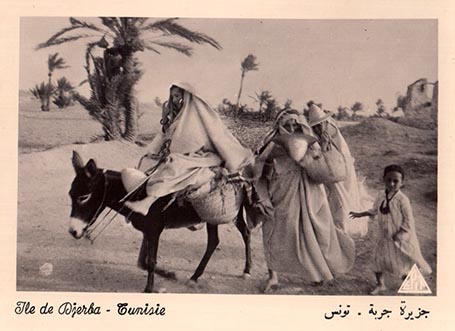
A postcard labeled “Femmes Djerbiennes” and published by Misscoui Mustapha, Fabrique de Couvertures – Houmt – Souk.
A postcard labeled “Femmes Djerbiennes” and published by Misscoui Mustapha, Fabrique de Couvertures – Houmt – Souk.
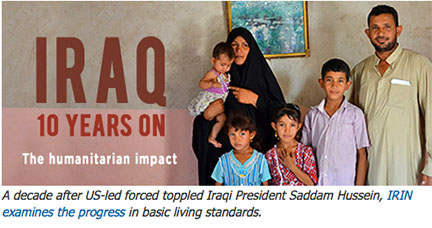
[Webshaykh’s Note: There is an excellent report on the progress in humanitarian aid to Iraq over the past decade on the website of the UN Office for the Coordination of Humanitarian Affairs. Click here to access the full report and updates.]
BAGHDAD/DUBAI, 22 April 2013 (IRIN) – Ten years after US forces took over Iraq, opinions on the progress made are as polarized as ever.
On one side, the Iraqi and American governments argue, the gains have been significant.
“Despite all the problems of the past decade, the overwhelming majority of Iraqis agree that we are better off today than under Saddam’s brutal dictatorship,†Iraqi Prime Minister Nouri Al Maliki wrote in a 9 April opinion piece in the Washington Post, marking 10 years after the fall of former Iraqi president Saddam Hussein.
Paul Wolfowitz, who served as the US Deputy Secretary of Defence between 2001 and 2005, wrote the same day in Asharq al-Awsat newspaper that given the hardships under Hussein, “it is remarkable that Iraq has done as well as it has thus far.â€
Others are more circumspect in evaluating these gains, looking to the 1980s – under Hussein’s rule – as a time when Iraqi society was much further ahead.
“By all measures and standards, there has been a deterioration in the quality of life of Iraqis as compared to 25 years ago,†said Khalid Khalid, who tracks Iraq’s progress towards the Millennium Development Goals (MDGs) at the UN Development Programme (UNDP). “The invasion comes on top of sanctions that came before it and the Iran-Iraq war. It’s one continuous chain of events that led to the situation Iraqis are facing now.†Continue reading IRIN on Iraq
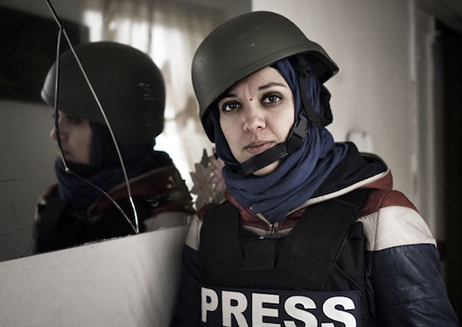
A dark, rancid corner Borri says journalists have failed to explain Syria’s civil war because editors only want ‘blood.’ (Alessio Romenzi)
Woman’s Work
The twisted reality of an Italian freelancer in Syria
By Francesca Borri, Columbia Journalism Review, July 1
He finally wrote to me. After more than a year of freelancing for him, during which I contracted typhoid fever and was shot in the knee, my editor watched the news, thought I was among the Italian journalists who’d been kidnapped, and sent me an email that said: “Should you get a connection, could you tweet your detention?â€
That same day, I returned in the evening to a rebel base where I was staying in the middle of the hell that is Aleppo, and amid the dust and the hunger and the fear, I hoped to find a friend, a kind word, a hug. Instead, I found only another email from Clara, who’s spending her holidays at my home in Italy. She’s already sent me eight “Urgent!†messages. Today she’s looking for my spa badge, so she can enter for free. The rest of the messages in my inbox were like this one: “Brilliant piece today; brilliant like your book on Iraq.†Unfortunately, my book wasn’t on Iraq, but on Kosovo.
People have this romantic image of the freelancer as a journalist who’s exchanged the certainty of a regular salary for the freedom to cover the stories she is most fascinated by. But we aren’t free at all; it’s just the opposite. The truth is that the only job opportunity I have today is staying in Syria, where nobody else wants to stay. And it’s not even Aleppo, to be precise; it’s the frontline. Because the editors back in Italy only ask us for the blood, the bang-bang. I write about the Islamists and their network of social services, the roots of their power—a piece that is definitely more complex to build than a frontline piece. I strive to explain, not just to move, to touch, and I am answered with: “What’s this? Six thousand words and nobody died?†Continue reading Freelancing the Syrian Conflict
The trendy 19th century Protestant philosophical theologian Søren Kiergekaard published a Danish book in 1843 entitled Either/Or. His faith-based binary is not the the standard good vs evil, God vs. Satan model that had long been enshrined in Christianity, but rather a dialogue between an aesthetic hedonist and a duty-bound ethicist. His point, or at least one of them, is that by rigidly following either life trajectory one can simply go too far and not realize one’s true self. He was aware of the binary bind that haunts many, if not most, religions and worldviews. In politics the mantra would be “my country, love it or leave it,” or more crudely, “my way or the highway.” In economics, capitalism vs communism. In all cases binaries bind us to intolerance and the hubris that I am right and you are wrong.
At least the Manicheans dared to assert the obvious that good and evil, like light and darkness, are locked in an eternal duel rather than an ultimate triumph of good. But this was deemed a heresy. The simple solution, what might be called the Salafi fix in Islam, is the fixation on a single standard of truth. Even if one takes the Quran as the literal word of Allah, it must still be interpreted. The history of Islamic exegesis demonstrates that very little is obvious in a text that was not originally written down as it was received in a linguistic idiom now fourteen centuries past. Yet, like the Bible thumpers in American Fundamentalism, there are always those who think they have the right interpretation and that alone must be followed. Continue reading Bipolar Religion

The Al-Ain-based Rock Band “Random Stars”
Where there is youthful fire, there is Smoke on the Water. I remember the first Deep Purple record I bought: Machine Head from 1972. The cover featured a blurry, almost metallic image of the long-haired heads of the band. The song that has since been immortalized describes a fire that destroyed a recording studio in Geneva. Where were these Deep Purple-ites to stay, since Frank Zappa was at the best place in town and the “Rolling truck Stones” were outside the Grand Hotel, which was empty and bare, but obviously full enough to record one of the classics of Rock.
Rock is about as Western as a person can get: sound tracks that serve as neoliberal commercialized crumbs that feed rebellious young people the idea that songs can substitute for real protest. And sex and drugs, of course. It is hard to imagine the band without the groupies, who at least in those days flocked like moths to a flame at every concert. Fundamentalist Christians were appalled, warned by their pastors that Rock songs played backwards held secret Satanic messages. The 1960s auto de fe had already consumed Beatles albums in Alabama. Janis Joplin was dead in 1970; the Lord finally gave her a Mercedes Benz as a hearse. Jimi Hendrix joined her the same year. Jim Morrison walked out of the door of life in 1971. Continue reading Deep Purple for your hijab
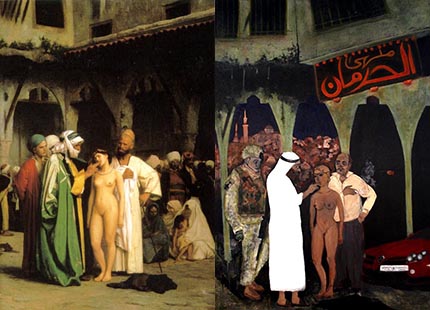
Gérôme’s “The Slave Market,” left; Inanna in Damascus by Sundus Abdul Hadi, Iraqi artist, right
Before Edward Said revitalized the term “Orientalism” in his seminal 1978 book of the same title, the major use of the term was for a genre of Western art, centering on exotic depictions of an imagined or at least embellished beyond the real “Orient.” The Gérôme painting of “The Snake Charmer” of the paperback version perfectly captured the prejudicial element that Said rightly exposed in much of the literature and academic writing about the Middle East and Islam. Such a biased representation cannot be glossed as mere “art for art’s sake,” if indeed art is ever really only for “art’s sake.” I recently came across a painting by Sundus Abdul Hadi, an Iraqi female artist, that responds aesthetically to another famous Orientalist painting by Gérôme; these are the two images juxtaposed above. There is nothing inaccurate in either painting. Selling female slaves was a lucrative trade throughout the Islamic era and current sexcapades by wealthy Arab sheikhs are well known.
The response painting is a brilliant counter to Gérôme. Both highlight the exploitation of women as sex slaves, either in the older legal and literal sense or the modern illegal but still practiced nonsense. It is possible to look at either picture and focus on the naked body of a woman on display. This is the voyeur’s gaze, which is often the prime motive for creating as well as viewing such a work of art. But when placed side by side with the modern response painting, the very fact that the woman is still only an object for purchase overrides a one-directional voyeurism. This is not simply a scene of the imagination, but a reality that has outlived the 19th century Orientalist genre and indeed is hardly unique to a genre exposing the bodies of Oriental women. Continue reading Art not for art’s sake

Joseph Massad: an Occidentalist’s Other Subjects/Victims
by S. Taha, The Arab Leftist
Joseph Massad, an associate professor at Columbia University and a now prominent figure in the US academic field of Middle Eastern studies, came to acquire his status through a hotly debated and highly acclaimed book, Desiring Arabs. Massad, who claims to be the disciple of another foundational academic figure from Columbia, Edward Said, seeks to complete his patron’s Foucauldian project on Orientalism. Said, who strikes me as a much more modest, engaged and consistent intellectual than his self-styled “discipleâ€, is best known for his critical study of “Orientalism,†which looks into the representation and construction of the “East/Orient†as Other to the Western/European self, a construction that, as Said had shown, was deeply engaged with the process of modern imperial expansion and colonialism. This process of domination was what both produced the European “will to know†the subject “Other†and enabled its realization “in an increasingly profitable dialectic of information and control.†However, while employing Michel Foucault’s analytical grid of power/knowledge and his methods of discourse analysis, Said’s project remains incompletely Foucauldian, since it does not probe into the effects of the colonial discursive regime of power/knowledge on the formation of the modern Arab subjects who languished under it for centuries. Therein, Massad makes his academic intervention and contribution, armed with Foucault’s conceptual tools to investigate sexual identities and subjects as effects and products of colonial power. Such territory of “subject formation†under colonialism, which Massad has ventured into is indeed an extremely slippery and delicate one, fraught with questions of agency and subjectivity, since it is not only an investigation into the workings of colonial power, but rather into the very subjectivity and the very being of those whom power represents and brings into its domain and universe of discourse. It is an investigation into the relationship between Western and non-Western, between colonizer and colonized with all that an interrogative representation of such relationship might, adverdantly and inadverdantly, entail about the truths, histories and identities of the two sides of the imperial divide. Continue reading Less than Desirable Review of “Desiring Arabs”

Webshaykh’s Note: An article entitled “Qat, Cosmopolitanism, and Modernity in Sana’a, Yemen” has been written by Irene van Oorschot, and published inArabian Humanities, Vol. 1, 2013. Her ethnographic study focuses on urban women in Sanaa. I attach here the beginning paragraphs, but urge readers to read the full article on Arabian Humanities, a new journal dealing with Yemen and the Arabian Peninsula.
The prevalence of qat consumption in Yemen strikes even the most casual of observers. Adolescent and adult men can be seen chewing in shops, taxis, and on the streets, while the many qat vendors in the streets and squares of Sana’a contribute —in the eyes of many tourists— to its quaint charm. While women do not usually chew qat in public places, married women chew qat in the privacy of their own or their female relatives’ houses. Chewing qat is however held to be shameful for unmarried women, a notion which is sometimes explained with reference to the alleged effects qat has on people’s libido. As a (sexual) stimulant, qat has no place in unmarried women’s lives. After all, they are not supposed to have premarital relationships, and as such are “not supposed to chewâ€. However, among unmarried women of the educated and urban elites, qat chewing is an popular way to spend one’s spare time:
“It is just a way to relax, to unwind, to be away from work, and to be with my friends,†WafÄ’, an unmarried woman, told me. “My married sister chews qat, too, and she is even younger [than I am]! So why should I not get to chew qat and relax?†Continue reading Qat, Cosmopolitanism, and Modernity in Sanaa, Yemen