Category Archives: Gender and Sexuality

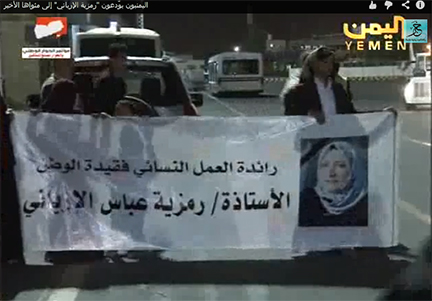
Ramziyya Abbas al-Iryani

The Yemeni literary figure Ramziyya Abbas al-Iryani, who recently passed away, is given tribute in this video with recollections by her students and other Yemenis who knew and respected her.

اليمنيون يوّدعون “رمزية الإرياني” إلى مثواها الأخير السبت, 16-نوفمبر-2013 صنعاء Ù€ خبر للأنباء: – استقبلت جموع اليمنيين، مساء السبت، جثمان فقيدة الوطن رمزية عباس الارياني – عضو اللجنة العامة للمؤتمر الشعبي العام.. رئيسة اتحاد نساء اليمن، الذي وصل مطار صنعاء، على متن طائرة تابعة للخطوط الجوية اليمنية قادماً من جمهورية ألمانيا الاتحادية. ويودع جموع اليمنيين، وفي مقدمتهم قيادات وكوادر المؤتمر الشعبي العام والفعاليات الوطنية الرسمية والحزبية ومنظمات المجتمع المدني والجموع الشعبية، غداً “الأحد” الجثمان الطاهر للفقيدة، إلى مثواه الأخير بمقبرة الرحمة ظهر الأحد بالعاصمة صنعاء بعد الصلاة عليه بجامع التوحيد. وخسرت اليمن واحدةً من أعظم قياداتها النسائية البارزة، حيث وافاها الأجل في احد مستشفيات العاصمة الألمانية برلين إثر إصابتها بجلطة دماغية. وكانت الفقيدة — رحمها الله — من أبرز أعلام النضال الوطني ولها حضورها المتميز في كافة المجالات وفي مقدمتها الدفاع عن حقوق المرأة اليمنية. وقد نعت رئاسة الجمهورية، وقيادة المؤتمر الشعبي العام، ومؤتمر الحوار الوطني، والوزارات، والأحزاب والمنظمات السياسية والمجتمعية، ومنظمات حقوق الإنسان، الفقيدة الراحلة. وعبرت البرقيات عن تعازيها الحارة للأسرة الكريمة، سائلة المولى العلي القدير، أن يتغمدها بواسع رحمته، ويلهم أهلها وكل محبيها الصبر والسلوان. إنا لها وإنا إليه راجعون

Politics and the Evolution of Takfeer in Yemen

By Sama’a Al-Hamdani and Afrah Nasser for The Atlantic Post, Yemeniati, October 12, 2013

I was declared an apostate at the end of April 2013 because of a political seminar on women’s empowerment hosted at my college in Taiz. In this gathering, I stated that Islam’s most stringent provisions – whether in the Qur’an or the Sunnah – are meant to refine rather than to terrorize. A radical cleric twisted my words and said that I called the Prophet Mohammed a liar and based on it, I was labeled a Kafir (apostate). – Sally Adeeb, age 21, law school student.

Since the overthrow in Yemen of former president Ali Abdullah Saleh in 2011, 11 people have been accused of apostasy (see chart 1 below) in the practice referred to as Takfeer. One of them, Jamal al-Junid, was detained by the police in May 2013 for 15 days and finally was released after the staging of several protests. Another accused “apostate” is Ahmed Al-Arami, a literature and arts lecturer who was labeled a “secularist” in April 2013 and subsequently fled the country because of serious threats and the possibility that he might be executed. The sensitivity of offending religion is a stumbling block in the quest to return Yemen to stability.

NDC and the Evolution of Takfeer

Yemen’s National Dialogue Conference (NDC), which was launched in March 2013 and is part of a Gulf Cooperation Council plan for a negotiated transition for Yemen, has been targeted for accusations of apostasy by one of the country’s leading clerics. Abdul Majeed Al-Zindani, Yemen’s influential Muslim Brotherhood/Wahhabist cleric who is also listed as a “specially designated global terrorist” by the United States Treasury Department in 2004, recently released a YouTube video in which he condemned the current NDC political process. The video presentation discussed the framing of the state’s legislation being managed by “the State Building Committee” and claimed that the majority of the committee’s members had voted that Islam is “the state’s main source of legislation” instead of “the state’s only source of legislation.” Continue reading Politics and the Evolution of Takfeer in Yemen

Burqa Avenger

Most of the debate over a Muslim woman who wears the burqa, niqab or hijab centers on how this restricts her freedom of choice. Those who are against the burqa argue that it is a preeminent icon of patriarchy and that societal pressure, valorized with religious rhetoric, does not give a Muslim woman a true sense of choice. The issue is hottest in Western contexts, where a woman wearing a burqa or niqab stands out almost as much as if she was walking around naked. On the other side, there are Muslim women who insist they are exercising free choice and choosing to dress in the conservative manner they want. Regardless of where you stand on the issue, the burqa is inevitably seen as an item that limits a woman’s movement or protects her, not one of empowerment.

So here comes Burqa Avenger to the rescue. This is a video cartoon series in which the star is a female Superwoman/Spiderwoman/Batwoman takeoff, a contemporary way of commanding the right and forbidding the wrong. The series itself is state-of-the-art in its cinematic presentation. You can even get a free app for a Burqa Avenger game on your iphone. As in all cartoons, the characters tend to be stereotypes. Of course, this makes the good stand out from the evil in a stark way that is seldom the case in real life. But the inspiration for the series is to provide young Muslim girls with a positive role model. Continue reading Burqa Avenger

Women picturing women


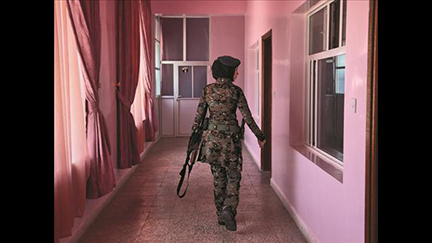
A lieutenant in the elite female counterterrorism unit patrols the women’s barracks in Sanaa, Yemen. Photo from the “Women of Vision” exhibit. Photography by Stephanie Sinclair

Associated Press, WASHINGTON (AP) – The National Geographic Museum in Washington has a new exhibit featuring the photography of 11 award-winning female photojournalists.

The exhibit is kicking off a three-year tour for “Women of Vision: National Geographic Photographers on Assignment.” It features nearly 100 photographs depicting a variety of cultures and topics. The exhibit is on view in Washington until March 9.

The photographers tackled subjects ranging from memory and teenage brain chemistry to social issues like child marriage and modern-day slavery. Visitors will also see how National Geographic magazine photo editors work with photographers to select images to tell a story.

The photographers featured in the exhibit are: Lynsey Addario, Kitra Cahana, Jodi Cobb, Diane Cook, Carolyn Drake, Lynn Johnson, Beverly Joubert, Erika Larsen, Stephanie Sinclair, Maggie Steber and Amy Toensing.


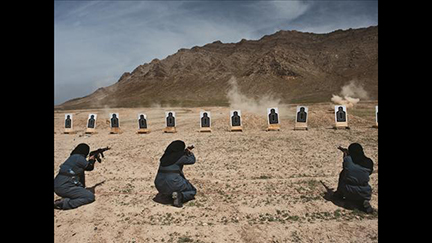
Women – mostly widows – train for police force jobs at a firing range near Kabul, Afghanistan. Photo from the “Women of Vision” exhibit. Photography by Lynsey Addario

For all the pictures, click here:

Shock Value and nothing to snore about


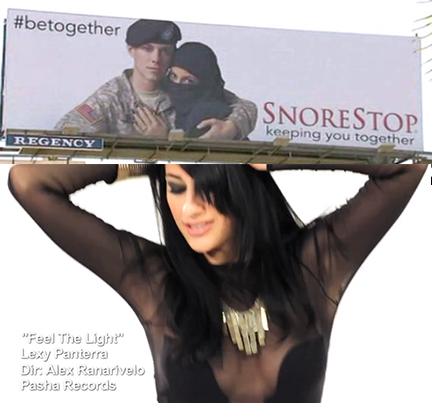
Billboard ad of SnoreStop, top: the actress sans hijab, bottom

Given the range of images available with a click and the sensationalism-hungry news media, it is hard to find anything that has shock value anymore. PETA asks Hollywood celebs and beauty queens to take off their clothes so rich people will shun mink fur. But there is so much nudity on the web that it hardly raises an eyebrow any more. Spencer Tunick, the Brooklyn photographer who invites several thousand people to don their clothes for a mass aesthetic photograph, sends few shock waves through the media. Gay marriage is slowly becoming a Blue State inevitability; even the new pope has asked Catholics to chill over the hot button moral issues that abort civil dialogue. So what can still be shocking? How about a billboard ad showing an American soldier embracing a Muslim woman in hijab?

This is an ad put up by “SnoreStop,” a pharmaceutical company with a slogan of “keeping you together.” Having identified one of the primary causes of relationship breakups (ahem), they offer a medicalized kit for only $14.95 that will pinpoint where your snoring occurs and zap it with a pill. Here is how the website explains it:

Every night in America and throughout the world millions of spouses have to make a decision about leaving the bedroom in order to get a good night’s sleep, which destroys all intimacy. When we lack a good night’s sleep, we break down emotionally, mentally, and physically. Moreover, snorers have sex less often or have a decreased interest in sex due to being tired. SnoreStop® saves relationships by ‘bringing peace to the bedroom.

Green Pharmaceuticals, a “woman-owned company,” is turning heads (the oldest and easiest way to stop snoring, although the company does not note this) with an ad that will definitely be a cup of tea for conservatives. According to a spokesperson the ad is not just about selling a product but making a wholesome point about people being together. So they went and looked for real couples and found the oddest couple an ad maker could imagine. Yes, this is supposedly a “real couple,” Jamie Sutton or Paul Evans (depending on the news source) and Aleah or Lexy, although it does not appear that the Aleah or Lexy normally wears a hijab, nor if either of them suffer from the trauma of snoring. As it happens “Aleah” is Lexy Panterra and she has a saucy video in which there is no niqab in sight but plenty of flesh. And it seems her boyfriend is not the soldier in the ad. No niqab, no snoring (well, I can not confirm this) and no soldier husband (or at least no longer). Her boyfriend is, appropriately for Instagram fame, Aladdin. How shocking: an ad campaign that deceives in order to sell a product that nobody probably needs. Continue reading Shock Value and nothing to snore about

What’s Up with Our Mosques?


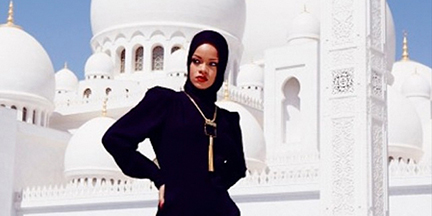
Image: Rihanna’s Instagram

by Fatimah Jackson-Best, Aquila Style, October 28, 2013

International pop icon Rihanna recently made the news after being asked to leave the Sheikh Zayed Grand Mosque in Abu Dhabi. According to a statement issued by the mosque, the singer’s removal from the grounds was based on several reasons, which include attempting to enter the mosque through a gate that was not allowed for visitors, failing to get the proper permission to visit and tour the mosque, and failing to behave in a way that was in accordance with the sanctity of the mosque.[i] Instagram photos of the singer posing in front of the mosque also sparked reactions from Muslims and non-Muslims around the world.

I learnt that she had been barred from entering the mosque on my Facebook wall, from a friend who jokingly reminded me that I could relate to the story, because I had also been prevented from visiting a mosque here in Barbados – twice. Continue reading What’s Up with Our Mosques?

Amat al-Alim al-Soswa at Hofstra

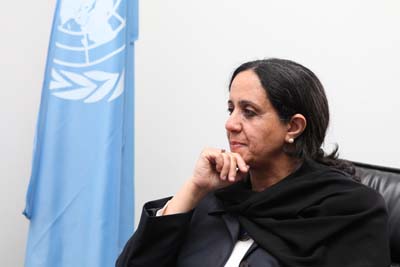
The Middle Eastern and Central Asian Studies Program of Hofstra University is pleased to announce a public talk by the Yemeni diplomat Amat al-Alim al-Soswa, who will be speaking about her recent work on Yemen’s National Dialogue. Details are provided here. This will take place on campus in 101 Barnard Hall on Thursday, October 24 from 2:20-3:45. For more information, please contact me at daniel.m.varisco@hofstra.edu.

Since March 2013 , Amat Al-Alim Alsoswa has been a member of the Yemen National Dialogue Conference and a member of its State Building Team. She also chaired a subcommittee to prepare and suggest the criteria and term of reference for the constitutional drafting committee.

She was appointed in December 2005 by United Nations Secretary-General Kofi Annan as Assistant Secretary-General, Assistant Administrator of the United Nations Development Programme and Director of its Regional Bureau for Arab States. In this post, Alsoswa has led UNDP’s 18 programme offices in the Arab region in their efforts to develop national capacities for poverty reduction, democratic governance, sustainable development, crisis prevention and recovery, and women’s empowerment. She has also provided regional thought leadership through the launching of two editions of the Arab Human Development Report, in 2006 and 2009, and in the preparation of the for the 2012 edition. Continue reading Amat al-Alim al-Soswa at Hofstra