Category Archives: Gender and Sexuality

Want to Watch My Harem?

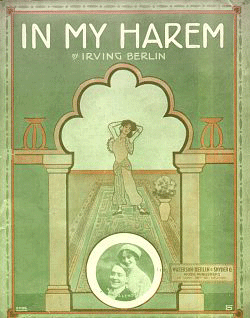
Ah, vaudeville. Before Elvis, the Beatles and the Beastie Boys, there were those corny songs targeting recent immigrants to America. One of those immigrants with a Sicilian last name would have been my grandfather, Martin Varisco, who in 1913 left the Big Apple Blossom to work on the railroad and work his way west. He made it to Ohio, where he married and settled down. But the very year he left New York, the songwriter Irving Berlin produced one of his less memorable songs. This was for the Irish, not the Italians, an important distinction on the streets and in the bars at the time. But here’s what can happen when Tin Pan Alley gets confused with Midaq Alley: an Irishman named Pat Malone with rhyme running amok in a Turkish harem. Continue reading Want to Watch My Harem?

Hip Hop Hijab Jabbing

To veil or not to veil: in Iran that is a question seemingly more relevant than getting an A-bomb. It is not so much the option of veiling as it is how to veil, how much to cover. With reports of a crackdown on what constitutes proper dress for Muslim women in public, the media has been flooded with stories of women with loose hijabs being harassed. For those who have bad feelings about Islam such stories add fuel to the fire of prejudice. But a toll is also taken on Muslims, especially in the West, who see themselves judged by the actions of an extreme case. Not surprisingly, some Muslims who do not see naked eye to veiled eye with the fashion enforcers in Iran are speaking hip hop to power.

Here on the Youtube Watch is an anti-hijab film by Mani Turkzadeh with a hip hop tune from GOZAR.

Debating Islamo-Fascism

[The message below was written by Marieme Hélie-Lucas, long time coordinator of the European Bureau of Women Living Under Muslim Laws, and was originally posted to the Women in Black (WIB) international list and reposted to ISLAMAAR, the discussion group on Islam of the American Academy of Religion, on September 6, 2007. Following her commentary is a response by Mohammed Fadel, who is on the faculty of the University of Toronto Faculty of Law. Both are commenting on the call by David Horowitz for an Islamo-fascism Awareness Week in October, posted upon earlier on Tabsir.]

Dear friends in WIB,
In response to the mail alerting us about this event against ‘islamo fascism’ led by conservative forces, I think there is a need for clarification from us, who lived under ‘islamo fascism’ :

First of all, let me say that the term ‘islamo fascism’ has been initially coined by Algerian people struggling for democracy, against armed fundamentalist forces decimating people in our country, then later operating in Europe, where a number of us had taken refuge. For us, it has never been equated to Islam, but it points at fundamentalists only : i.e. at political forces working under the cover of religion in order to gain political power and to impose a theocracy ( The Law – singular – of God, unchangeable, a-historical, interpreted by self appointed old men) over democracy ( i.e. the laws – plural – voted by the people and changeable by the will of the people). Continue reading Debating Islamo-Fascism

Slam Drunk Fascism:Coming to a Campus Near You

Fascism, a thorn rather than a rose by any other name, has a long and sordid history. The modern term was resurrected from the gore-galore glorified history of ancient Rome by Benito Mussolini in the 1920s to signal the power of the state (his state, of course) über alles (as his ersatz Aryan co-fascist to the north put it). As an ideology it dispensed of a need for any other religion than the twisted Durkheimian notion that the dictatorial “state” was really at stake when talking about “God.” As a fashionable pejorative term to heap abuse on one’s enemies, “fascist” readily becomes the modern day equivalent of saying the hated other is a bloodthirsty cannibal.

Now there is the recent moniker “Islamofascism,” which appears to have been coined by the Marxist French scholar Maxime Rodinson to describe the overthrow of the Shah and unexpected rise of an Islamic Republic in Iran. If so, this demonstrate the malleability of a term in which one form of fascism seemingly replaces another. But then the rhetorical door opens at least a crack for renaming the Vatican a “Christofascist” city state — surely a word game that would make both Mussolini and the popes turn over in their graves.

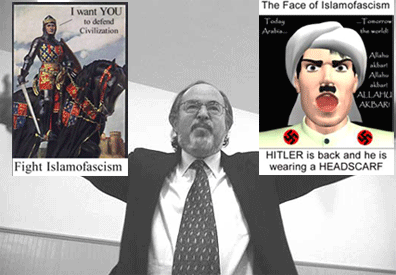
Confused? Not to worry … because David Horowitz, an idiotologue out to save “Western civilization” along with Daniel Pipes and Robert Spencer, has embarked on a cybercrusade campaign to make “you” aware of the apocalyptic dangers of Islamofascism. Forget about global warming (a liberal trick to discredit the Bush administration) and look out for bearded jihadis on the march. Mark your calendars for the week of October 22-26 for the coming of “Islamo-Fascism Awareness Week.” Don’t expect any parades down Main Street (we need to keep up the barriers so the terrorists don’t get us at home), but man the campus barricades and stick it to the Women’s Studies Centers. Continue reading Slam Drunk Fascism:Coming to a Campus Near You

An Unbelievable White Man


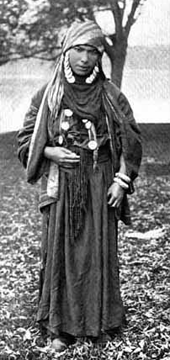
Syrian Bedouin girl at the 1893 Columbian Exposition

In his picturesque memoir of life in late 19th century Palestine, Philip J. Baldensperger recounts a number of adventures he had as a young man visiting his parent’s land with a Bedouin group. One of the foods loved by the Bedouin was the fruit of the doum palm. One day a group of Bedouin girls were surprised to see Philip’s white skin, something of a novelty at the time in rural Palestine. Here is his account:

“Being the only European, it was thought, in those days (1874), to be safer for me to wear Bedawi-clothing: a long shirt with broad, pointed sleeves hanging to the ground, a Sayé, and, on my head, a silken Kafiyé. With the exception of the girdle, which held the skirt and the Sayé together, the ‘Akal, or head-cird, wound around the Kafiyé, and a fringe of hair hanging over my forehead, in accordance with the fashion among Bedawîn youngsters, I was a figure in spotless white. In order to be able to walk more easily whilst on the march, I used to gather up the long folds of my dress and stick them in my girdle, leaving my legs bare. No wonder that one day four Bedawiyat, gathering Dôm-apples in the forest, fled with loud screams at my approach. Continue reading An Unbelievable White Man

The Forbidden Fruit of the Iraq War

War is mainly a man’s game. Men like Osama Bin Laden send men like Muhammad Atta to bomb a New York building. Men like George Bush and Tony Blair react like, well like men, and take it out on men like Mullah Omar and Saddam Hussein by sending young men to dodge bullets and iuds in a real video-game scenario. Men like Nouri al-Maliki are purple-fingered into a Green Zone political club so that mostly men can wear uniforms or hide bombs in order to kill other men, as well as women and children. Even a pacifist like Jesus predicted no end to war and rumors of war.

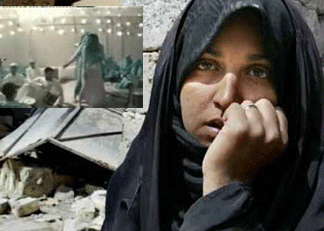
Everyone, not just men, suffers in the manly game of war. But while some men think it honorable to kill others, the burden of war probably hits women harder than anyone else. Suicide bombs are as likely to tear apart female bodies as male bodies, as able to cut short the life of a child as trump the survival of the elderly. In Iraq we see the blood smears that mark death and hear the mourning that haunts the grieving of the left behind. But beyond the battlefield and the car-blown open markets the exercise of war bears more fruit, one that harks back to the forbidden fruit in the innocence of Eden. Continue reading The Forbidden Fruit of the Iraq War

A Quiet Revolution in Algeria?


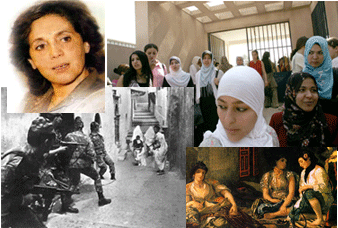
[left to right: Djamila Bourhiredf; Women waiting for bus at University of Algiers, photo by Shawn Baldwin for The New York Times; scene from “The Battle of Algiers”; “Algerian Women in Their Apartments” by Eugene Delacroix, 1834

One of the lead articles in yesterday’s New York Times was titled “A Quiet Revolution in Algeria: Gains by Women” by Michael Slackman. Revolutions, no matter where they erupt, tend to be noisy, even when they are not successful. The French stormed the Bastille; America had its Boston Tea Party; the Russians knocked off the Czar and his family. The Algerian Revolution, which took eight years from 1954-1962, claimed an estimated one to one-and-a-half million lives, not to mention the French military casualties of some 18,000. In the past decade or so more than 100,000 Algerians have died as a direct result of partisan extremist religious fighting. So if Algeria is now having a quiet revolution, where did all the noise go? Continue reading A Quiet Revolution in Algeria?