Category Archives: Gender and Sexuality

Style in the Dawn of Civilization


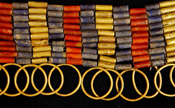
Belt made of lapis lazuli, gold and carnelian worn by Queen Pu-abi, who was buried in the Royal Tombs of Ur.

The frenzy caused by New York Fashion Week and red-carpet style at the Oscars may give the impression that contemporary society is particularly clothes-obsessed, but the research of Aubrey Baadsgaard, an anthropology doctoral student at Penn, shows that the concept of fashion is as old as human history itself. Baadsgaard is writing her dissertation on how clothing and ornamentation both reflected and helped construct gender and gender roles in ancient Mesopotamia during the Early Dynastic Period (circa 2900 – 2100 B.C.), considered to be one of the ‘cradles of civilization.’

For the rest of this article, with pictures, click here.

Dreams Stifled, Egypt’s Young Turn to Islamic Fervor

By MICHAEL SLACKMAN
The New York Times, February 17, 2008

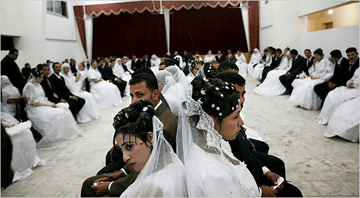
CAIRO — The concrete steps leading from Ahmed Muhammad Sayyid’s first-floor apartment sag in the middle, worn down over time, like Mr. Sayyid himself. Once, Mr. Sayyid had a decent job and a chance to marry. But his fiancée’s family canceled the engagement because after two years, he could not raise enough money to buy an apartment and furniture.

Mr. Sayyid spun into depression and lost nearly 40 pounds. For months, he sat at home and focused on one thing: reading the Koran. Now, at 28, with a diploma in tourism, he is living with his mother and working as a driver for less than $100 a month. With each of life’s disappointments and indignities, Mr. Sayyid has drawn religion closer.

Here in Egypt and across the Middle East, many young people are being forced to put off marriage, the gateway to independence, sexual activity and societal respect. Stymied by the government’s failure to provide adequate schooling and thwarted by an economy without jobs to match their abilities or aspirations, they are stuck in limbo between youth and adulthood. Continue reading Dreams Stifled, Egypt’s Young Turn to Islamic Fervor

Politics of Piety: A Case Study in Cairo


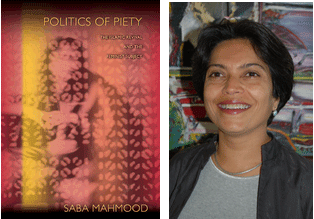
[In 2005 anthropologist Saba Mahmood published “Politics of Piety: The Islamic Revival and the Feminist Subject” (Princeton University Press). This important ethnography of the women’s mosque movement in Cairo not only presents an informative case study but challenges notions of how Muslim women’s involvement in pious movements should be analyzed in a feminist framework. The following excerpt is from the beginning of Mahmood’s book.]

Over the last two decades, a key question has occupied many feminist theorists: how should issues of historical and cultural specificity inform both the analytics and the politics of any feminist project? While this question has led to serious attempts at integrating issues of sexual, racial, class, and national difference within feminist theory, questions regarding religious difference have remained relatively unexplored. The vexing relationship between feminism and religion is perhaps most manifest in discussions of Islam. This is due in part to the historically contentious relationship that Islamic societies have had with what has come to be called “the West,” but also due to the challenges that contemporary Islamist movements pose to secular-liberal politics of which feminism has been an integral (if critical) part. The suspicion with which many feminists tended to view Islamist movements only intensified in the aftermath of the September 11, 2001, attacks launched against the United States and the immense groundswell of anti-Islamic sentiment that has followed since. If supporters of the Islamist movement were disliked before for their social conservatism and their rejection of liberal values (key among them ‘women’s freedom’), their now almost taken-for-granted association with terrorism has served to further reaffirm their status as agents of a dangerous irrationality. Continue reading Politics of Piety: A Case Study in Cairo

The Sheik Comes to NPR


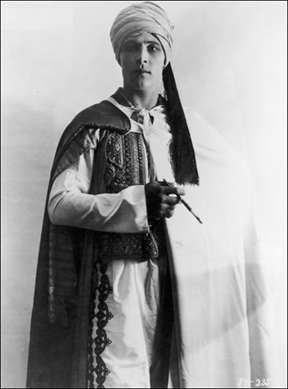
Italian-born actor Rudolph Valentino poses in costume in The Sheik.
Hulton Archive/Getty Images

NPR, Morning Edition, February 4, 2008

In 1921, a silent film transported American audiences to a mysterious, faraway place — and introduced an exotic, erotic character to millions of fans.

The Sheik starred a smoldering Italian immigrant named Rudolph Valentino and featured a title character who bore little resemblance to the venerated Arab leaders commonly known as sheiks. Instead, the character was drawn from the pages of a best-selling romance novel by the wife of a British farmer.

Written in 1919, Edith Maude Hull’s fictional The Sheik inspired a whole subgenre of desert romance, in which hot, swarthy Arabs kidnap reckless white women.

Valentino’s playful treatment of the character captivated female audiences and established him as Hollywood’s first male sex symbol. Mary Brewer Barkley, who was 13 years old when the film was released, recalls newspaper reports that young women were running off to the Middle East in the hope of being abducted by handsome Arabs. Continue reading The Sheik Comes to NPR

The Girl of Qatif


Saudi judge ignores Quranic rights in harsh decision over the ‘Girl of Qatif’

By Khalid Chraibi
Arablife.org, Tuesday, 22 January 2008

In a memorable scene in Ingmar Bergman’s movie Wild Strawberries, Isak, the central character, dreams that he is standing in court, waiting to be sentenced. But he has no clue as to the charges against him. When the judge declares him guilty, he asks, bewildered: “Guilty of what?” The judge replies flatly: “You are guilty of guilt”. “Is that serious?” asks Isak. “Unfortunately,” replies the judge.

The verdict in the case of the ‘Girl of Qatif’, as the incident has become known worldwide, is as bewildering to most people as the judge’s verdict was to Isak. How can a young bride of 18 who has been subjected to the harrowing experience of being blackmailed by a former ‘telephone boyfriend’, then gang-raped 14 times in a row by seven unknown assailants, be further brought to trial for the offence of khalwa and condemned to 90 lashes? How does one justify raising the punishment to 200 lashes and 6 months in jail when she appealed the first sentence?

The case had all the necessary ingredients to become an instant cause célèbre, when word of it reached the global news agencies. It received very large coverage in the media, with the verdict being criticized by commentators, politicians and citizens in all walks of life, within the region and in far away countries.

Amnesty International protested against the flogging verdict (which was also applicable to the men involved in the case), observing that “the use of corporal punishment constitutes cruel, inhuman and degrading punishment.” It added that “the criminalisation of khalwa is inconsistent with international human rights standards, in particular, an individual’s right to privacy.” The sentence against the ‘Girl of Qatif’ and the boy who sat with her in the car “should therefore be declared null and void”. Continue reading The Girl of Qatif

Veiled Voices


Brigid Maher, Director of “Veiled Voices”

Veiled Voices is a one-hour documentary that investigates the grassroots movement of Muslim women in the Middle East who act as religious leaders. It introduces the viewer to a world rarely seen by outsiders: the world of devout Arab Muslim women leading other women in prayers and lessons. Veiled Voices concentrates primarily on Ghina Hammoud, a divorced mother separated from her children, who has a television program and a charitable foundation in Lebanon, and Huda al-Habash, who has a loving and supportive husband and children, and runs lessons and programs in a mosque in Syria. Veiled Voices also travels to Egypt, where women struggle for public recognition in roles of authority over men; this is contrasted with Syria, where some male religious authorities, such as the Grand Mufti, are encouraging of women in leadership roles. The film shows women empowered, while exploring the struggles they face on both a personal and a public level. Continue reading Veiled Voices

MPAC and the Bad News Bear Story

I am a Canadian Muslim who has been living and teaching in Los Angeles for the past decade. My recent book, Oil and Water: Two Faiths, One God is an introduction to Islam for a North American audience. As a Muslim, I am deeply concerned about violence committed by Muslims, especially when it is done in the name of Islam. Muslims around the world have condemned the recent cases in Sudan and Saudi Arabia. For example, the Muslim Public Affairs Council (MPAC) wrote this in response to the jailing of the teacher in Sudan: “‘Jailing Ms. Gibbons is the real insult to Islam in this case,’ said MPAC Communications Director Edina Lekovic. ‘Invoking Islamic law to jail and deport her for this insignificant class project is absurd and appalling.'” Their full response can be found on their web page and is reproduced here:

MPAC Appalled by Sudanese Jailing of Teacher for Naming Teddy Bear
November 30, 2007

The Muslim Public Affairs Council today expressed its disgust with the Sudanese court decision to jail and beat a British teacher who allowed her students to name a class teddy bear “Muhammad.”

SEE: “Calls in Sudan for Execution of British Teacher” (New York Times, 11/30/07)

The hundreds of protesters, some waving ceremonial swords, outside the presidential palace denouncing the teacher and calling for her execution are falling into a pathetic trap by making a story out of nothing. The leaflets condemned Gibbons as an “infidel” and accused her of “the pollution of children’s mentality” by her actions.

“Jailing Ms. Gibbons is the real insult to Islam in this case,” said MPAC Communications Director Edina Lekovic. “Invoking Islamic law to jail and deport her for this insignificant class project is absurd and appalling.” Continue reading MPAC and the Bad News Bear Story

Where are the Moderates?


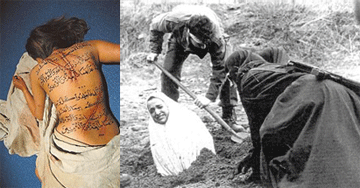
[Illustration: Ayaan Hirsi in the Theo Van Goghin film, left;alleged preparation of woman for stoning, right.]

In a New York Times op-ed published yesterday by Ayaan Hirsi Ali, a controversial Dutch Somali, a relevant and timely question is asked: Where are Muslim moderates when misogynist renderings of Islam sweep the media? She has a point in noting the relative absence of condemnation of three recent tabloid news items. There is the Shi’a woman in Qatif, raped by several Shi’a men, and herself branded (to the barbaric tune of 200 lashes) guilty by a Sunni Wahhabi court for “mingling” with a man not her husband. Then the hug-my-teddy-bear-but-don’t-mention the-prophet’s-name fiasco over a naive British teacher in Sudan, and finally the case of Taslima Nasreen, a Bangladeshi writer vilified for her feminist writings that approach the controversial barzakh of Rushdie’s Satanic Verses. So where are the moderates? For Ms. Ali they are phantom progressives, too blinded by their loyalty to the faith and fearful of telling truth to Muslim power. Here is her assessment:

It is often said that Islam has been “hijacked” by a small extremist group of radical fundamentalists. The vast majority of Muslims are said to be moderates. Continue reading Where are the Moderates?