Category Archives: Gender and Sexuality

Hijab Scene #7

by Mohja Kahf

No, I’m not bald under the scarf
No, I’m not from that country
where women can’t drive cars
No, I would not like to defect
I’m already American
But thank you for offering
What else do you need to know
relevant to my buying insurance,
opening a bank account,
reserving a seat on a flight?
Yes, I speak English
Yes, I carry explosives
They’re called words
And if you don’t get up
Off your assumptions
They’re going to blow you away.

From Mohja Kahf, E-Mails from Scheherazad (Gainesville: University Press of Florida, 2003), p. 39.

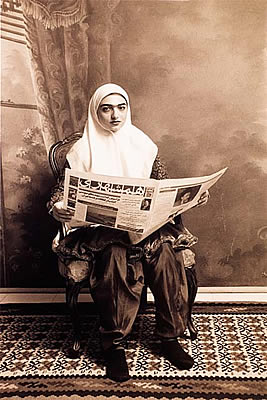
Woman Reading

Shadi Ghadrian
Untitled (Qajar Series), 1998
Silver bromide print, Los Angeles County Museum of Art.

Shadi Ghadirian (Iran, b. 1974), who works in the medium of photography, uses her art to express herself as an Iranian and as a woman. Ghadirian’s best-known body of work, the Qajar Series, was inspired by nineteenth-century studio portraits of women depicted in the fashion of the day: thick, black eyebrows; headscarves; and short skirts worn over baggy trousers. In order to re-create the earlier photographic settings, Ghadirian employed painted backdrops and dressed her models in vintage clothing from the late 1800s. She added modern objects to these traditional scenes, such as a Pepsi can, a boom box, or, as in these two images (figs. 61, 62), a bicycle and an avant-garde Tehran newspaper. She has said of her work, “My pictures became a mirror reflecting how I felt: we are stuck between tradition and modernity.”

For the full exhibit on Islamic Art at the Los Angeles Museum of Art, click here.

The Habib and Remy Show

Many things are not funny, but most things can be poked fun at. Certainly the ongoing violence, destruction and daily killing in Iraq is not funny. But when we stop belonging to Homo ludens as a species, we lose yet another part of our humanity. There is a lot of prejudice against Arabs, Iranians, and Muslims in general. This is no more funny to most Arabs, Iranians, and Muslims than Black Sambo is to African Americans or Chief Wahoo to Native Americans. But there are times when laughing at yourself is a way of dealing with tragedy. In the real world Arabs are not a bunch of bearded, hook-nosed, camel-smelling harem masters, so making fun of the stereotype can at times be like streaking naked in front of a boring commencement speaker. Such raw moments are provided by Habib, an Iraqi, and Remy, a Virginian, in a YouTube rap video called A-R-A-B: the Rap. Continue reading The Habib and Remy Show

Human rights violations in the name of religion

by Wazhma Frogh, from Persian Mirror

As the world is witness of Afghanistan stepping into development and rehabilitation phase, but experiences have revealed that no country can ever develop without a sound base for human rights issues. Afghans are suffering from a very harsh situation and human values are worthless in many parts of the region. As I am a researcher on women issues in Afghanistan and I travel frequently to different parts of the region to find out the living circumstances of women.

Some three months before I has a visit to an eastern south province of Afghanistan and observed the situation of women and children, their rights have been massacred entirely under the shadow of ignorance those who call themselves Muslims. In this province, in every 10 families , 9 of them have sold their daughters at a value equivalent to 300 US $. Continue reading Human rights violations in the name of religion

Hijab or Hellfire

Having grown up in a fundamentalist Baptist church in which even bobbed hair was condemned by some as Satanic, I find it ironic that conservative Muslims resort to the image of the Shaytan to moderate the moral choice of Muslim women’s fashion. There is a slick “Garden of Eden” approach at play in a recent Youtube video featured on Mujahideen Ryder. Check it out.

As for that venal sin of bobbed hair, here is John R. Rice, the spiritual founder of Bob Jones University, holding forth like a salafi mullah:

Long hair, the glory of a woman

“Nevertheless neither is the man without the woman, neither the woman without the man, in the Lord. For as the woman is of the man, even so is the man also by the woman; but all things of God. Judge in yourselves: is it comely that a woman pray unto God uncovered? Doth not even nature itself teach you, that, if a man have long hair, it is a shame unto him? But if a woman have long hair, it is a glory to her: for her hair is given her for a covering.” (1 Cor. 11:11-15)

Let no woman be discouraged because God insists that she shall take a place of subjection and wear the mark of humility and femininity on her head. It is true that the man was created first and then woman created second as a helpmeet, as we were told in verses 8 and 9 above. But dear woman, be not grieved. Long hair is not a shameful mark. Rather, it is a mark of glory. God did not mean for the man to be without the woman (v. 11). Both are necessary. Each one is a complement for the other. Each is dependent upon the other. And God’s way is the fitting and beautiful and happy way. Continue reading Hijab or Hellfire

Georgetown Conference on Alternative Perspectives of the Gülen Movement


CALL FOR PAPERS
ISLAM IN THE AGE OF GLOBAL CHALLENGES:
Alternative Perspectives of the Gülen Movement
October 17 – 18, 2008
Georgetown University

Conference Website

Georgetown University President’s Office, Alwaleed bin Talal Center for Muslim Christian Understanding at Georgetown University, The Institute of Turkish Studies, and Rumi Forum would like to invite you to participate in a conference that explores alternative perspectives of the Gülen Movement within the larger framework of Islam in the Age of Global Challenges. The conference will take place at the Georgetown University on October 17 – 18, 2008. Continue reading Georgetown Conference on Alternative Perspectives of the Gülen Movement

The Bad Business of Badal

A Palestinian filmmaker, Ibtisam Mara’ana, has recently made a film on badal (exchange) marriage from her own personal experience. Although in Arabic, it has English subtitles. To watch a five-minute clip from the film, click here.

Director Ibstisam Mara’ana was predestined, like most of her relatives, to be married off through the badal, a kind of package deal in which a brother and sister from one family marry a sister and brother from another. This marriage exchange is mainly aimed at providing less marriageable daughters with a husband. Mara’ana was told that she was too old and dark, and too ugly due to a scar on her hand, and that without the godsend of the badal, she would fall by the wayside. She refused to cooperate. Instead, she made this award-winning documentary to show how women oppress women. Continue reading The Bad Business of Badal

An American in Baghdad

Editor’s Note: The Baghdad I am referring to is that of the Arabian Nights fantasy and the American is the extraordinary man of letters, Edgar Allen Poe. Among his humorous short stories is a tale called “The Thousand-and-Second Tale of Scheherezade,” archived online at http://www.online-literature.com/poe/45/. Here is a taste of the tale, but I suggest you read the whole story online.


Truth is stranger than fiction.
Old saying.

HAVING had occasion, lately, in the course of some Oriental investigations, to consult the Tellmenow Isitsoornot, a work which (like the Zohar of Simeon Jochaides) is scarcely known at all, even in Europe; and which has never been quoted, to my knowledge, by any American — if we except, perhaps, the author of the “Curiosities of American Literature”; — having had occasion, I say, to turn over some pages of the first — mentioned very remarkable work, I was not a little astonished to discover that the literary world has hitherto been strangely in error respecting the fate of the vizier’s daughter, Scheherazade, as that fate is depicted in the “Arabian Nights”; and that the denouement there given, if not altogether inaccurate, as far as it goes, is at least to blame in not having gone very much farther.

For full information on this interesting topic, I must refer the inquisitive reader to the “Isitsoornot” itself, but in the meantime, I shall be pardoned for giving a summary of what I there discovered. Continue reading An American in Baghdad