Category Archives: Gender and Sexuality

Terrorism That’s Personal


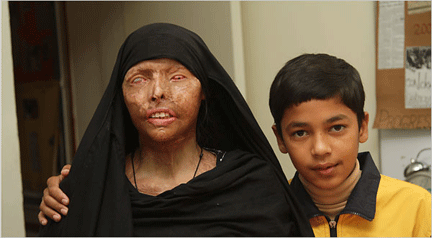
Acid attacks and wife burnings are common in parts of Asia because the victims are the most voiceless in these societies. Naeema Azar, above, was attacked by her husband after they divorced. Her 12-year-old son, Ahmed Shah, looks after her.

Terrorism That’s Personal

By NICHOLAS D. KRISTOF, The New York Times, November 30, 2008

ISLAMABAD, Pakistan

Terrorism in this part of the world usually means bombs exploding or hotels burning, as the latest horrific scenes from Mumbai attest. Yet alongside the brutal public terrorism that fills the television screens, there is an equally cruel form of terrorism that gets almost no attention and thrives as a result: flinging acid on a woman’s face to leave her hideously deformed.

Here in Pakistan, I’ve been investigating such acid attacks, which are commonly used to terrorize and subjugate women and girls in a swath of Asia from Afghanistan through Cambodia (men are almost never attacked with acid). Because women usually don’t matter in this part of the world, their attackers are rarely prosecuted and acid sales are usually not controlled. It’s a kind of terrorism that becomes accepted as part of the background noise in the region. Continue reading Terrorism That’s Personal
Killing Time


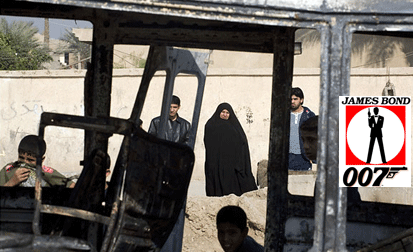
Iraqis with the remains of a minibus hit by a roadside bomb on Monday morning in Baghdad: Joao Silva for The New York Times

There are those decisive moments when something important or historic or even catastrophic happens. These are the things historians chronicle and poets bemoan. Then there is the universal act of killing time, the boring drudgery of day-to-day life but the kind of mundane routine we all long for after the unsought catastrophes. Thomas Friedman in a Saturday op-ed views the current economic crisis as a WMD dug up in our own backyard, a danger so potent that the January inaugural might be best moved up to Thanksgiving, killing two birds (a sacrificial turkey and a lame duck) with one bold act. President-elect Obama is hardly killing time, as his proposed cabinet appointees are press-conferenced to the nation in rapid-fire progression. Time in the larger sense is mercifully short, unless it stops completely in one of those mortality shocks that deadens any sense of time.

Like Monday in Baghdad, where killing time has been the rule both before and after the fall of Saddam Hussein. Continue reading Killing Time

Reproductive Health in Yemen


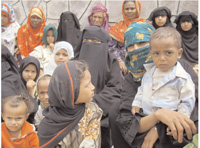
Despite the fact that fertility rate in Yemen is still one of the highest in the world, due to national efforts to promote family planning the projected population for Yemen in 2050 is now 58 million, 1.5 million less than expected in 2007. Yemen Times Photo by Amira Al-Sharif

Integrating culture into development strategy for reproductive health
By: Salma Ismail, Yemen Times, November 19, 2008

SANA’A, Nov. 19 — The United Nations Population Fund (UNFPA) last week released its annual State of the World Population Report for 2008 worldwide. The launching of the report in Yemen took place at Sana’a University and was attended by a number of representatives from the ministries of health and information, the National Population Council, as well as a number of academia and researchers.

Coinciding with the 60th anniversary of the Universal Declaration of Human Rights, the fifth report of the UNFPA, entitled Reaching Common Ground: Culture, Gender and Human Rights, focuses on cultural politics and development, and examines gender inequality and cultural differences with regards to reproductive health. It asserts the importance of cultural interaction with development strategies. Continue reading Reproductive Health in Yemen

A Fatwa that Hits Back

Fatwa Gives Women the Right to Hit Husbands

Riyadh, Asharq Al-Awsat – A fatwa originating from Turkey has given women the right to strike their husbands in cases of self-defense.

Sheikh Mohsen al Obeikan, an adviser to the Saudi Ministry of Justice and a member of the Saudi Shura Council agreed with some Islamic scholars in Turkey and Egypt in this regard. “This [issue] is acknowledged by Islamic jurists and it has roots in Islamic Shariah, the Quran and the Hadith [Prophetic traditions],” said the Sheikh. He referred to the following excerpts of the Quran: ‘The recompense for an injury is an injury equal thereto (in degree),’ [Surat Ashoura: 40] and ‘…whoever then acts aggressively against you, inflict injury on him according to the injury he has inflicted on you…’ [Surat al Baqara: 194] Continue reading A Fatwa that Hits Back

Sex and the Islamic City

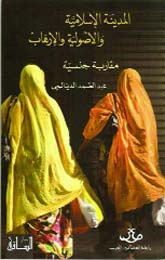
[The following is a review by Omar El Kouch of Al-Madina al-Islami wal-Ouçoulya wal-Irhab: Muqaraba Jinsya, (Islamic City, Fundamentalism and Terrorism: a Sexual Approach), Beirut, Arab Rationalist League, Dar Es Saqi, 2008, 208 pages, ISBN 978-1-85516-287-7 by Abdessamad Dialmy. The review is translated here from Arabic into English by Said Allibou and Imad Mahhou (Mohamed V University, Rabat, Morocco).]

The new book of Prof. Dr. Abdessamad Dialmy holds a new treatment and handling, where the author attaches a particular importance to the sexual factor in the composition and the reasoning of a fundamentalist, radical and terrorist personality. This is a factor which is absent in the various studies on fundamentalist and radical movements in the Kingdom of Morocco and witnessed in the rise of radical movements and incidents of violence and bombings, fields of study and research. Continue reading Sex and the Islamic City

A Persian Catwalk


Iran’s Catwalk Ban Is Only The Beginning

by Farangis Najibullah, Radio Free Europe/Radio Liberty, September 20, 2008

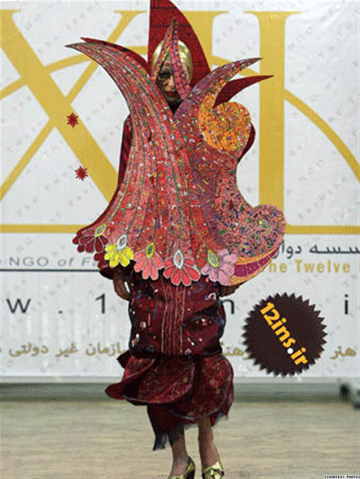
Move modestly. No garish makeup. Don loose and unrevealing clothing. Those are some of the new rules for Iranian models, who have been told not to attract too much attention during fashion shows.

The orders, handed down by the Culture and Islamic Guidance Ministry and published this month, are intended to promote Iranian and Islamic designs and stave off the influence of Western culture.

Live models “should avoid any behavior that would distract visitors’ attention from the clothes put on display,” according to the eight-part “Guideline For Fashion And Dress Shows.”

“Models are not allowed to show off the curves of their bodies, and their hair should not be seen,” the document reads. “The wearing of tight and body-hugging clothes and types of makeup that are incompatible with Islamic and Iranian culture are prohibited.”

Musical accompaniment must be “well-matched to Islamic and Iranian culture,” and should not prompt models to move or walk in an inappropriate manner.

And the fashion-show runway, better known as the catwalk? That’s been banned altogether, since it’s been deemed a slavish imitation of foreign culture. Continue reading A Persian Catwalk

Lucie Wood Saunders, 1928-2008

Lucie Wood Saunders, 1928-2008

One of AMEWS’ earliest members and warmest supporters, Lucie Wood Saunders, passed away on July 26, 2008. Lucie received her PhD in Anthropology from Columbia University in 1959. Her dissertation research was on parallel cousin marriage in Arab families. She carried out research in Egypt, at the invitation of Laila el Hamamsy, Director of American University of Cairo’s Social Research Center, starting in 1961 and into the 1980’s in the Egyptian Delta village, Tafahna el-Ashraf. She worked with Sohair Mehanna of the SRC, authoring many articles with her on Tafahna el-Ashraf. Lucie was among the first Anthropologsits to write on issues of gender in the Delta villages. Her research inspected family and gender relations, the local zar cults, women and development issues around small businesses such as poultry, and medical anthropology. Her early work focused more on psychological issues and her later work more on economic issues. Continue reading Lucie Wood Saunders, 1928-2008

Tzipi Livni is Israel’s Barack Obama


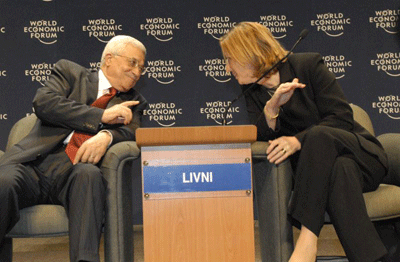
Mahmoud Abbas and Tzipi Livni, 2006

Tzipi Livni is Israel’s Barack Obama

By Neri Livneh, Haaretz Correspondent, September 18, 2008

If, as John Lennon and Yoko Ono said, “Woman is the N—-r of the World,” then Tzipi Livni is Israel’s Barack Obama.

Unlike Hillary Clinton, Livni did not exploit the fact that she was a woman in order to get elected. She is also not married to one of the most beloved individuals in the world.

Instead, Livni won the Kadima primary despite being a woman, and despite being married to a private man who prefers to steer clear from the limelight. (Israeli comics – all of them men, of course – are now busy thinking up new puns on the old “Mr. Tzipi Livni and Mrs. President.”)

And all this while Livni is zealously trying to protect the privacy of her family, and is probably the last person anyone would turn to for a Rosh Hashanah cake recipe. Continue reading Tzipi Livni is Israel’s Barack Obama