Category Archives: Gender and Sexuality

Daydreams and Arabian Nights


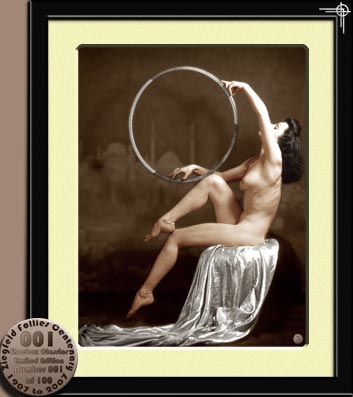
Ziegfeld Follies Girl representing Scheherazade from The Arabian Nights

On a personal note, today is my birthday. It is hard to be serious on such a foreboding occasion, especially when the magic number now exceeds the number of varieties of Heinz pickles. Besides (myself), the sun is shining and it is spring and silliness is in the air. [Isn’t it silly that we drop the ‘y’ to make silliness gramatically correct?] Since I have been preparing a powerpoint for a class on the history of ways in which the human body has been depicted, especially in the art of Adam and Eve in Eden, I have come across a number of Google-ill-begotten images, some of which are hilarious, some risque and some poignant. Take, for example, the picture above, which is not off a current porn site but actually a Ziegfield Follies Centennial print, indeed the first in the series.

So what do you see here? Continue reading Daydreams and Arabian Nights

Musawah Framework for Action

The following information is taken from a relatively new Muslim organization dedicated to equality and justice in the Muslim family. The name of the group is Musawa.

Musawah was initiated in March 2007 by Sisters in Islam, a Malaysian non-governmental organisation that is committed to promoting the rights of women within the framework of Islam, and a 12-member international planning committee of activists and scholars from 11 countries. The committee came together to consolidate information, experiences, and ideas that have been used by NGOs and activists in countries around the world to advance equality in the family. Women’s groups have been conducting these advocacy efforts for decades (see the background papers for more information). Continue reading Musawah Framework for Action

Towards Theocracy?


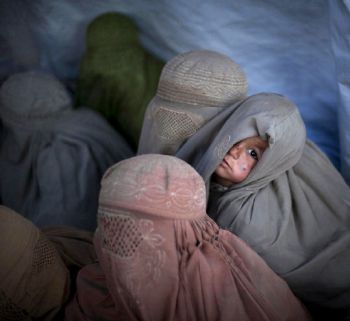
Women in burqas and children from the Bajaur and Mohmand agency areas wait to be registered at a refugee camp near Peshawar in January. Today a full-scale war is being fought in FATA, Swat and other “wild” areas of Pakistan, with thousands dying and hundreds of thousands of displaced people streaming into cities and towns. Photo by Emilio Morenatti/AP.


Towards Theocracy? State and society in Pakistan today.

by PERVEZ AMIRALI HOODBHOY, Frontline, March 14-27, 2009

FOR 20 years or more, a few of us in Pakistan have been desperately sending out SOS messages, warning of terrible times to come. Nevertheless, none anticipated how quickly and accurately our dire predictions would come true. It is a small matter that the flames of terrorism set Mumbai on fire and, more recently, destroyed Pakistan’s cricketing future. A much more important and brutal fight lies ahead as Pakistan, a nation of 175 million, struggles for its very survival. The implications for the future of South Asia are enormous. Continue reading Towards Theocracy?

Social Freedom for Turkish Women


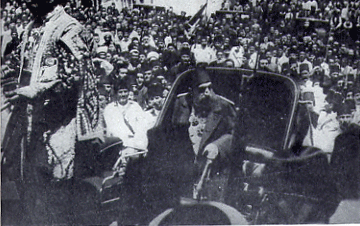
The sultan of the Ottoman Empire going to mosque the day after the constitution was announced.

Social Freedom for Turkish Women
by Mary Mills Patrick.

[The following excerpt is from “The Emancipation of Mohammedan Women,” published in the National Geographic Magazine, January 1909 (Volume XX, No. 1, p.p. 61-62).]

Their past experience has been slowly preparing the Turkish women for the larger opportunities that the constitution gives them. On the morning of the 24th of July all classes of the Turkish Empire entered into a new life, but the greatest change of all took place in the harems. Women everywhere threw off their veils. A prominent woman in Salonica openly assisted her husband in the political celebration.

One woman went so far as to have her picture published in a Paris paper. At this the members of the Reactionary party rose up in common protest and said, “If this be the result of freedom, that our women display their faces to the public with such brazen immodesty, we do not wish a constitution.”

The turkish women are true patriots, and when they saw that the question of freedom for women appeared to have such deep significance to the nation, not only from a political and social, but also from a moral point of view, they said with one accord, “Of what consequence is so small a matter as the veil! We will continue to wear our veils, and will seek the larger opportunities that the new constitution gives us.” Turkish women everywhere have accordingly resumed their veils; but it is a very different thing to wear a veil voluntarily from being obliged to do so, and eventually they will probably appear in the streets without them.

The moral freedom that the revolution has brought the Turkish women is showing itself in many different lines. The freedom of the press has been offered to women. They are writing for the papers openly and without fear of censorship, and their voices are being heard in regard to the affairs of the nation.

Mary Mills Patrick was President of the American College for Girls at Constantinople.
Kama Sutra, Indian Islam and Missionaries

Sex and the country: Islamic rule did not disturb the long Indian tradition of erotic writing
By William Dalrymple, New Age Islam, August, 2008

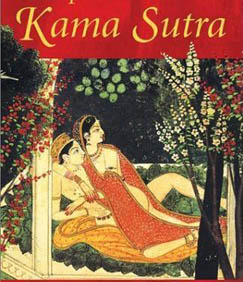
There is nothing new about India being perceived as a place of great and growing wealth: for much of the pre-colonial period, the west was the eager consumer of the spices, silks, and luxuries of the subcontinent, while India was the prosperous supplier. You can still get a flavour of the intoxicatingly rich and sophisticated classical India that supplied these luxuries at the once-great port of Mamallapuram on the Coromandal coast. Here massive relief sculptures faced onto the port where, according to a seventh-century poet, “ships rode at anchor, bent to the point of breaking, laden as they were with wealth, with big-trunked elephants, and with mountains of gems of nine varieties”. The reliefs cover one side of a hill: at the right are two huge elephants, trunks swinging; nearby, warrior heroes and meditating sages stand below flights of gods and goddesses, godlings, nymphs, and tree spirits. There is a breezy lightness of touch at work: a flute is playing, there is dancing, and the heavenly apsara fertility spirits and goddesses are whispering fondly to their consorts. Continue reading Kama Sutra, Indian Islam and Missionaries

Muslim in America: a ‘voyage of discovery’


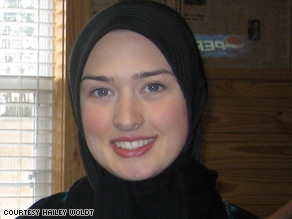
Hailey Woldt, in a traditional Muslim head scarf, studied how people react to her garb in Arab, Alabama.

Muslim in America: a ‘voyage of discovery’

ATLANTA, Georgia (CNN) February 9, 2009 — Hailey Woldt put on the traditional black abaya, expecting the worst. Hailey Woldt, in a traditional Muslim head scarf, studied how people react to her garb in Arab, Alabama.

The last time she’d worn the Muslim dress that, with a head scarf, covered everything but her face, hands and feet, she was in Miami International Airport, where the stares were many and the security check thorough.

This time, she was in a small town called Arab. Arab, Alabama, no less. Continue reading Muslim in America: a ‘voyage of discovery’

American Muslims Call for Swift Action Against Domestic Violence

American Muslims Call for Swift Action Against Domestic Violence

Murder of Buffalo resident Aasiya Zubair spurs American Muslims to forcefully address domestic abuse and violence against women; call on imams to address DV in Friday sermons

SAN FRANCISCO – A coalition of Muslim organizations, journalists, community leaders, imams, and other concerned citizens are calling for immediate action by American Muslim leaders and religious figures to address domestic abuse and violence in America, including that found in the American Muslim community, on Friday, February 20, 2009.

In response to the collective concern of the American Muslim community, imams and religious leaders across America have been asked to speak out against domestic violence to their congregations. They are asked to remind congregants of the Prophet Muhammad’s abhorrence of harshness, abuse and violence, and emphasize solutions that strengthen families and ensure all members are treated with fairness and respect, free of fear of abuse or violence.

Members of the coalition are contacting imams and religious leaders in major Islamic centers and mosques. They are encouraging sermons addressing domestic violence and are offering resources available through the Peaceful Families Project, a Muslim-run domestic violence prevention organization founded in 2000, to help educate the American Muslim community. This education addresses the extent to which domestic violence exists and strategies to stop it.

Several prominent imams have heeded the call to action by concerned American Muslims including Shaykh Hamza Yusuf of the Zaytuna Institute in Berkeley, Ca. and Imam Tahir Anwar of the South Bay Islamic Association in San Jose, Ca. These imams have committed their Friday sermons to addressing domestic violence and preaching that in the Islamic tradition and by the example of the Prophet Muhammad, family harmony can never be achieved by force and that emotional and physical abuse is never acceptable. Continue reading American Muslims Call for Swift Action Against Domestic Violence

Iraqi Women’s Minister Resigns, Draws Support


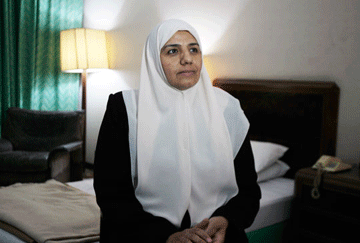
Nawal al-Samarraie, Photo by Karim Kadim

Iraqi Women’s Minister Resigns, Draws Support

by Corey Flintoff, NPR, February 12, 2009

Women in Iraq’s parliament have rallied behind the country’s minister for women’s affairs, who resigned earlier this week saying she was frustrated by a lack of support from the government.

The resignation highlights the plight of many Iraqi women, especially widows created by the country’s decades of war.

Nawal al-Samarraie had served as Iraq’s minister for women’s affairs for less than six months when she created a stir by turning in her resignation. She complained she had never received support from the government of Prime Minister Nouri al-Maliki, and that her budget for projects had been slashed from about $7,500 a month to around $1,500.

“I think it is wrong to stay as a minister without doing anything for my people, especially in this time and in this situation of Iraqi women — we have an army of widows, violated women, detainees, illiteracy and unemployment — many, many problems. I had to resign,” she said. Continue reading Iraqi Women’s Minister Resigns, Draws Support