Category Archives: Gender and Sexuality

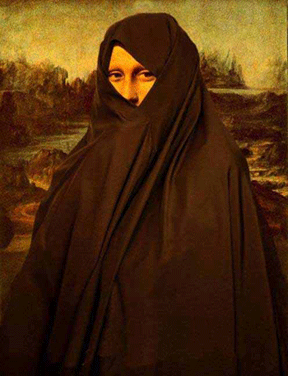
Rumi-nations on Houris

Houris
by Rumi, translated by William C. Chittick

If anyone asks you about houris, show your face and say, “Like this.”

If anyone speaks to you about the moon, rise up beyond the roof and say, “Like this.”

When someone looks for a fairy princess, show your face to him.

When someone talks of musk, let loose your tresses and say, “Like this.”

If someone says to you, “How do clouds part from the moon?”

Undo your robe, button by button, and say, “Like this.”

If he asks you about the Messiah, “How could he bring the dead to life?”

Kiss my lips before him and say, “Like this.” Continue reading Rumi-nations on Houris

This Ain’t Your Mama’s Revolution: Or Is It?


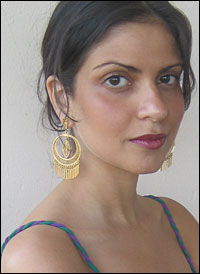
Melody Moezzi, writer, activist, author and attorney

by Melody Moezzi, NPR, July 10, 2009 ·

It has been reported to death since last month’s Iranian presidential election: Young Iranian women are at the forefront of the opposition movement, maybe even at the forefront of the next revolution. What hasn’t been effectively reported, however, is the fact that this isn’t some new, mysterious phenomenon. As an Iranian woman, I can assure you, we weren’t just drinking tea and doing our makeup in the lead-up to all of this.

Women have been fighting for equal rights in Iran for years. Even during the Islamic revolution, women helped lead the struggle against imperialism, for a free and independent nation. They also made huge strides in improving reproductive rights by getting the government to subsidize birth control (hence the acute drop in birthrates after the revolution), and they began entering the work force and universities in ever-increasing numbers. Continue reading This Ain’t Your Mama’s Revolution: Or Is It?

No Honor among Election thieves

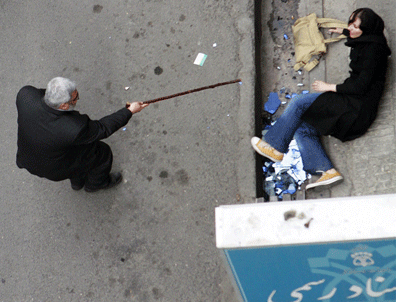
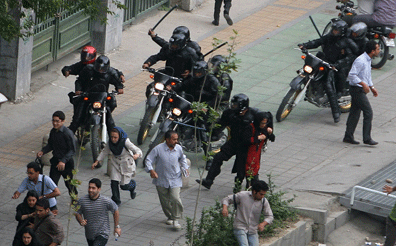
The instant forms of communication that cyberspace creates may spell the demise of rule by dictatorship. Had there been no email, youtube or twitter, the events unfolding in Iran after the rigged election of Ahmadinejad would largely go unnoticed. But instead the brutality of the police and armed vigilantes against ordinary Iranians are being seen around the world. There is a gallery of images, some quite graphic, compiled by the Boston Herald. Whatever the ruling mullahs decide, the deep divisions within Iranian society are exposed to the world. The Islamic Republic is now more clearly seen as an Islamic Dictatorship, increasingly out of touch with the youth and educated members of the society.

Consider the two pictures here of men taunting and manhandling Iranian women. It goes to show that in Iran there is no honor among election thieves. Has anyone stopped to ask: WWMD (What would Muhammad do?)

Islam and Contemporary Issues

By Asghar Ali Engineer, April, 2009

A few days ago I was invited to speak in a Prophet Day’s function. There were other speakers as well. As usual the speakers before me indulged in rhetoric ‘Islam is the solution’ and also said the world economy has failed and slowed down as it is based on gambling and interest. Another person said Islam declared human rights 14 hundred years ago whereas UNO declared it only sixty years ago. Yet another speaker said Islam has given equal rights to women and made it obligatory for them to seek education. Also it was emphasized that Islam is religion of peace.

All this provoked me to say all this is true and I can add much more to it but have we ever seriously reflected why Islamic world is in such turmoil today. Why Muslims have totally failed to adopt these teachings in practice. I said if one caste a critical glance at Islamic world today one finds exactly opposite of what Qur’an teaches. If Qur’an lays great emphasis on knowledge, Islamic world from Indonesia to Algeria has more illiterates than any other community. Continue reading Islam and Contemporary Issues

Gender and Justice in Palestine


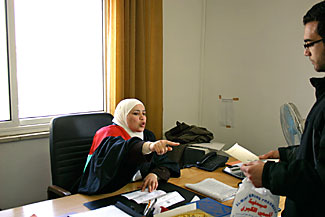
Khouloud el-Faqeeh argues a legal point in her West Bank office. In March, she became one of the two first female Islamic judges in the Middle East.

New female judge transforms Islamic court

Khouloud el-Faqeeh is part Judge Judy, part Sunday School teacher.
By Ilene R. Prusher,The Christian Science Monitor, May 10, 2009

Ramallah, West Bank:

Khouloud el-Faqeeh has shattered the glass ceiling of Islamic jurisprudence.

After years of pushing to break into the all-male ranks of sharia judges in the Palestinian territories, she finally secured a post after scoring among the best – along with another woman – in a recent test for new jurists. They are widely considered to be the first female sharia judges in the Middle East.

Now, Ms. Faqeeh is setting a new tone in her Ramallah courtroom, where defendants are often shocked to see a woman on the bench. With a style that’s part Judge Judy, part Sunday School teacher, she’s on a mission to change her society, case by case. But sometimes, even the most progressive intentions won’t overcome powerful social forces, such as those driving Miryam Abed-Nabi, a newlywed who came to court recently to finalize a divorce. Her husband – Fahmi Awadullah, a man twice her age – took her as a second wife just a few months ago. But the marriage infuriated his adult sons, who worried about their portion of his inheritance. Continue reading Gender and Justice in Palestine

Why hedonistic polygyny is against Islam


Mukhtaran Mai

Why hedonistic polygyny is against Islam

by A. Faizur Rahman

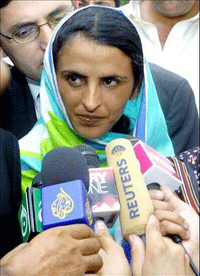
The marriage, under pressure, of Mukhtaran Mai, the courageous woman who stood up to the atavistic tribal laws of Pakistan after being honour-raped by a gang of human beasts, has brought into focus the enormity of the gender bias prevailing in Muslim societies, particularly through the misuse of the law of polygyny. Without doubt, Ms. Mai is a victim of both emotional and physical blackmail. That she is also a victim of medieval indoctrination can be deduced from her unqualified statement (“A controversial marriage in Pakistan,” The  Hindu, March 30, 2009) that taking a second wife is permitted in Islam. Therefore, it could be said with some conviction that it was the belief that her marriage was not un-Islamic (rather than the fear of jeopardising the marriages of three other women) that prompted her into marrying an already married man. For it is unbelievable that a woman of the mental strength of Ms. Mai could have succumbed to the threats of a cowardly blackmailer. Continue reading Why hedonistic polygyny is against Islam

Reforming Islamic family law

Reforming Islamic family law within the religious framework: the « best practices » strategy
by Khalid Chraibi

Many people in the Muslim world believe, wrongly, that shari’ah is a compilation of legal rules which are uniformly applied in all Muslim countries. But, the facts are otherwise: these rules vary significantly from one country to another, as well as over time. As a result, the status of women in Muslim countries, which is ruled by shari’ah, differs in many ways from one country to another. On any given issue, some national “personal status codes” grant more rights to women or better protect their interests than other codes.

According to feminine NGOs working in the field of Muslim women’s rights, if Governments accepted to apply the more favourable rules on any Islamic family law issue (designated as the “best practices”), this would contribute significantly to the reform of family law “within the religious framework”, bringing it closer to contemporary international standards. Continue reading Reforming Islamic family law

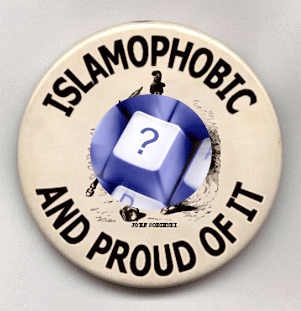
Islamophobia 101, A call to analyse

[Webshaykh’s Note: This is the start of a new blog thread dedicated to energizing scholarly and pedagogical attempts to combat, or at least mitigate, the ongoing volume of Islamophobia in the media, especially on the Internet. The question is simple: what can be done to respond to Islamophobia in the media by our efforts in the blogosphere, formal media outlets, classroom, community and scholarly forums? I invite fellow scholars, professors and teachers and anyone concerned with this issue to contribute to the discussion here at Tabsir.]

People of any particular religious faith are understandably offended when someone or something they hold to be sacred is dragged through the media-made mud of ridicule. There is no way to completely stop desecration, even when hate crime laws are in place. As long as there are synagogues with walls and anti-Semites with paint, swatstikas will be painted. As long as there are artists who stretch their creative energies to the limit of tolerance, animal dung will adorn the body of the Madonna. And as long as so many individuals in Western societies fear Islam through the veil of their own ignorance and historically constructed disdain, the Prophet Muhammad will be pictured as a profligate. The Danish cartoon controversy was only the tip of the iceberg, one that created a titanic rift in the Muslim community worldwide. The irony is that portraying Muhammad in any form is considered wrong in Islam, so that placing a stud missile in the turban of a caricatured Mahound (to drop a literary motif of the same controversial dimension) glosses over the level of misunderstanding motivating those who made and appreciated the cartoon images.

So what is the proper response to the volume of prophet bashing out there, not only in the case of Islam. Here are a few suggestions to jumpstart the process of analysis so that we as scholars can mitigate the paralysis created by an Islamophobia that is only a mouse click away.

• Identify resources (books, relevant articles, websites, speakers) which provide a scholarly and objective-as-possible perspective on Islamophobia
• Discuss the merits of whether or not to provide examples of Islamophobic writing, art and videos that are admittedly offensive to many Muslims
• Provide lesson and project ideas to encourage students to critically assess the Islamophobia in specific examples they are likely to find in the media and on the Internet
• Engage with fellow scholars and concerned Muslims about the most effective and least offensive ways to combat and mitigate Islamophobic writing and art
• Link examples of Islamophobia to other forms of verbal and artistic ridicule of sacred materials.
• Expose Islamophobic rhetoric by politicians, celebrities and other people in the news.

Having set out the goals, I invite colleagues contribute comments, commentaries and examples for and against Islamophobia for this series, please email the webshakh at daniel.m.varisco@hofstra.edu. I will post the first commentary tomorrow.

Daniel Martin Varisco