Category Archives: Gender and Sexuality

The future of Islam in Europe


by Khalil El-Anani, Al-Ahram, 17-23 June, 2010, Issue 1003

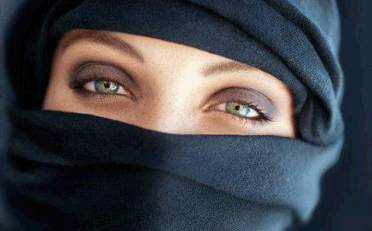
The current Western obsession with the niqab, or full- face veil, often seems part of a subconscious plot to restrict anything Arab and Islamic, symbolic as that may be. The niqab is not really Islamic garb, this I am sure something that Western politicians know. And yet it is becoming a target of hate because it is seen as a cultural symbol that is extraneous, and indeed dangerous, to European societies.

Sometimes I wonder, what if it were Indian women, or Sikhs and Buddhists for that matter, who wore the niqab ? Would European parliaments still spend entire sessions discussing the niqab ?

Theological debate on niqab aside, Western outrage against the niqab seems to be a by-product of Islamophobia, a phenomenon that is raging like wildfire across Europe, asserting itself sometimes as mosque- phobia and at other times as minaret-phobia. Should this trend continue, the day may come when European parliaments ban men from wearing their beards long and shaving their moustaches. I wonder what kind of phobia we’ll name that one! Continue reading The future of Islam in Europe
From Islamist Watch to Islamic Mimbar: The Politics of Hypocrisy


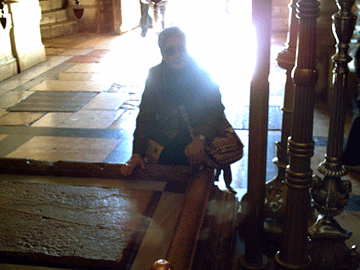
Raheel Raza at the Church of the Holy Sepulchre in Bethlehem

by Huma Dar, Dept. of South and Southeast Asian Studies, University of California at Berkeley

On Thursday, June 10, 2010, Jerome Taylor, the Religious Affairs Correspondent of The Independent posted an article headlined, “First Woman to Lead Friday Prayers in UK.” Two-thirds of the way down this article, we find that:

“Ms Raza’s appearance in Oxford is a repeat of a similar prayer session in 2008 which was led by Amina Wadud, an American-born convert and Muslim feminist. But this is the first time a Muslim-born woman will lead a mixed prayer service in Britain.”

Taylor’s differentiation between “American-born convert” and “Muslim-born woman” and labeling of the latter as the “first woman” in the headline create a false hierarchy and subtly delegitimize Dr. Wadud, a leading Muslim scholar and author of Qur’an and Woman: Rereading the Sacred Text from a Woman’s Perspective, a path-breaking text in the study of gender and Islam. Taylor’s late admission of “repeat” after the (mis)leading announcement of “First” in the headline does not quite cover up for the critical sins of omission and commission, especially as Raheel Raza, the Pakistani-Canadian woman leading the prayer at Oxford, is neither an ‘Alima or a scholar of Islam nor is she known for her advocacy of Muslims at large.

In fact Raza is a rather polarizing figure amongst Muslims in North America and her record does not indicate much learning in the letter or spirit of Islam, as in speaking truth to power and standing with the oppressed. Continue reading From Islamist Watch to Islamic Mimbar: The Politics of Hypocrisy

Miss USA (and no burqa)


[Editor’s Note: For a change we can report something about a Muslim woman and not have to discuss the issue of wearing hijab. For videos from the pageant website, click here.]

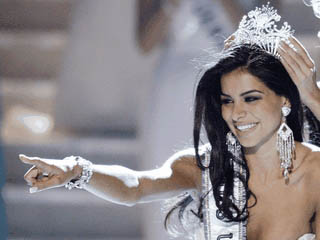
Arab-American Crowned 2010 Miss USA

The Independent, May 17

Lebanese immigrant Rima Fakih says it was a certain look from Donald Trump that tipped her off that she had won the 2010 Miss USA
title.

The 24-year-old Miss Michigan beat 50 other women to take the title last night, despite nearly stumbling in her evening gown.

She told reporters later that she believed she had won after glancing at pageant owner Trump as she awaited the results with the first runner-up, Miss Oklahoma USA Morgan Elizabeth Woolard.

“That’s the same look that he gives them when he says, ‘You’re hired,”‘ on Trump’s reality show “The Apprentice,” she said.

“She’s a great girl,” said Trump, who owns the pageant with NBC in a joint venture.

Fakih took top honours at the pageant at the Planet Hollywood Resort & Casino on the Las Vegas Strip after strutting confidently in an orange and gold bikini, wearing a strapless white gown that resembled a wedding dress and saying health insurance should cover birth control pills. Continue reading Miss USA (and no burqa)

Islam and Feminism


Photograph by Tom Hartwell

Islam and Feminism

by Hania Sholkamy, Contestations, Issue #1

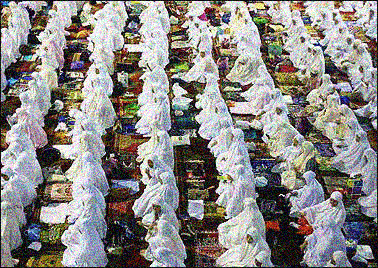
Islam and feminism have had a troubled relationship. Over the last two decades, scholars and activists have questioned the western credentials of feminism and claimed justice as a purpose and possibility that can be captured via religious routes. Religion provides women with an ethical framework and a moral foundation that recognizes their rights as individuals and as a collective, albeit redefining equality in the process. The mosque movement in Egypt has empowered women to find dignity, companionship and comfort through piety and conformity to a religious ideal and challenge the less-than-perfect world around them. Moreover by engaging with religion, Muslim women are able to redefine the tenets that have endowed Islam with an unnecessary bias for men; one which feminist scholars of Islam are certain is antithetical to the spirit and philosophy of our religion.

Such serious engagements are, however, quite separate and distinct from the popularization of religion as a veneer that enables anyone to get away with anything! Continue reading Islam and Feminism

On Colonels, pantyhose and honor killings

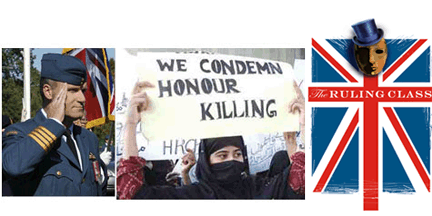
At the start of one of my all-time favorite movies, The Ruling Class, actor Harry Andrews as the 13th earl of Gurney returns to his well-groomed estate to relax after a long day of waxing conservative in the House of Lords. While this film should be required viewing for the current British parliamentary campaign, my interest is in the way this revered judge and former soldier relaxes: by dressing in a ballet skirt and jumping off a stool with a silk noose around his neck. Last Friday the New York Times carried a story about Col. David Russell Williams, a Canadian commander of a major air base in the Afghanistan war. He is described as “once among Canada’s most successful military officers,” the automatic pilot for visiting dignitaries, including Prime Minister Harper. Why “once”? Because the colonel on the battlefront against those honor-killing Taliban appears to be a “serial sexual predator.”

Ottawa police arrested Colonel Williams last February in connection with two murders of women, two sexual assaults and numerous break-ins in the Ottawa area “most of which involved lurid sexual details.” Continue reading On Colonels, pantyhose and honor killings

Female Islamic Leadership Research Network

Female Islamic Leadership Research Network

WHO SHOULD JOIN
Academics interested in any aspect of female religious authority or leadership in Islamic communities worldwide – historical or contemporary – should join this network. The goal of the list is to enable academics spread across a wide variety of disciplines to pass along relevant information and resources, and to discuss topics of interest.

WHY THIS NETWORK
This research network is an outgrowth of a conference held in October 2009 at St Antony’s College, University of Oxford on contemporary female Islamic authority, Women, Leadership and Mosques: Changes in Contemporary Islamic Authority. The conference focused on the growing number of women active teaching, preaching, interpreting scriptures, or leading prayer in mosques or madrasas around the world.

The large response to the call for papers for this conference made it clear that academic interest in this topic is high and increasing, and also that academics working on this topic are divided by an unusually large number of disciplinary boundaries. A virtual network with a mailing list is an ideal way to connect scholars interested in this topic.

The network is open to scholars studying any aspects of female religious leadership in Islam, and therefore includes topics outside the conference’s purview, for instance, the reinterpretation of Islamic scriptures by women who are primarily active outside of mosques and madrasas. Continue reading Female Islamic Leadership Research Network

Arabian Idol: for better and for verse

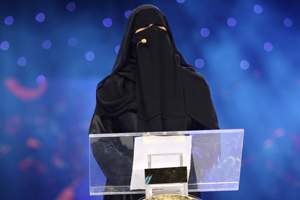
The BBC has an interesting video available online on the popular Emirates television show take-off on “American Idol” but for poets speaking Arabic. Among the final contestants was Hissa al-Hilal, whose frank response to sexist clerics has made her a household name despite being under almost a full hijab. If you think poetry does not pay in this part of the world, think again. The winner walked away with about 1.4 million dollars and Hissa earned 817 thousand dollars. She apparently won the votes of the panel of critics, but lost out to the audience.