Category Archives: Gender and Sexuality

Nawal El Saadawi on Osama Bin Laden


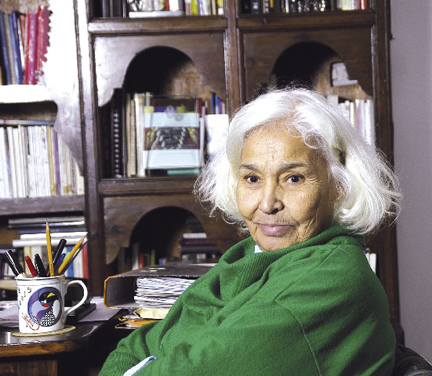
Nawal El Saadawi


Nawal El Saadawi: Leftist support of Taliban is short-sighted

by Sahar Saba, Viewpoint, Pakistan, September 10, 2010

Award-winning Egyptian writer and feminist Nawal El Saadawi hardly deserves an introduction. Author of over forty books—-translated to over 30 languages—-she has inspired women all over the world but particularly in Muslim world with her writings as well as courageous struggle against obscurantism. She has faced threats to her life, was fired from job by Egyptian authorities and imprisoned, has seen her books banned, even went in exile but has been steadfast and vocal when it comes to women rights and socialism.

Sahar Saba:
Osama bin Laden’s act nine years ago became instantly popular all over the Muslim world. Now after nine years, in your assessment, how has the Muslim/Arab world benefitted or suffered as a result of September 11?

Nawal El Saadawi:
After nine years of September 11, nobody has benefitted from Sept 11 except global and local powers who started the colonial oil war and triggered religious conflicts in the Arab region. Continue reading Nawal El Saadawi on Osama Bin Laden
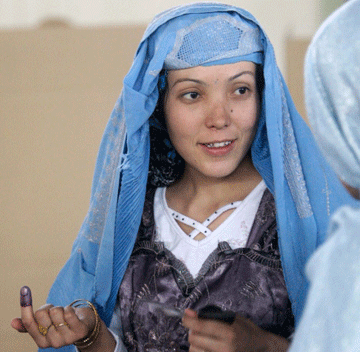
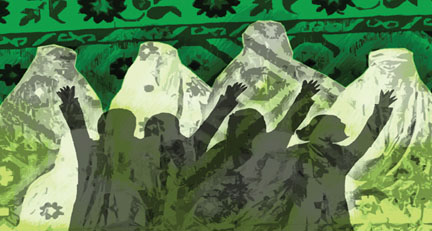
Questioning the Veil


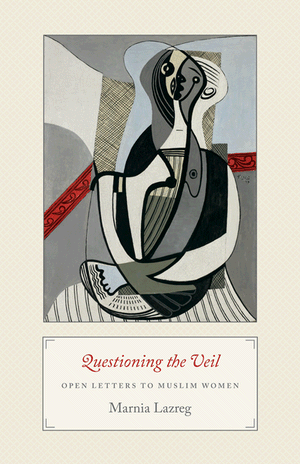
[Editor’s note: Marnia Lazreg’s Questioning the Veil: Open Letters to Muslim Women (Princeton: Princeton University Press, 2009) is a refreshing unveiling of the long debated arguments on the use of some sort of “veil” in Muslim societies. These letters, concise and impassioned arguments in essay format, are for all to read. Modesty? Protection against sexual harassment? Newly formatted cultural identity? Conviction and Piety? Lazreg draws on her own upbringing in Algeria and research as a sociologist to frame her conviction of why Muslim women should not wear the veil. No one interested in the ongoing discussion should fail to read her important contribution. I provide here a brief excerpt from her Introduction.]

I do not approach veiling from the perspective of the struggle between “tradition” and “modernity,” which purportedly women resolve by opting for the veil, as a number of studies have claimed. New styles of veiling are less confining to a woman’s ability to move about than old ones, and a number of veiled women throughout the Muslim world have been carrying out their professional activities side by side with men in their workplaces. Nor do I consider wearing a veil at work as ushering in a new form of “modernity.” Furthermore, I do not intend to characterize veiling as representing women’s “alienation,” “enslavement,” or “subjugation” to cultural norms. Such characterizations are unhelpful as they can easily be applied to our postmodern condition, marked as it is by a retreat from a meaningfully shared human experience and the flaunting of privatized forms of consciousness, which result in conceptions of women that are as detrimental to women’s integrity as the veil might be. Continue reading Questioning the Veil

The Meaning of Democracy

The Meaning of Democracy

by Roya, Afghan Womens’ Writing Project

After the Taliban‘s black regime, when houses were cages for women and only the wild Taliban ideology was law, when the burqa was accepted as a symbol of freedom and the real Islamic hijab disappeared unknown—after all this, Afghan women recognized the word for Democracy.

But Democracy is a very young word for the people of our country, very new in our cultural dictionary, and the question is: Do women understand this word? Do they welcome it, or hide under their burqa?

I think Democracy knocked on the doors of only some women in Kabul, Mazar, Herat, only a few of Afghanistan’s 34 provinces. In most areas, Afghans still don’t know this word. Many think it is a word used only by politicians who travel all over the world, live in the tallest buildings and own the latest car models. Democracy, easiest explanation, is government of the people, for the people. But in our country, people think whatever your heart wants, do it, and that is the meaning of democracy. Continue reading The Meaning of Democracy

Manly manoeuvres


By Nadeem F. Paracha. Smoker’s Corner, Dawn.com, July 4, 2010

It is rather startling to note how the powerful ‘Women’s Lib’ movement in the 1970s was manhandled by certain sections of society in the West. They scrapped the intellectual aspects of the concept and used the fruits of the movement by simply exhibiting it as a way to justify nudity.

The above was what most frontline women activists of the movement bemoaned, alluding that their movement’s many positive social outcomes had been misused. In fact, such is also the view of a majority of conservative Muslim thinkers — especially those who have been at the forefront of encouraging the usage of veil among Muslim women.

Interestingly, a lot of young Muslim women who adorn the hijab/burqa suggest that veiling demonstrates their liberation from becoming an object of the pitfalls of the Women’s Lib movement. But just as one is correct to point out that these pitfalls involve emancipated women who shroud their obvious objectification by describing it as liberation, one isn’t too far off the mark to also question the other side of the divide. Continue reading Manly manoeuvres

Covering Afghanistan


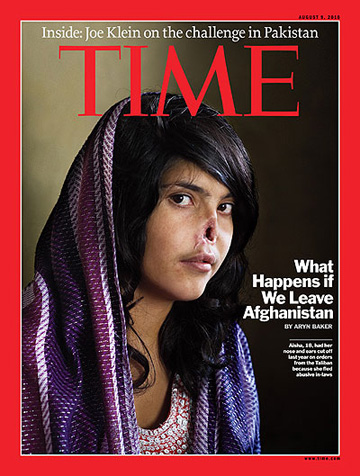
August 9, 2010 cover of Time Magazine

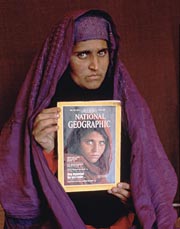
As usual for the end of the week, my Time arrived yesterday. It seems a bit unusual that I should receive the August 9 issue a week early, but then Time is not always accurate. The cover photograph is startling, haunting, disturbing and an unfortunate example of sensationalized news reporting. I cannot help but compare this to the widely traveled National Geographic photograph of an Afghan woman. I have no objection to covering a human tragedy etched in the face of young Aisha, the 18 year old girl whose nose and ears were cut off by self-righteous extremists who practice a brand of Islam that would make the Prophet Muhammad roll over in his grave. But the cover’s prominent announcement of the article inside by Aryn Baker is in fact not the title of the article, nor the main message of the author. “What happens if we leave Afghanistan” is a lot more sensational than “Afghan Women and the Return of the Taliban,” which is why it graces the cover. Tragedies, like sex scandals, sell. The issue for me is how they should be reported responsibly.


Afghan woman holding 1985 National Geographic issue with her picture on the cover

Continue reading Covering Afghanistan

Born Free, unless you are female

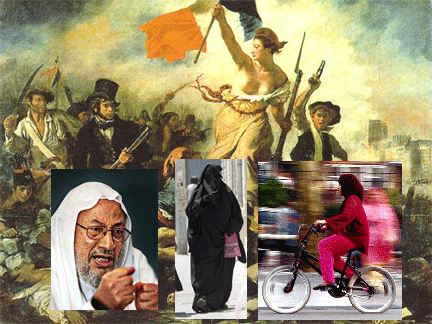
I opened my email this morning and back-to-back there was instant conflict: a posting about a new Indian Deoband fatwa ruling that veiled Muslim women should not ride bicycles and another about a female French lawyer who ripped the face covering off a young Muslim girl in a shopping mall near Nantes, the latter a pre-emptive strike for the pending anti-niqab law in the French parliament. Both rulings strike me as silly, both as overtly political. So now instead of the standard “Death to America” vs. “Muhammad is a child molester” chant wars we have entered the era of dueling over social mores through Fatwa Wars. Although not as erotic as the recent tit-illating fatwa controversy, also involving women’s bodies, the battle lines are still drawn over the same resource: what males do to control women’s bodies and minds.

Let’s start with the Deoband bicycle banning. The commentary by Nigar Ataulla, an Indian Muslim who happens to be female as well as a journalist who enjoys bike riding, called “Cycle Fatwa  Rides into My Re-Cycle Bin” reads:
Continue reading Born Free, unless you are female

Viagra for Aladdin Lovers


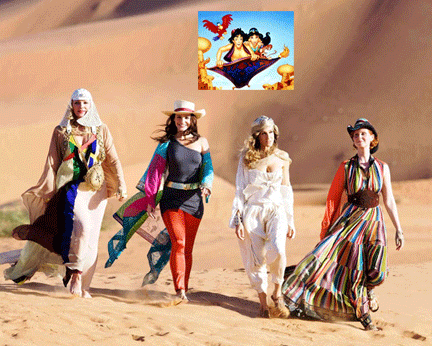
“Sex and the City 2’s” stunning Muslim clichés
It’s hard to overstate the offensiveness of the fabulous four’s exquisitely tone-deaf trip to Abu Dhabi

By Wajahat Ali, Salon, May 26

I’m a heterosexual, Muslim dude who until recently thought pleated khakis and loafers were “hip” and mistook Bergdorf Goodman for an expensive Swiss chocolate. So it is not surprising that 40 minutes into “Sex and the City 2,” a 150-minute cotton candy fantasy accessorized with materialism and fashion porn, I was comatose with boredom.

But I was defibrillated by the film’s detour into Abu Dhabi (really Morocco and studio sets) and what can only be described as an Orientalist’s wet dream. After discovering they will visit the Middle East, the ladies whip out hall-of-fame Ali Baba clichés: References to “magic carpet” (a double entendre, naturally), Scheherazade and Jasmine from “Aladdin” come in rapid succession. Upon hearing a stewardess give routine flight instructions in Arabic, Samantha behaves like a wild-eyed child hearing a foreign language for the first time. “I wonder what she’s saying. It sounds so exotic!”

Michael Patrick King’s exquisitely tone-deaf movie is cinematic Viagra for Western cultural imperialists who still ignorantly and inaccurately paint the entire Middle East (and Iran) as a Shangri La in desperate need of liberation from ignorant, backward natives. Continue reading Viagra for Aladdin Lovers

Habibi Rasak Kharban


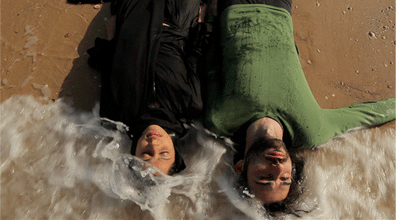
Habibi Rasak Kharban (Darling, Something’s Wrong with Your Head) is a dramatic feature that tells the story of a forbidden love in Gaza. The film is a modern re-telling of the famous ancient Sufi parable Majnun Layla and is the first full-length narrative set in Gaza in over 15 years.

Susan Youssef is the writer and director. This is her first feature film. Her five shorts have screened at venues such as Sundance Film Festival and Museum of Modern Art (NY), and have been acquired for distribution by Video Data Bank, Third World Newsreel, and Canadian Filmmakers Distribution Centre. For information on her past films, click here.