Category Archives: Gender and Sexuality

Orientalist Cheesecake


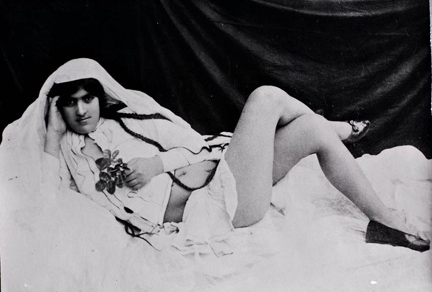
Portrait of a lying woman, Antoine Sevruguin, Iran, 1901 (geheugenvannederland.nl).

If a picture is worth a thousand words, then one like this century-old photograph taken in Iran will leave the reviewer with no loss for words. Here is the quintessential native Ottoman Era odalisque to ogle at. A number of enticing props are they as well: the flowers in hand, the shoes on the bed at the end of a curvaceous bottom in corso flowing down the exposed torso, the half-hidden belly button, long pigtails and dark kohl-laced eyes. Not only is this figure exposed to the viewer, but she engages with a direct gaze, using a hand to cradle her head. Here, visually presented, is the Orient represented: a luscious and willing consort for the taking.

The photograph above is part of a series of Ottoman Era images from the Ottoman History Podcast, a radio program and Facebook site based in The Netherlands. The site has a splendid selection of photographs from the Ottoman Era, the vast majority of which are not odalisque cheesecake, and it is well worth perusing.

Regarding the photograph above, here is how the Facebook site describes it: Continue reading Orientalist Cheesecake

Yemen Conference at Harvard


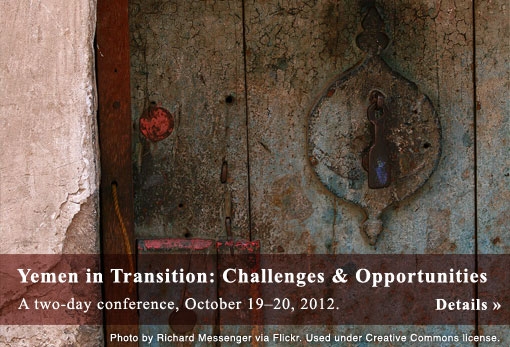
This past Friday and Saturday a conference was held on “Yemen in Transition.” While I was originally scheduled to give a presentation, I was not able to attend. But here is an overview of the conference, with complete details on the conference website.

Date: October 19, 2012 (All day) – October 20, 2012 (All day)
Speaker: various
Yemen in Transition: Challenges and Opportunities
Organized by Steven C. Caton, Harvard University, and the Yemen Working Group, this conference brings together Yemeni American professionals and academics along with some of their counterparts from Yemen, and academics from the U.S., Europe, and Yemen to discuss the future of Yemen and what might be done to help the country as it transitions into its new historical phase. It also brings together students from Harvard and the Boston area who are from Yemen. The main topics to be discussed are: women and youth, economic development, politics and political reform, and the water crisis. As an academic conference, the focus will be on theory and analysis, though concrete proposals and recommendations will also be presented.

The panels and the keynote address are open to the public. These presentations will be videotaped and made available on the website of the Harvard Center for Middle Eastern Studies but they will not be published as part of a conference proceedings. The use of recording devices by anyone other than the organizers is strictly prohibited.

Malala and malevolence

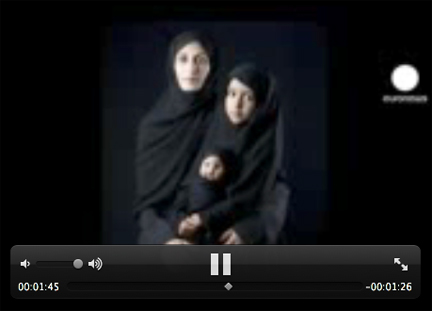
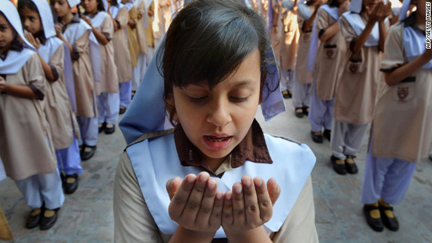
Pakistani school girls pray for the recovery of teen activist Malala Yousufzai at their school in Peshawar on Friday.

A fourteen-year old girl is shot in the head for wanting to be educated. It is hard to imagine a more sadistic premeditated attack on innocence. Her name is Malala and her attackers are Taliban extremists who have so perverted the teachings of Islam that they commit the ultimate modern-day shirk: assuming that their cowardly act has divine sanction. The assassination attempt on a school bus is now one of those shots heard across the world. To be sure, the gunshots that have ripped through bodies in Muslim countries number in the thousands these days. The attack on Malala does not override the horrific bloodshed taking place in Syria, the continuing violence in Afghanistan and Iraq and elsewhere. But it stands out as a symbol of what goes terribly wrong when partisan religious fervor enters the political arena.

Pakistan’s president, Asif Ali Zardari, recognizes this: “”The Taliban attack on the 14-year-old girl, who from the age of 11 was involved in the struggle for education for girls, is an attack on all girls in Pakistan, an attack on education, and on all civilised people.” He recognizes that such malevolence puts every young girl in Pakistan in danger and threatens to further divide debates in his country into violent conflict. But this is not only an attack on “all civilised people”; this is an assault on all people. And, as the photograph of a young Muslim girl praying above shows so well, an attack on the very idea of the merciful God she prays to.

I have never met Malala and probably never will. But Malala is my daughter, my wife and my mother. Shooting her is an attack on my family and yours. If the shooters dared to whisper bi-ism-Allah-al-rahman-al-rahim before they pulled the trigger against a child of God, may that same God have mercy on their souls, because they never learned the true meaning of the words they spoke. Continue reading Malala and malevolence

Challenging the Norm


Q&A: Boushra Almutawakel
Challenging the Norm

The Economist, Aug 16th 2012, by S.B.

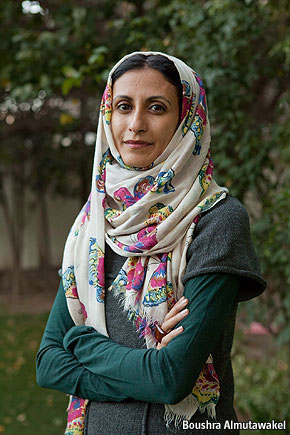
BOUSHRA ALMUTAWAKEL, a Yemeni photographer, aims to provoke discussions about social norms and question the ways people and cultures judge one another. Her stylised portraits, mostly of Middle Eastern women, challenge the view held by many in the West that the veil is a symbol of oppression. Issues of identity are central to her work. Though she is skeptical of veils that completely obscure the individual, she draws similarities with the way some women hide behind heavy make-up: in both cases, a woman is concealed behind a social mask of sorts, often for her own comfort. Ms Almutawakel (pictured below) is openly critical of certain social expectations of women in Yemen, yet she wears a long black abaya in public because she “wouldn’t feel comfortable otherwise”. This ambivalence pervades her work.

Having studied in America, Ms Almutawakel has returned to live and work in Sanaa in Yemen. Her photographs—controversial among Yemenis—seem designed mainly for a Western audience. But some can now be seen in a show of regional artwork at the National Museum of Yemen in Sanaa.

Ms Almutawakel recently met with The Economist to discuss her photography, her views on women and the role artists play in revolutionary Yemen.

Tell us about the art scene in Yemen.

When I started in the 1990s I was supposedly the first female photographer. There were only a few artists throughout Yemen and we formed a network to hold exhibitions. Now there are many more because digital cameras have made photography more accessible and schools and universities teach design. But the scene is still limited and goes up and down with the economic and political situation. We need support to have our work exhibited locally and internationally. Continue reading Challenging the Norm

Body Politics: Muhammad and Middleton


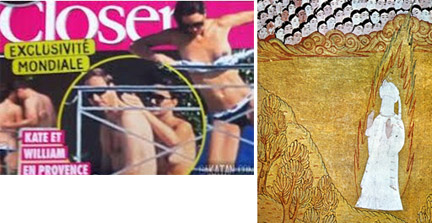
The offending photographs of Kate Middleton, left; an Islamic depiction of Muhammad by not showing his face, right


[Note: The following commentary has been posted to my column “Middle East Muddle” on the online website of Anthropology News, published by the American Anthropological Association. To read the entire commentary, click here. For more commentaries on “Middle East Muddle, click here.]

Two scandals have dominated the news, at least in Europe and America, over the week following the 9/11 anniversary. The first, which has yet to abate as I write this, is the widespread protests against a pathetic anti-Muslim film trailer trolled from Youtube, rhetorically warmed over in Arabic and promoted by extremist Muslims to stir up violence. The troll took a toll with the American ambassador and several other Americans killed in Libya, violent clashes in Egypt and in Yemen and a range of protests (many of which have remained peaceful) across Muslim communities. The second, which is equally absurd as a pretext, is the voyeuristic publishing by French, Irish and Italian tabloids of a long-distance photograph of the naked breasts of Kate Middleton, the newly wed wife of Britain’s Prince William. The paparazzi have once again harmed Britain’s royal family, first by chasing Princess Diana and now by turning a powerful lens on a private moment in a private home while Diana’s son vacationed in France. In both the body is all about politics…

For the entire commentary go to “Middle East Muddle” by clicking here.