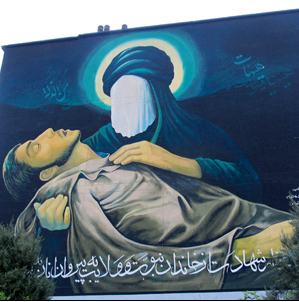
Martyrdom is the inheritance of the Prophet and his family to their followers (translated title). Three-storey high mural located on Mudarris Freeway, Abbas-Abad, Tehran, Iran, Fotini Christia, photographer.
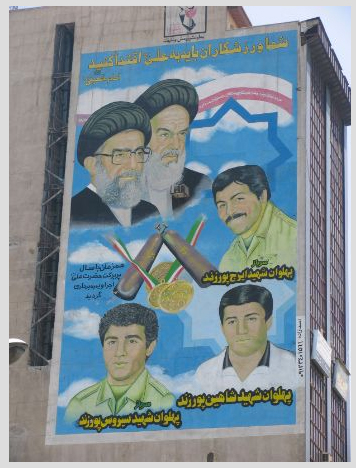
“You athletes should follow Ali (peace be upon him)”, Fotini Christia, photographer,
Yemeni Artists
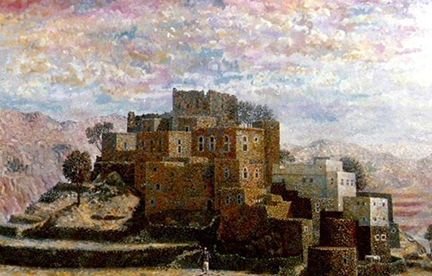
Yemeni artist Ziad Nasser al-Ansi, who won fourth place at the Dubai Cultural Innovation Awards, blends Yemeni architecture with local decoration and patterns. Above, al-Ansi’s painting that won the President’s Award in 2006.
Yemenis take home top awards at Dubai cultural competition
by Faisal Darem, Al-Shorfa, September 6, 2013
Yemeni Bassam Shamseddine was taken by surprise when his wife told him she had submitted his novel, “Laanat al-Waqif” (The Curse of the Stander), to the 2013 Dubai Cultural Innovation Awards without his knowledge.
A bigger surprise awaited him when his book placed fifth in the novel category, he told Al-Shorfa.
Shamseddine is one of three Yemenis who placed at the eighth edition of the awards.
Khaled Abdul Haleem al-Absi placed second in the short story category for his collection, “Wa Alam Adhaat Sihruha” (And the Pains Have Lost Their Magic), while Ziad Nasser al-Ansi placed fourth in the fine arts category.
The winners’ names were published in the September issue of the Dubai Cultural Magazine.
Awards were distributed across eight categories, including UAE cultural personality of the year, poetry, short story, novel, fine arts, dialogue with the West, theatre writing and documentary film.
“This is the first time I have taken part in a literary competition, and the award is a significant moral support for me to continue writing novels and stories,” Shamseddine said. Continue reading Yemeni Artists
Street Art in Sanaa
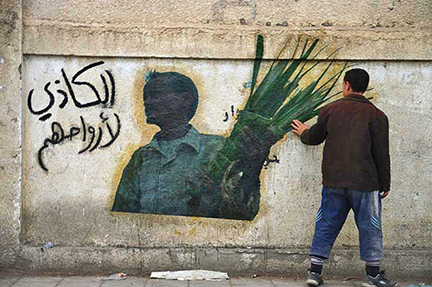
Pasted photography on wall, Sana’a 2012; photograph by Jameel Subay
From Street Politics to Street Art in Yemen
By Anahi Alviso-Marino, Nafas Art Magazine, July 2013
In January 2011, demonstrations inspired by the contentious mobilizations taking place in Tunisia and Egypt started to be carried out in Yemen. Gradually, anti-governmental demonstrators came to modify old repertoires of contention, such as the demonstration or the sit-in, into what became a permanent camp and a new space of contention in Sana’a named “Change Square.” Among the self-proclaimed “revolutionary youth” of a sit-in that lasted until April 2013 were a number of visual artists. Their presence in the Square contributed in giving political demands an artistic expression, alongside using artistic practices as a means of contention. Contributing to the symbolic aspects of this mobilization, artistic practices developed inside and outside the tents. As a continuation of street politics acquired in the Square, certain visual artists incorporated dissent, transgression, and civil disobedience in their artistic practices. Among such cases, street art techniques such as graffiti, free writing, mural painting or stenciling participated throughout 2011 in reproducing political slogans that aimed to overthrow Ali Abd Allah Saleh’s regime.
In 2012 this contentious street art underwent certain changes. Continue reading Street Art in Sanaa
Writing off Iraqi Bodies
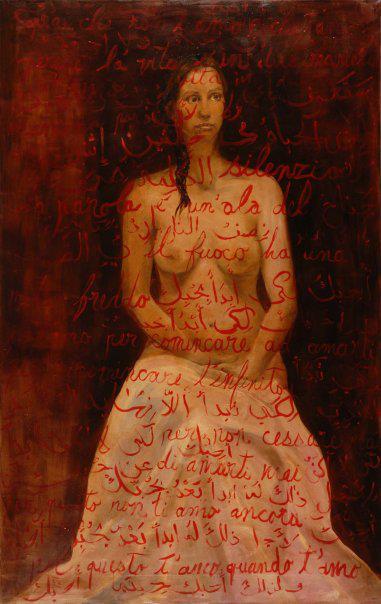
A painting by Iraqi artist Hadeel Azeez on Arab Women Artists.
Lebanese Hymns of Love and War- Part 2
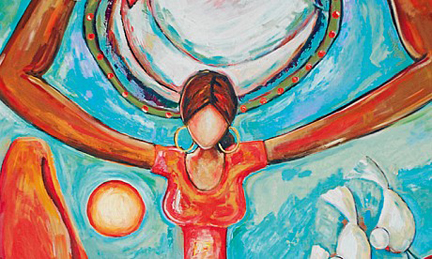
Artwork by Lebanese artist Fady Habib
By George N. El-Hage. Ph.D.
[Originally written in Arabic and Translated by Allen Lederman and George Nicolas El-Hage. For part 1, click here.]
1 – Glory be to Lebanon and the strength and dignity of man in her, now and forever.
2 – Oh my Lebanese friend, if only you could witness the politicians, and by God they are many. Those who deprived politics of its national obligations, you will see them as they are, without their chameleon skins, parrot tongues, and raven cloaks. If only you saw them in the mirror of truth and patriotism, you would curse them and refuse their sedition.
3 – Because Lebanon embodies love, and love embodies God, Lebanon endures. Fear not, oh Lebanese.
4 – No. The sound of the cannons and the explosions of the bombs and bullets no longer frighten our women. For the Woman who reared history’s greatest heroes is able to beget heroism any time.
5 – Those who died in the cause of Lebanon know they live in our hearts and that to die for Lebanon, is to live.
6 – Never have invaders and oppressors been more powerful than a people fighting for its survival. Thus we know we will triumph and endure.
7 – Those who sold their homeland and bartered their cause do not even deserve the curse of history, for he who has neither country nor cause, is non-existent.
8 – Those whom Lebanon harbored and fed, and carried their cause to the world, chased her people out, starved and killed them. We will continue to love them, for what good is it to love only those who love you. Continue reading Lebanese Hymns of Love and War- Part 2
Petition for a Kahlil Gibran US Postage Stamp
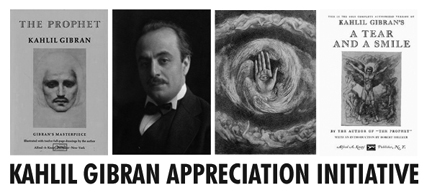
Sign the Petition for a Kahlil Gibran US Postage Stamp!
Why Gibran?
Since his passing, fans of Gibran Kahlil Gibran (1883-1931) have called for a fitting tribute to the poet, author, artist, and philosopher, who remains one of the most renowned figures in the world literary landscape. For Arab Americans and Arabs daunted by political, financial and social uncertainty, Gibran holds a valuable place as the immigrant voice in America. Arab Americans and Arabs have long ago claimed Gibran’s achievements as their own, proudly holding his life and works close to their hearts.
Perhaps this protective emotional engulfing has to do partly with Gibran’s own quest to belong. Early on in his childhood, the Lebanese born poet was rendered homeless after his father was sent to prison for tax evasion, and his property was impounded. Shortly thereafter, the family emigrated to Boston’s South End, where non-English speaking Gibran was told he should Anglicize his name, and refer to himself simply as Kahlil Gibran. Continue reading Petition for a Kahlil Gibran US Postage Stamp
George Nicolas El-Hage: If you were mine, 2
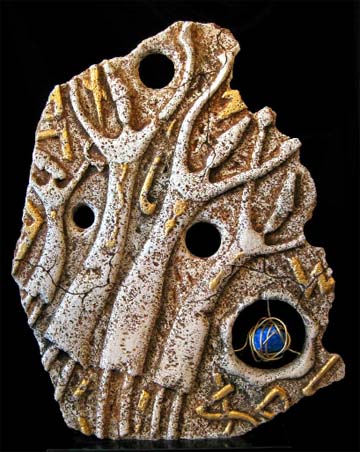
[This is the second in a series of poems translated from the Arabic of George Nicolas El-Hage’s If You Were Mine. For the first installment, and information about the poet, click here.]
Exile
My unbelief and sins and faith
And black cares watch over me
September and March come
And I am in my room, collapsing
A nightmare wears my sorrows …
It comes to me also, comes to me
News, my dark one, threw me
Into your eyes’ hollow it threw me …
Other years I wait
December and January …
The room swells in my breast
I die slowly …
The room swells in my breast
I live through seasons, unaware,
That exile is my country.
Continue reading George Nicolas El-Hage: If you were mine, 2
Take a Turk to the Movies
The Turkish artist Murat Palta has posted a series of drawings online about famous movies, but with an Ottoman miniaturist flair. Check out his fabulous website. Here are my favorites…
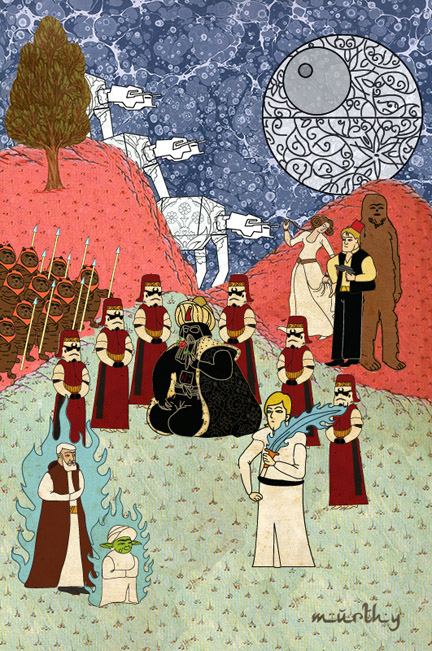
Star Wars
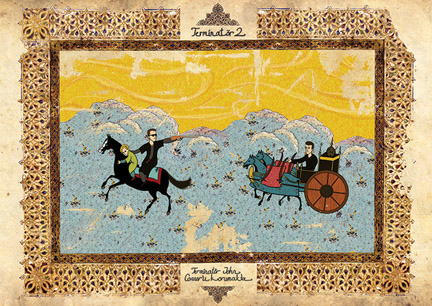
Terminator 2