All posts by dvarisco

A Sad Tale of Two Cities

For almost two weeks the nights in parts of Paris and other cities in France have belonged to rioters, who seem intent on taking out parked cars (more than 6000 at last count) rather than fellow French citizens. Then tonite flames rose from three luxury hotels in Amman, Jordan with scores dead in the early reports. Although the blasts in Amman occurred in heavily touristed hotels, they are venues just as frequented by well-to-do Jordanians. In the Raddison a suicide bomber apparently set himself off in the midst of a Jordanian wedding. Continue reading A Sad Tale of Two Cities

Channeling the Crusades

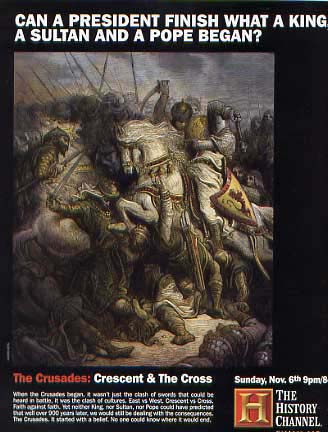
On Sunday, Nov. 6 at 9 pm EST The History Channel will resurrect the era of the Crusades with a special program called “The Crusades: Crescent & The Cross.” I have not seen the program, so I cannot comment on its historical accuracy, fairhandedness or cinematic quality. Were it to air (I am tempted to say err) on Fox News, I would make every effort not to see it. But my academic bent idealistically treats “The History Channel” as National Geographic with substance.

I have, unfortunately, seen the advertisement for this program gracing the back of my recently arrived November Smithsonian magazine. I repeat “unfortunately” because either the ad maker has no clue what the program is trying to say (this is my hope) or else this special might as well be on Fox.

Let’s start with the hook. “CAN A PRESIDENT FINISH WHAT A KING, A SULTAN AND A POPE BEGAN?” Just about everything in this question (I do so hope it is meant to be rhetorical) is backwards. Surely, this program is not going to argue that Bush’s well-oiled but poorly thought out war in Iraq is a new crusade. Yes, our president uttered the inappropriate c-word (I am thinking of the non-sexual one here) soon after 9/11, but I do not think the Pentagon got its game-plan from Rev. Franklin Graham. I can only wonder what “King” will be targeted as the royal jump-starter for the Crusades? Unless this is a subliminal plug for Larry King Live on another channel. Nor do I remember any sultan in the Middle East or yet-to-be occupied Constantinople making a preemptive strike on Christendom. Why save the Pope for last, since Pope Urban’s fiery speech in 1095 C.E. is what historians used to cite as kindling the flame? Continue reading Channeling the Crusades

Numbers in Context

In an op-ed column in today’s (October 27, 2005) in New York Times, classicist and Hoover Institute commentator Victor Davis Hanson tries to put the reaching of 2,000 American military casualties in Iraq “in context.” “Compared with Iraq,” he argues, “America lost almost 17 times more dead in Korea, and 29 times more again in Vietnam – in neither case defeating our enemies nor establishing democracy in a communist north.” For those of us who think 2,000 is 2,000 too many, Hanson suggests we remember the 400,000 dead in World War II. “If our enemies similarly believed in the obsolescence of war that so heartlessly has taken 2,000 of our best young men and women, then we could find solace in our growing intolerance of any battlefield losses. But until the nature of man himself changes, there will be wars that take our youth, and we will be increasingly vexed to explain why we should let them.”

But why stop with World War II? Continue reading Numbers in Context

Burning Bodies, Burning Bridges

Reports have recently surfaced that a few frustrated American soldiers in Afghanistan may have desecrated the bodies of two dead Taliban fighters by burning them. Beyond this they are accused of taunting nearby villagers to be “lady boys” (which I take to be a militarized cognate of Arnold’s conventional “girly men”) for not coming out to retrieve fellow Muslim bodies purposely set on fire facing the West. Perhaps the soldiers doing this thought it silly that Afghan men do not wear Western pants and at the same time believe in resurrection of the dead.

Continue reading Burning Bodies, Burning Bridges

Trial by Ordeal

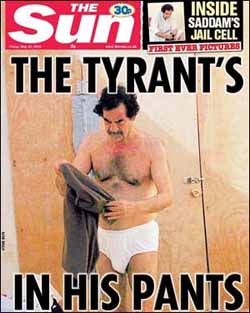
The headline of the October 20, 2005 New York Times says a lot: “Defiant Hussein, Lashing out at U.S., Goes on Trial.” Everyone involved in this scene, from the defiant defendants to the many victims under Saddam’s brutal dictatorship, knows what the verdict will be. We are trying Saddam Hussein in a televised court of legal process not to determine if he is guilty but to remind the world of his crimes against humanity. There is no innocence to presume. Nor is there a Johnny Cochran waiting in the wings with too-tight, blood-stained gloves.

All indications are that this trial will be an ordeal. Continue reading Trial by Ordeal

Reporting Suicide is Not Painless

In an editorial in Wednesday’s New York Times (“Silence and Suicide.” October 12, 2005, p. A23), op-ed columnist Thomas Friedman vents about “Sunni Muslim insurgents” who are said to have “no respect for the sanctity of Muslim lives, Muslim houses of worship or Muslim holy days…” He continues, “… and no one from their own wider Sunni community really moves to restrain or censure them.” What does this mean for Sunni Muslims? “If the Sunni Muslim world does not act to halt this genocidal ethnic-cleansing campaign against the Shiites of Iraq… the Sunni world will eventually be consumed by this very violence. A civilization that tolerates suicide bombing is itself committing suicide,” he concludes.

The rhetorical traps in this piece are a good example of how not to report the obviously problematic issue of suicide bombings in the name of a major world religion. Continue reading Reporting Suicide is Not Painless

In Iraq, Mourning Has Broken on a Bridge to the Past

On Wednesday, Aug. 31, upwards of a thousand Muslim pilgrims died in a panic on a bridge in Baghdad. In a matter of minutes there were at least half as many fatalities as American forces have suffered so far in the entire Iraq War. This time there was no suicide bomber, but fear of an attack proved just as deadly.

The pilgrimage that left so many women and children dead was itself an act of mourning for the execution 1200 years ago of the seventh Imam in Shi’a tradition, Imam Musa ibn Ja’far al-Sadiq. Partisans believe the imam was poisoned by the fabled “Arabian Nights” Abbasid caliph Harun al-Rashid while he was in the custody of the chief of police in Baghdad. Musa ibn Ja’far lingered on for three days until achieving martyrdom in the eyes of his countless followers over the centuries. Continue reading In Iraq, Mourning Has Broken on a Bridge to the Past