All posts by dvarisco

A Quiet Revolution in Algeria?


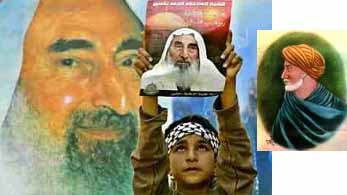
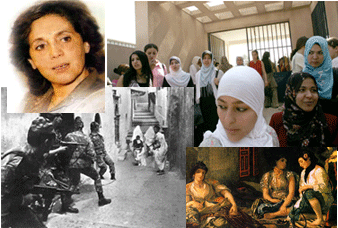
[left to right: Djamila Bourhiredf; Women waiting for bus at University of Algiers, photo by Shawn Baldwin for The New York Times; scene from “The Battle of Algiers”; “Algerian Women in Their Apartments” by Eugene Delacroix, 1834

One of the lead articles in yesterday’s New York Times was titled “A Quiet Revolution in Algeria: Gains by Women” by Michael Slackman. Revolutions, no matter where they erupt, tend to be noisy, even when they are not successful. The French stormed the Bastille; America had its Boston Tea Party; the Russians knocked off the Czar and his family. The Algerian Revolution, which took eight years from 1954-1962, claimed an estimated one to one-and-a-half million lives, not to mention the French military casualties of some 18,000. In the past decade or so more than 100,000 Algerians have died as a direct result of partisan extremist religious fighting. So if Algeria is now having a quiet revolution, where did all the noise go? Continue reading A Quiet Revolution in Algeria?

The Reach of War


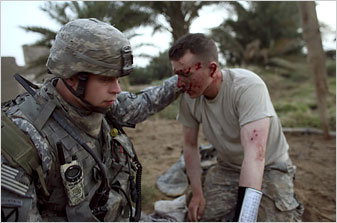
[Photograph by Michael Kamber for the New York Times.]

While the news media feed on the battle between congressional democrats and the Bush administration over the war budget, the war continues day by day with no congressionally prodded end in sight. The war in Iraq also dominates the field of political play for the next presidential election, with Bill Richardson declaring his candidancy yesterday and in no uncertain terms blasting the current war policy. But in all of this the war does not really reach us. Yet it is possible to reach out and feel some of the pain of the war. In today’s online New York Times, Michael Kamber, a photographer, provides a slide show of an attack on an army unit in which an American soldier was killed. I suggest you ignore the talking heads of politicians today and see for yourself the agony of loss on a battlefield with no visible enemy. Don’t wait to see the name in the paper; absorb the context that took a life needlessly to satiate the ideological appetite of the current lame duck (pun intended) administration.

Daniel Martin Varisco

A Voice in the Wilderness that is Gaza


[Illustration: Khalil Yaziji found two bodies outside his shop, al-Jazeera.]

So what is today’s top story of violence in the Middle East? Take your pick: the Lebanese army vs. Fatah al-Islam in the camps of Tripoli, a Taliban-ignited bomb exploding in a market and killing civilians in Afghanistan, an assassination attempt on the mayor of Mogadishu, six U.S. soldiers and an interpretor killed in Diwaniya in southern Iraq, more deaths in Gaza. Reading the news (I almost made the anachronistic slip of “picking up” a newspaper) today is a time warp back to the revelationary isle John of Patmos and his prophetic vials of plagues. I am not referring to an incendiary end of the world scenario spun by the late Jerry Falwell (may he rest in Baptist solitude), but the continuing hell on earth. If you think this is about religion (or democracy), think again. Remove the politics (and American involvement or influence) from each of the stories above and the religion is reduced to a drizzle.

So here is my pick of the day, one from the little guy. Al-Jazeera, which has the resources and access that Western journalists can only dream about, published a piece by reporter Laila Haddad, who interviewed a variety of ordinary Palestinians living through the nightmare of Gaza these days. It is worthwhile looking at the violence from the ground-up, a welcome break from the bird’s-dropping view usually spun in the media. Here is what Khalil Yaziji, 26 years old, a shopkeeper and banker thinks of his present and future: Continue reading A Voice in the Wilderness that is Gaza

Hamas and Ibn Khaldun: Going for the Cycle?

I am not an expert on the Palestine issue, nor am I trained to think in the apocalyptic terms sometimes engaged by pundits who forget that political science is more often an art or even impure fiction than a replicable analytical technique. But the ongoing in-fighting between Hamas (the neo-bad guys) and Fatah (the paleo-bad guys) is too intriguing to pass up. Today’s BBC News has a comparison of the two parties, following the resignation of the interior minister. Much of the speculation in the media is about tactics: Will Hamas ever give up support of violent acts against Israelis? Will Israel stubbornly refuse to negotiate with a group it would rather see fade into oblivion? Will the United States promote this democratic experiment as a bridge or a barrier on the so-called road map to peace? In all this I cannot help but think about what the famous 14th century North African savant Ibn Khaldun would have said if he could be interviewed from the grave for the New Tunis Times. It might go something like this… Continue reading Hamas and Ibn Khaldun: Going for the Cycle?

Faces of the Fallen

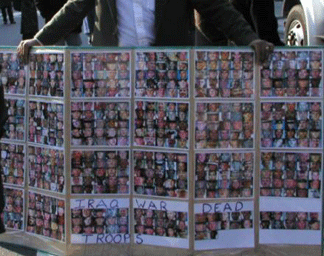
While Congress debates target dates for withdrawal and President Bush wields his veto bravado, the casualties from a no-longer-admired, quagmired war in Iraq continue to mount. For Operation Iraqi Freedom 3,345 American military personnel have lost their lives; for Operation Enduring Freedom in Afghanistan the number is a far more modest 381, yielding a total of 3,726 total fatalities overall. Then there are the Iraqi civilians and insurgents who have died, usually in bloody and terror-damned ways, reaching between 63,000 and 69,000 according to Iraq Body Count, but with estimates well above 100,000. Figures for Afghanistan are harder to come by. The initial bombing campaign four years ago took an estimated 3000-3400 civilian lives, with more every passing year. The sheer numbers, although not catastrophic when compared to big bloody wars of the past, are still numbing. But listing names is the easy way out; looking at the faces of the fallen takes more courage. Continue reading Faces of the Fallen

Letters of an Egyptian Kafir


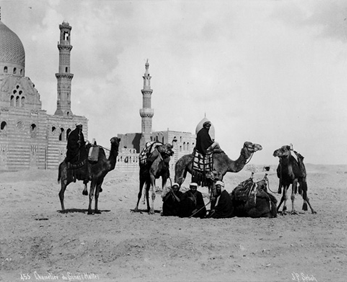
[Illustration: “Camels and Tombs of the Mamelukes” ca 1870]

While conducting research in Oxford’s Bodleian Library two summers ago, I came across an anonymous work entitled Letters of an Egyptian Kafir on a Visit to England in Search of a Religion, enforcing some neglected views regarding the duty of theological inquiry, and the morality of human interference with it. Published in London in 1839, the plot of the lengthily titled treatise is a series of letters allegedly written by a non-Muslim Egyptian to a Muslim friend back home. I rather suspect these were penned in a learned vicar’s study as an attempt to rationalize the superiority of Protestant Christianity over all comers. There is little to be learned about Egypt and much about the arguments Christians might use at the time to convert these descendants of the pharaohs. Continue reading Letters of an Egyptian Kafir

Divide and Think You Conquer

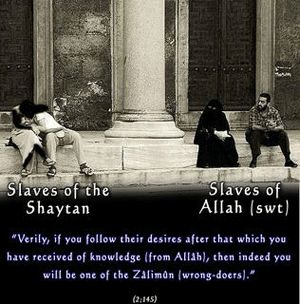
The distinction between sunni and shi’a in Islam has both political and doctrinal issues at stake. In a political sense, the original causes are moot. There is no caliphate today, no unbroken record of temporal earthly dominion for successors of Muhammad in the Islamic ummah. In the older sense to identify on a macro-level as sunni or shi’a follows differences in interpretation of the Quran, statements of the Prophet Muhammad, and the continuing role of descendants in the Prophet’s family from ‘Ali. The actual divergences over mostly issues of Islamic law, apart from succession of the Prophet. These are as varied in the sunni schools as they are between sunni and the various shi’a views. Much of the disagreement can be explained on cultural terms as Muslim communities have evolved almost fromt he start outside of the Arabian heartland.

But for anyone interested in disrupting unity or political reconciliation, the embedded historical grievances between sunni and shi’a can be resurrected in a flash. Consider the power-scarred sectarian wedge in the current security chaos of Iraq, where Saddam’s secular Ba’th party had mitigated religious identity politics for several decades. Those in the West who hate Islam, who may even view it as a Satanic plot out to destroy Jews or Christians, must be smiling broadly every time Muslims kill each other, bomb each other’s mosques and treat each other as worse than the “other” infidels. Continue reading Divide and Think You Conquer

May Day, May Day

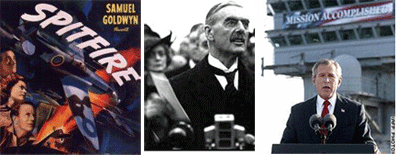
“May day, may day.” You can take this in two ways. First, this is the day in which many working people in the world celebrate being workers. This is not the way it will be commemorated on the front lawn of the White House today. Then there is the military version of a Spitfire on fire and a pilot knowing it is time to bail out. The pilot currently occupying the White House is wielding his veto power today in order to stay the course. Since he is not yet convicted that the war is lost, he sees no need to bail out.

But let’s flash back four years to the banner day “Mission Accomplished” speech of a boastful George Bush on the deck of USS Abraham Lincoln. Continue reading May Day, May Day