All posts by dvarisco

Innocent with no chance to be proven guilty


Khaled El-Masri with two of his children

Perhaps it is time to stop asking “Why do they hate us?” and consider “why do we hate ourselves?” America does stand for something, as it has for generations of immigrants (including my grandfather from Sicily and my wife from Lebanon). That something, enshrined in our sacred documents promoting liberty and justice for all, is a much-needed system of checks and balances to keep any particular part of our governing system from monopolizing its power at the expense of the citizens. If, as President Bush insists, they hate us because we have liberty, then the decision Tuesday by the Supreme Court not to hear the case of Khaled al-Masri must be good news. We no longer have liberty, so “they” should have nothing to hate. Let’s declare an end to the War of Terrorism, keep our shoes on the next time we board a flight, and take all those with the suspicious name of Muhammad or Ali off the Homeland Security list of the unwanted.

The editorial in today’s New York Times cuts through the liberal vs. conservative crap shoot of opinion mongering to a sober assessment of the case in question. Take a look for yourself, before I comment further. Continue reading Innocent with no chance to be proven guilty
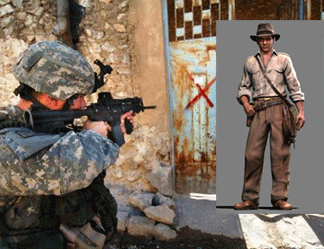

Anthropo covertus: A Disputed Species

Get ready for a shock. Anthropology (the best kept discipline secret in American academics) made the front page of today’s New York Times. And, believe it or not in the Ripley tradition, it was not about finding the “missing link” or “Noah’s ark”. In a report filed by David Rohde and entitled “Army Enlists Anthropologists in War Zones,” the focus is on the Pentagon’s newly instituted “Human Terrain Teams,” a kind of social science intellectual swat team approach, in which the military uses experts on the local culture. In a video on the website, an American officer explains that his soldiers no longer routinely break down doors of houses and violate the cultural space of Afghan homes, but let their Afghan counterparts knock first while they wait respectfully outside. While I am not sure it takes an anthropologist to point out what should be obvious through simple experimentation, the basic argument of the article is that the military is being coached to listen and work with the local population rather than play knee-jerk mercenary search and destroy games.

It is hard to argue with the sentiment that talking and negotiating are better ways to accomplish a proposed peace-building mission than assuming everybody in sight is a terrorist or is hiding one. So anthropologists, especially recent graduates who have a hard time finding jobs, should be pleased that supply actually might be influenced by a newfound demand for their services. Take Marcus B. Griffin, for example, an embedded anthropologist in Iraq who has a blog discussing his work. Continue reading Anthropo covertus: A Disputed Species

Tenure Crashers Gone Wrong

In a previous post I commented on the media-made controversy over the tenure case of anthropologist Nadia Abu El-Haj at Barnard College. In noting a pingback to my post on another blog, I discovered that those who would try to interrupt the tenure process at Barnard have gone even further into the wrong territory. The “Deny Abu El Haj Tenure Committee” has created a website using Prof. Abu El-Haj’s name (http://www.nadiaabuelhaj.com/) in order to attack her. The url has even been copyrighted. For a group that claims to be interested in restoring “honor” to Barnard, it appears any means justifies their tenure crashing end. I am not a lawyer (as my salary would well document), but this site seems a prime case for a libel suit. How can a group copyright a person’s name for a website and use that to attack? Forget the bulldozer, this is what the bull drops on the ground and it sure doesn’t smell like a fact.

Daniel Martin Varisco

Sociology or Anthropology? What’s the Difference?

Note: The following is an excerpt from my Islam Obscured (New York: Palgrave, 2005, 137-138). I invite comments from both sociologists and anthropologists to help bridge the disciplinal gap in our joint interest and intellectual history over the Middle East.]

What is the difference between the anthropology of Islam and the sociology of Islam?

It is the character of lived experience I want to explore, not the nature of man. Michael Jackson (the ethnographer)

Whether or not an approach to religion is anthropological or sociological is a bit of a red herring. To a certain extent the answer is as trite as the discipline in which a researcher has been trained. But the interchange of labels is too rampant to be dismissed as simple cross-border interchange. Consider that French scholar Jean-Pierre Digard provides “perspectives anthropologiques” in a French journal of “sociologie,” while calling what he does “ethnologie.” In France Jacques Berque and Pierre Bourdieu teach “sociologie.” In Britain a number of social anthropologists regard what they do as a type of sociology, a notable example being Ernest Gellner. Since Gellner was trained as a philosopher and harbored lifelong suspicions of any notion that could be called Wittgensteinian, I suppose one category is as good for him as another. American academics are generally more disciplined. Clifford Geertz is an unabashed anthropologist, although he relies to a great extent on sociologists like Weber and Parsons. Even in formal ethnographies, the bread and butter of anthropological communication, the distinction can be fuzzy. Dale Eickelman, who conducted an ethnographic study of a pilgrimage center in Boujad, Morocco, identified his primary goal as making “sociological sense.” Given that most readers have a relatively clear idea of what sociology is about but little knowledge of what anthropologists do, the word choice may in fact be pragmatic rather than programmatic. Continue reading Sociology or Anthropology? What’s the Difference?

The Immovable East


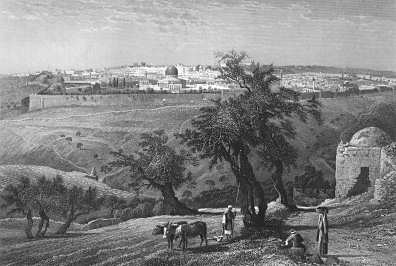
Jerusalem from the Mount of Olives

It is easy to dismiss past travel writing about the “Orient” as mere “Orientalism,” the kind that Edward Said disparaged as a style for dominating the supposed “Oriental” other. But viewing such texts through a politicized post-colonial lens thus becomes a kind of scorched-earth form of literary criticism. True enough, there are many narratives, especially by Christian writers, that approach the physical ‘Holy Land’ with a schizophrenic ax to grind: an over-appreciation of the biblical character of the land coupled to an under-valuing of the people who lived in the land at the time. But occasionally there are texts that dig beneath the surface if the reader has the patience to read beyond the surface rhetoric. One of these is a delightful first-person narrative by Philip J. Baldensperger, published in 1913 about experiences in Palestine during the last half of the 19th century. Continue reading The Immovable East

Blackwater vs. Backwater

“All the News That’s fit to Print.” This is the masthead mantra of The New York Times, one of America’s most important and best funded newspapers. For college professors like myself, it is the paper of choice, if it must be a paper. Long Island’s Newsday is local and closer to Little League than Big League for this Yankees fan; as a periodical Newsday is a great source for buying used cars and finding the nearest cinema. I avoid The Post, except to fill in the chortle gap now left by the demise of once super-marketed Weekly Wierdo News (or whatever…). I also listen to PBS, which all things considered actually tries to grapple with issues rather than just sensationalize how far a baby can fall from a window and still survive. But, my comments today are not really about a particular news outlet. Liberal or conservative is not the issue; a gut reading reaction is. I start with the premise that news media are all in the same boat, sinking in cyberspace apart from the Times Elite crowd and its pay-for-view ilk, which is steaming over an ocean of ignorance on one fuel: profit. It may still be possible to try to limit news items to what is “fit to print”, but most of us have a fit with a lot of what does get printed across the spectrum of right, left, up and down.

It is the choice of fit in today’s NYT that I noticed. Continue reading Blackwater vs. Backwater

Fear of Mosques

On Thursday Newsday (p. 2) published the latest in the loose-neocon-cannon-fodder remarks of Rep. Peter King, from Seaford, Long Island, New York. He remarked on a blogged video (politico.com) that there are “too many mosques in this country, there’s too many people who are sympathetic to radical Islam.” Before I read this in the morning, I had just returned from teaching a class on the Peoples of the Middle East when I found a request to discuss Rep. King’s comments with New York’s Eyewitness News Channel 7. The reporter arrived in less than an hour and I provided the context on why Muslims, especially on Long Island, take offense at these kinds of remarks. About 10 seconds of my commentary (although not the part directly relevant) made the evening news. Later in the afternoon I was contacted by a New York Times reporter who was following the same story. My comments to him did not make the brief “Metro Note” on King in today’s edition. With the daily rags telling Ahmadinejad to “Drop Dead” for daring to ask to lay a wreathe at the 9/11 site and Rudy vaunting that he would set Iran back “five or 10 years” if they dare develop nukes, the King’s comments seem to be but an echo of the more newsworthy Islamophobia on display. Continue reading Fear of Mosques

Lebanon is Laid Waste

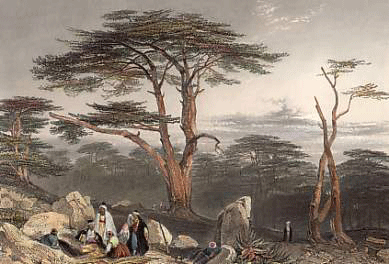
[The Cedars of Lebanon, steel engraving by J. D. Harding after C. Barry, 1835]

Lebanon is laid waste.
I need no bible-toting prophet to remind me
that someone’s long silent God gave the order
to saw through the last cedars.

The litany of woes crosses the Litani
but no bridge is left behind to burn,
just the kindling of ersatz-born leaflets that first say “Flee”
then demand “Stop,”
but really mean “Do not breathe, we own the air.” Continue reading Lebanon is Laid Waste