All posts by dvarisco

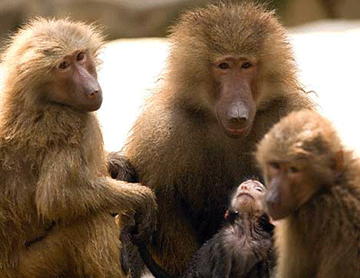
Observations on the Baboons in the Garden of the “Bostan” Restaurant (1)

Observations on the Baboons in the Garden of the “Bostan” Restaurant (Part One)

[Note: These observations were first published in 1991 in Yemen Update and are archived online. The “Boston” has long since disappeared, but memories live on.]

It was a bright and breezy Friday afternoon in Sanaa. Having only recently arrived to the Sheba Hotel, I decided to forego experiencing the haute cuisine available in my room or at poolside for a Lebanese repast at the “Bostan Restaurant”. This Levantine oasis in Yemen is located only a stone’s throw away from the great wall of the Chinese Embassy on the road that parallels Zubeiri Street. On the sign outside you are welcomed to the “Bostan Tourism Restaurant”, although the astute diner will note that on the menu cover this metamorphoses into “Boustan”. (Perhaps the menu cover was printed in Paris? The French seem to love adding the letter “u” to words that can be perfectly well pronounced without: when I see “Bilquis” my tongue utterly fails). Continue reading Observations on the Baboons in the Garden of the “Bostan” Restaurant (1)
Truth, Troops, Tooth and Clausewitz


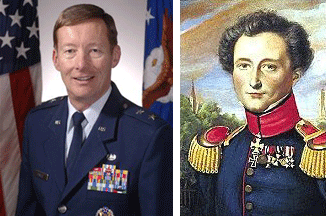
Maj. Gen. Charles J. Dunlap Jr., left; General Carl von Clausewitz, right

The surge to victory for John McCain in yesterday’s New Hampshire primary is attributed by Senator McCain to his telling the truth on a statewide bus tour. Truth and politics are seldom embedded fellows, so surely there is more at stake. It may be that the seeming success of the “surge” of U.S. troops combined with McCain’s last ditch, Chuck Norris tactic of shouting that he will get Osama on Day One in the White House was a factor in rousing New England independents to brave the snowbanks. Less American soldiers are reported dead in the daily papers, the suicide bombings in Baghdad are claiming less lives, and the economy looms larger in voter minds in the current trillion-dollar-deficit-spent free fall. The Democrats, on the other partisan hand, dismiss the Bush/McCain surge as the kind of military victory that can not win the diplomatic war in the end. Most of us would like to find some kind of truth in all the spin, but the super-media-charged primary machine surges on with truth as the main casualty.

So what do the generals say we should do? Today’s New York Times carries an op-ed commentary by Charles J. Dunlap Jr., an Air Force major general, who is about to publish a monograph called Shortchanging the Joint Fight?. In the general’s gung-ho “We Still Need the Big Guns,” he writes tooth and Clausewitz that effective counter insurgency in Iraq and future conflicts still needs to be measured in dead insurgent bodies. As he states:

Many analysts understandably attribute the success to our troops’ following the dictums of the Army’s lauded new counterinsurgency manual. While the manual is a vast improvement over its predecessors, it would be a huge mistake to take it as proof — as some in the press, academia and independent policy organizations have — that victory over insurgents is achievable by anything other than traditional military force.

Unfortunately, starry-eyed enthusiasts have misread the manual to say that defeating an insurgency is all about winning hearts and minds with teams of anthropologists, propagandists and civil-affairs officers armed with democracy-in-a-box kits and volleyball nets. They dismiss as passé killing or capturing insurgents. Continue reading Truth, Troops, Tooth and Clausewitz

Apostasy in Islam

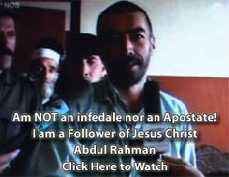
In the furor throughout the Islamic world over the publication of negative caricatures of the Prophet Muhammad in Danish newspapers, and more recently giving the name Muhammad to a teddy bear, the earlier anger about author Salman Rushdie’s Satanic Verses was rekindled. The critical difference, of course, is that Rushdie was condemned not only for blaspheming the Prophet but for leaving Islam as the faith he was born into. This issue of apostasy — leaving Islam — resurfaced a year ago in the case of an Afghan man named Abdul Rahman, who proudly claimed he had converted to Christianity. Several Islamic nations, including Afghanistan regard apostasy as a crime and impose the death penalty for this.

The issue seems to be simple; it is egregious to any modern notion of human rights and Islamophobes are quick to dredge up a long history of Islamic legal rulings that legitimize such a death penalty. In point of fact no contemporary Islamic nation state follows all the ascribed shari’a penalties to the letter of the law. Even when constitutions state that the laws are based on the shari’a, it is the state itself which takes over many of the functions once given to Islamic judges. What might have worked (and we know that laws were always unevenly applied) at some point in the caliphate is not working today. Continue reading Apostasy in Islam

You’ve Gotta Be Al-Qaiding Me

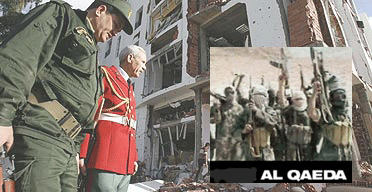
Pick up your morning newspaper or log on to an online news source and chances are there will be reports of suicide bombings somewhere in the Middle East (or Sri Lanka). The latest example, reported only a few hours ago, is from Algeria, as published in The Guardian:

At least 47 people, including a member of UN staff, were killed in two car bomb attacks in the Algerian capital today.

A car packed with explosives rammed into the offices of the UN’s refugee agency (UNHCR) in Algiers, and another was detonated outside the constitutional court.

Official estimates put the death toll at 47, but the BBC reported that the figure was over 60. A further 43 people have been injured.

The US president, George Bush, condemned the attacks as “senseless act of violence”.

The two car bombs, in upmarket areas of the capital, happened 10 minutes apart.

The first car bomb was driven into the constitutional court building in the Ben Aknoun district, killing at least 30 people. The official Algerian news agency reported that several of the victims were students who had been travelling on a school bus.

Ten minutes later, the second car bomb was driven into the UNHCR, in the Hydra district, killing at least 15.

Farhan Haq, a UN spokesman, said the member of staff who died had been working in the office of the UN development programme, which is across the road from the UNHCR building and was also damaged in the blast.

More of the same, you might think. The story could as easily have been about Iraq or Afghanistan or Israel or fill in the increasing number of blanks. So why is all this happening, as if the pragmatic reasons are not painfully obvious? More of the same again. The media, echoing the Bush administration, has a suspect. Continue reading You’ve Gotta Be Al-Qaiding Me

Where are the Moderates?


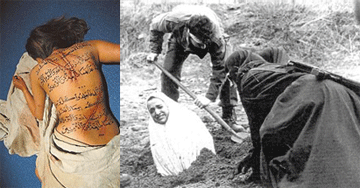
[Illustration: Ayaan Hirsi in the Theo Van Goghin film, left;alleged preparation of woman for stoning, right.]

In a New York Times op-ed published yesterday by Ayaan Hirsi Ali, a controversial Dutch Somali, a relevant and timely question is asked: Where are Muslim moderates when misogynist renderings of Islam sweep the media? She has a point in noting the relative absence of condemnation of three recent tabloid news items. There is the Shi’a woman in Qatif, raped by several Shi’a men, and herself branded (to the barbaric tune of 200 lashes) guilty by a Sunni Wahhabi court for “mingling” with a man not her husband. Then the hug-my-teddy-bear-but-don’t-mention the-prophet’s-name fiasco over a naive British teacher in Sudan, and finally the case of Taslima Nasreen, a Bangladeshi writer vilified for her feminist writings that approach the controversial barzakh of Rushdie’s Satanic Verses. So where are the moderates? For Ms. Ali they are phantom progressives, too blinded by their loyalty to the faith and fearful of telling truth to Muslim power. Here is her assessment:

It is often said that Islam has been “hijacked” by a small extremist group of radical fundamentalists. The vast majority of Muslims are said to be moderates. Continue reading Where are the Moderates?

A Man, A Sign, a War

Yesterday afternoon on a crowded Connecticut Avenue roundabout in our nation’s capital, Washington, D. C., a man stood holding a sign. The sign read “Bring our Troops Home” on one side and “End the War” on the other. He was not simply holding the sign, but slowly twirling it back and forth so both messages came across. I would guess his age was late 50s or early 60s and he was well-dressed, a man who would fit comfortably on Wall Street. He was not your stereotypical t-shirt labeled liberal icon, so who was he and why was he standing there? I will never know. My 30 seconds of peripheral vision, waiting for the traffic to clear, allowed only a glance. But today when I close my eyes I see him standing there. Continue reading A Man, A Sign, a War

Déjà Voodoo

Consider the opening line of the lead story in yesterday’s New York Times:

BAGHDAD — Saudi Arabia and Libya, both considered allies by the United States in its fight against terrorism, were the source of about 60 percent of the foreign fighters who came to Iraq in the past year to serve as suicide bombers or to facilitate other attacks, according to senior American military officials.

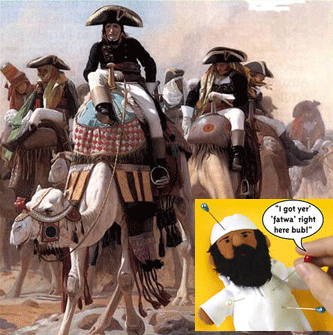
In the long durée, as Napoleon might say if he were alive today, politics makes strange embedded fellows of nation states. There are three nations at play here in the field of lording over by the world’s reigning super power. Iraq and Libya had European imposed (and later revolution-deposed) monarchs at mid-stream in the 20th century. At the same time Saudi Arabia’s royal line evolved an iconclastic religiously mandated kingship that has withstood toppling and seems likely to do so far into the security based future. All three states are where they are today largely because of the world’s thirst for crude oil. The same three states, should Iraq survive de facto federation, face a future defined by a mega-politicized war on terrorism, a war with no state-like enemies being fought by a coalition of nation states willing to arm themselves to the teeth with conventional weapons and make airline passengers take their shoes off each and every time they fly. Two centuries from now a future Napoleon, whatever his or her nationality, may look back on the current political climate and have a hindsight sense of déjà vu, or will it be more of the voodoo politics mass mediated today? Continue reading Déjà Voodoo

What Makes a A Muslim Laugh?

Today’s BBC News has a story with the headline “Does Islam have a sense of humour?” This is the kind of question that makes me want to cry. “Islam”, like any religion, will “have” whatever people read into it. For a Christian or Hindu apologist just about everything that Muslims do is “funny” in the sense of being different and looked down upon, although it is not funny to non-Muslim fundamentalists when Muslims practice their faith in ways that are dismissed as violent or antagonistic. Muslims do not generally take their own faith as a joke, unless they are in the Enlightenment-mentored mode of rationalizing away whatever fixed dogma demands about the power of Allah. Islam is not inherently funny, especially to those who practice it, but neither is it opposed to laughter. Humor is a pan-human trait and it is highly contextual. Yes, there are Muslims who have a sense of humor and those who do not. In the real world how could it be otherwise?

The article’s hook-line teaser notes: “Muslims are often depicted as people who can’t take a joke. But as a stand-up comedy tour showcasing Islamic talent arrives in the UK, is that fair?” There is something quite different about looking for a sense of humor in an entire religious tradition compared to observing what individual Muslims do. Continue reading What Makes a A Muslim Laugh?