All posts by dvarisco

If Lincoln Had Seen Aladdin


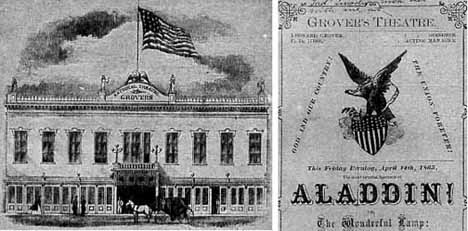
Grover’s Theater, Washington D.C.

April 14, 1865. For Americans, at least above the Mason Dixon line, this is one of those dates that live in infamy. John Wilkes Booth, a rather bad actor on the stage, shot President Abraham Lincoln at Ford’s Theatre. According to an account by Mrs. Helen Palmes Moss in The Century Illustrated Monthly Magazine for 1909, Lincoln had the option of going to a rival theatre, the National or Grover’s, that night where a private box had been prepared for him by Mr. C. D. Hess, the co-manager. Apparently Booth had planned to attempt the assassination at whichever theater Lincoln attended. He much preferred Ford’s, since he had no inside help at the National and would have to shoot Lincoln as he stepped out of the carriage. What does this fateful event have to do with the Middle East? If Lincoln had attended the National Theatre and J. Wilkes Booth had missed, the President would have seen a dramatization of the Arabian Nights tale “Aladdin.” Would that Lincoln had been more of an Orientalist… Continue reading If Lincoln Had Seen Aladdin

Hijab or Hellfire

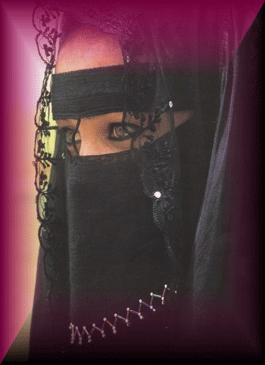
Having grown up in a fundamentalist Baptist church in which even bobbed hair was condemned by some as Satanic, I find it ironic that conservative Muslims resort to the image of the Shaytan to moderate the moral choice of Muslim women’s fashion. There is a slick “Garden of Eden” approach at play in a recent Youtube video featured on Mujahideen Ryder. Check it out.

As for that venal sin of bobbed hair, here is John R. Rice, the spiritual founder of Bob Jones University, holding forth like a salafi mullah:

Long hair, the glory of a woman

“Nevertheless neither is the man without the woman, neither the woman without the man, in the Lord. For as the woman is of the man, even so is the man also by the woman; but all things of God. Judge in yourselves: is it comely that a woman pray unto God uncovered? Doth not even nature itself teach you, that, if a man have long hair, it is a shame unto him? But if a woman have long hair, it is a glory to her: for her hair is given her for a covering.” (1 Cor. 11:11-15)

Let no woman be discouraged because God insists that she shall take a place of subjection and wear the mark of humility and femininity on her head. It is true that the man was created first and then woman created second as a helpmeet, as we were told in verses 8 and 9 above. But dear woman, be not grieved. Long hair is not a shameful mark. Rather, it is a mark of glory. God did not mean for the man to be without the woman (v. 11). Both are necessary. Each one is a complement for the other. Each is dependent upon the other. And God’s way is the fitting and beautiful and happy way. Continue reading Hijab or Hellfire

Who’s a Muslim Heretic?


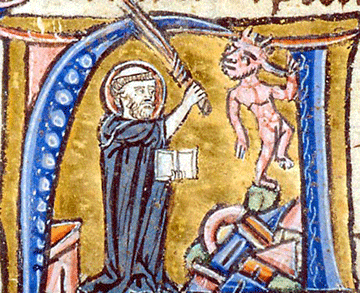
“Augustine of Hippo Refuting Heretic,” (Illuminated manuscript, thirteenth century, from Morgan Library, New York, M. 92, ©Morgan Library)

The history of Islam, like that of any religion, is littered with heretics. When you start with a divine revelation, revealed only in an Arabic dialect understandable to a seventh century illiterate Prophet alone in a cave with an archangel, add a cult of personality adoration for this Prophet and then acknowledge a cycle of violence and assassinations within the emerging Muslim community, heresy is inevitable. So who were the heretics over the fourteen centuries of the Islamic ummah? In a sense, everybody. Certainly every single sect calling itself Muslim has been attacked by some other sect. It is not just the majority Sunni vs. the marginalized Shi’a, nor the rational Mutazilites vs. the hardline literalists, nor the Arabs vs. the non-Arab converts, nor the trained clerics vs. the itinerant dervishes, nor simply the women-can’t drive Wahhabis of Saudi Arabia, the Buddha-bashing Taliban or those brave souls who pursue Queer Jihad. Simply put, the heretic is the person who does not take your truth as his or her own. Continue reading Who’s a Muslim Heretic?

Gangs of Thugs


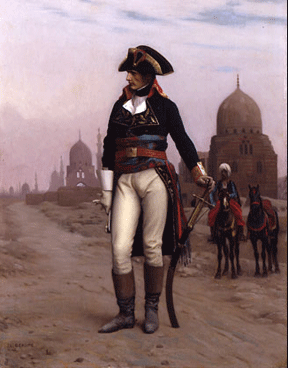
Painting by Jean-Léon Gérôme’s “Napoleon in Egypt,” 1867-68.

Please read the following quote:

“Gangs of thugs looting, as well as other hooligans, thieves, pickpockets, robbers, highwaymen, all having a field day. Relations between people ceased, and all dealings and business came to a standstill. The roads in the city became insecure, not to mention those outside it. Violence flared up in the countryside, and people began to kill each other. They stole cattle and plundered fields. They set fire to the barns and sought to avenge old hatreds and blood feuds, and so on.”

So who said this and what tragedy is being described? If you are thinking that this could be the post of an embedded journalist in Iraq or an Iraqi blogger looking out at the violence on the streets in the past couple of days, it would not be a surprise. Of course, this kind of atrocity-ridden rabble-ous melee has happened over and over again. When security goes down the tubes, violence almost always takes over. This is not because humans are evil by nature, but evil times draw out the worst in us all.

The excerpt above was written as an eye-witness account about events in Cairo in 1798. The author was ‘Abd al-Rahman al-Jabarti, an Islamic religious authority who wrote a chronicle of events about the invasion of Egypt by a Western power. Continue reading Gangs of Thugs

Opening the Quran


Note: The Qur’an can be divided into thirty equal parts. One part takes only twenty-four reading minutes, and the whole Book requires 12 reading hours. There are 114 chapters, and 6,236 Arabic verses (Abu ‘Amr Al-Dani in his book Al-Bayan), containing 77,439 Arabic words (reported by Al-Fadl bin Shadhan) made up of 371,180 Arabic letters (Abdullah b. Kathir reporting Mujahid, although there are different accounts). By contrast the King James Version of the Christian Bible (OT and NT) has 783,137 words and 3,566,480 letters. Muslims believe the Quran in Arabic is the actual Word of God given to Muhammad through a series of revelations from 610-632 C.E. and not written down as a “book” until after Muhammad died.

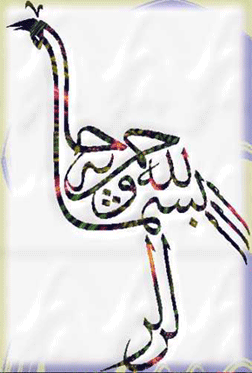
Given the general ignorance in American society of Islam, especially the theology based on the teachings in the Quran, it is important to go back to the beginning, the essence, the opening, the words that are by definition significant to all Muslims. This eloquent key is the opening (fatiha) of the text, a set of verses as repeated by Muslims daily as the Lord’s Prayer is by Christians. Continue reading Opening the Quran

So if it’s not about religion …

The War on Terror, upon which the GOP presidential candidates (minus libertarian Ron Paul) have been feasting, is promoted as a clash of civilizations masquerading as religions. In this pop culture scenario there is the secular West, which promises freedom of religion and only tolerates freedom from religion, vs. the fanatically religious non-West currently reduced to mad mullahs and Islamic Jihadists. We are told it is not about religion. That is true. It is, however, about religions. The West assumes it has tamed its religious impulse to crusade and colonize the Gospel to the ends of the commercially driven earth. Our religious wars are in the history books. Or are they?

Inquistors with holy orders have been replaced by mega-church preachers with rock-music intros. Witch trials have been overturned by a mentality that still thinks the 10 Commandments trump the U.S. Constitution. The United States is in legal theory not allowed by law to prohibit religious worship (although it did so against Native Americans). But America has only a veneer of secularism. Religious organizations no doubt take in more money than the IRS and not all that goes to charity. Much of this freedom of religion is an invitation to convert others or to promote outmoded notions such as biblical creation and Noah’s flood. The fact that half of the population in the U.S. still holds on to the myth of Adam and Eve as an explanation for human origins, despite the evidence from scientific research, says we are not yet free of irrational thinking.

Then there is “their” religions. Continue reading So if it’s not about religion …

The Problem with “Fundamentalism”

[This is an excerpt from my article, “The tragedy of a comic: fundamentalists crusading against fundamentalists,” published in Contemporary Islam (2007, Vol. 3, #1).]

The issue of religious fundamentalism has been raised both in the popular media and by academicians as one of the most critical global challenges to a smooth transition into the third millennium. The Y2K alarm over cyberspace as the clock turned over 2000 was only the Book of Revelation in digital imagination. Debating the death of God, especially in the halls of Academe, has had little impact on the perpetual panopticon of apocalyptic scenarios literally decoded out of the Bible. The Catholic church and mainline Protestant denominations have largely left behind the baggage of prophecy as contemporary politics, though in the past Christian clerics of all persuasions had no trouble conjuring enemies, including the Ottoman Turks, as anti-christened candidates. In Christianity biblical literalists today are often, and erroneously, dismissed in blanket condemnation as “Fundamentalists” because of what they reject rather than what they believe. The problem with being a “Bible believer” is that this implies rejecting rationalism, modern science and theological reform. The problem with being labeled a “Fundamentalist” is that most people fit into the category do not use or accept the term.

“Fundamentalism” as a term should be of interest to scholars who study the phenomenon not only because of what it is said to represent, but also because it is “our” term – a word coined almost a century ago within American Protestantism to define a self-proclaimed conservative religious movement contra a liberal shift in mainline denominations.(1) Continue reading The Problem with “Fundamentalism”

Muslims on the American Landscape

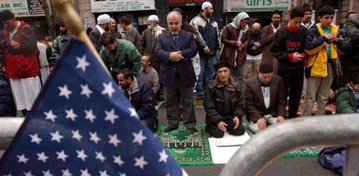
Yesterday the Pew Forum on Religion and Public Life issued a 143 page report, downloadable here, surveying the changing religious landscape of the United States. Based on interviews with some 35,000 individuals and drawing on earlier Pew research specifically on Muslims in America, this report is well worth reading. The findings are suggestive of the decline of strait-laced Puritan and venomous WASP America. Indeed, it seems that the United States is on the verge of losing its Christian Protestant edge, at least by direct affiliation. There has also been a dramatic decline in Catholicism, offset in large part by the fact that twice as many recent immigrants are Catholic rather than Protestant. One of the main findings is that Americans have taken on the habit of changing religions. “More than one-quarter of American adults (28%) have left the faith in which they were raised in favor of another religion – or no religion at all. If change in affiliation from one type of Protestantism to another is included, 44% of adults have either switched religious affiliation, moved from being unaffiliated with any religion to being affiliated with a particular faith, or dropped any connection to a specific religious tradition altogether,” conclude the authors. A full quarter of respondents between the ages of 18-20 are not affiliated with any organized religion. “Honk if you love Jesus” is being bumped off the sticker wars and overrun by “Our Father, who art in Walmart.”

To be sure, the Christian veneer of the United States will ensure “In God We Trust” on our mammon for some time to come. Over 78% of Americans self-identify as Christian, the largest block being the amorphous, and now apparently porous, Protestants and the politically courted Evangelicals constituting the largest Christian segment (26%), just a little larger than the total percentage of Catholics (24%). The 1.7 % of Americans who follow the Joseph Smith/Brigham Young (as opposed to the New Orleans) saints (that most people dub Mormons) accounts in part for the fact that Mitt Romney is not the Republican candidate this year. For a reality check on minority status, the same percentage (1.7) of Americans follow Judaism. Islam is way down the list at .06%, slightly less than the number of Buddhists (0.7%), but almost double the number of New Age enthusiasts at .04 %). Please keep in mind that these figures only refer to “adults” of the age of 18 and over. Since so many Muslims are young, there are in fact many more Muslims overall (as there are many more Christians) than this figure suggests. Continue reading Muslims on the American Landscape