All posts by dvarisco

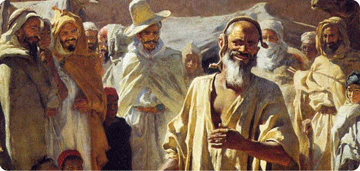
Flipping through Yemen a Millennium Ago


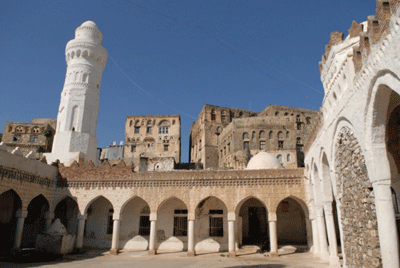
Mosque in Jiblah, Yemen

There was a time when books were hard to come by. Either they cost too much or were inaccessible in a private or exclusive university library. Whatever else the world wide web has done (and that is a mouthful), it now functions as an archive. More and more, the rare and out-of-print books I used to be forced to read in a library reading room are becoming available online. Mr. Gutenberg might roll over in his Grab at the very thought of a pdf file, but print has taken a new and universal turn. I especially enjoy the “flipbook”, which simulates turning the pages of images of the original. For an enjoyable read on the early history of Yemen, there is the flipbook version of Henry Cassels Kay’s translation called YAMAN, ITS EARLY MEDIAEVAL HISTORY, published in London in 1892. This has excerpts (not always trustworthy in their translation) from Umarah ibn Ali al-Hakami (1120/21-1174), Ibn Khaldun (1332-1406); Muhammad ibn Yaqub al-Janadi (d. 1332?).

The sad thing is that well over a century ago, Kay lamented that there was virtually nothing available on the history of Yemen, which had become of strategic interest to the British empire. Continue reading Flipping through Yemen a Millennium Ago

When the Fat Lady Sings

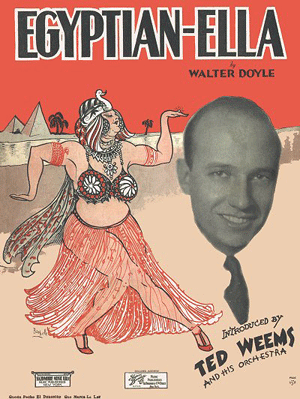
For those fortunate enough to own a MAC computer there is the digital blessing of ITunes. One of the stations listed under “Eclectic” is “The 1920’s Radio Network” which features jazz and vaudeville songs from the 20s through the 40s. Every once in awhile along comes one of those “Oriental” tunes, usually riding stereotypes into the desert on a sand-blasted camel of Araby. One I recently heard manages to offend both Egyptians and obese women (not to mention any serious poet). This is Egyptian Ella, not to be confused with Ella Fitzgerald, who did not debut until four years after this tune was written by Walter Doyle and popularized by Ted Weems and his orchestra.

Egyptian Ella

by Walter Doyle

Ella was a dancing girl who started getting fat
Every day saw three more pounds on Ella
Until one day she found she’d lost her job because of that
And to make it worse, she’d lost her fella
She took a trip to Egypt to forget
And she made such a hit that she’s there yet … Continue reading When the Fat Lady Sings

Guns and Bibles


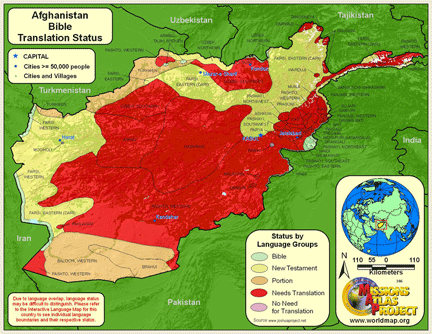
Bible Translation map for Afghanistan from Mission Atlas Project

So much for the secular state. When the founding fathers envisioned the transformation of the thirteen original colonies into the United States of America, the explosive baggage of a state religion was wisely foregone. Contemporary Fundamentalist preachers may bemoan the historical fact, but we do not live in a “Christian” nation. Other states have chosen to maintain a formal religious identity, with varying levels of tolerance for those who are not in the majority. Take Afghanistan, for example. Indeed, the Bush administration did just that, or at least did so partially. Although the Taliban were sent packing into the hills, much to the dismay of Pakistanis who value sovereignty in Swat, Afghanistan is still a solidly Muslim country. The American military is present in Afghanistan in order to ensure security and protect the development agenda. Obviously this takes guns. But the latest addition to the peace-on-earth-keeping mission arsenal appears to be Biblical.

A report on al-Jazeera reveals that an American military chaplain is exhorting evangelical men in the ranks to tote more than their rifles. “The Special Forces guys, they hunt men. Basically, we do the same things as Christians. We hunt people for Jesus. We do, we hunt them down. Get the hound of heaven after them, so we get them into the Kingdom. That’s what we do, that’s our business,” he said. Continue reading Guns and Bibles

Tea Party A[O]bom[a]inations


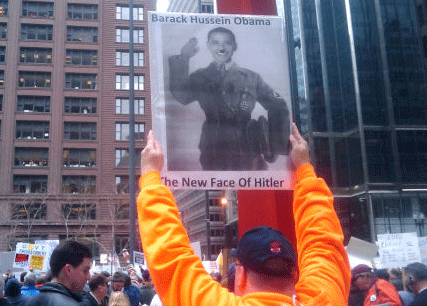
Sign at a tea party tax protest earlier this week in Arizona

In the 1770s the beer and coffee drinking crowds of revolutionaries in Boston heaved sacks of British tainted tea into the deep. Since American colonists were never that fond of tea, the symbolism was not very taxing. “No taxation without representation” was the rallying cry. Earlier this week, encouraged by the right-wing media pundits on Fox News and the radio rush of vitriol, a slight rage [the oxymoron here is intentional] of tea bagging took place. Apparently the government that poured millions and millions of dollars into an unnecessary war in Iraq and lined the pockets of Wall Street executives through deregulation was doing its job when it was Republican in name. But tea is the wrong drink to describe the protesters, few of whom were the two-martini lunch crowd. This was a shot of sour grapes straight up. Continue reading Tea Party A[O]bom[a]inations

Islamophobia and MisIslamothropes


Geert Wilders, the right-wing Dutch politician. Photograph: Jerry Lampen/Reuters

“Islamophobia” is a relatively new word, perhaps only from the late 1980s. What it signifies, however, dates back to the very beginning of the Islamic faith. Indeed, the initial response of the Meccan elite to the monotheistic preaching of Muhammad was so fearful of the economic fallout and political challenge of the message brought by this new prophet that the first Muslims were forced to flee to a safe haven in Madina. After Islam was established as a community and expanded, it came into conflict with the Christian enclaves in Syria and Egypt, as well as the Sassanian Persian empire to the east. By the time Muslims had briefly made forays into southern France in the 9th century, the Venerable Bede villified them as a “very sore plague.” Whether seen as Arabs, Moors or Turks, the many ethnicities represented by the growing religion understandably struck fear among those who saw the faith as a political or religious threat.

Fear is understandable; anything new is prone to be misunderstood, especially when the issue is about how to believe in God. Christians and Jews came to fear Islam because it was a rival, one with powerful political muscle through the 16th century. Fear, however, is not the problem. The major stumbling block for peaceful coexistence between rival faiths or ideologies of any kind is hatred. Continue reading Islamophobia and MisIslamothropes

Reading Orientalism on Rorotoko

Rorotoko? Yes, Rorotoko. Forget about the name, but enjoy a relatively new website which allows authors to describe their books. As the site suggests:

• Rorotoko is an online venue for engaging the ideas and elaborations serious books are made of.
• Rorotoko is exclusive authors’ interviews on some of the most fascinating books coming out of some of the finest nonfiction and scholarly presses.
• But Rorotoko is not about books, it is about what books are about.

The April 3 edition of Rorotoko features an article I wrote about my Reading Orientalism: Said and the Unsaid, published by University of Washington Press in 2007.

Reading Orientalism is literally a re-reading of the late Edward Said’s Orientalism. Said’s powerful critique remains a milestone in the critical theory of academic bias three decades after its first publication. As the years go by, Orientalism survives more as an essential source to cite rather than a polemical text in need of thorough and open-minded reading. Read by academics as well as the general public in almost three dozen translations, Said’s text analyzes novels, travelogues and academic books to argue that a dominant imperialist discourse of West over East has underwritten virtually all past European and American representation of a so-called “Orient.” The debate over these views of Edward Said, a prominent intellectual of Palestinian heritage, continues unabated even after his passing in 2003. Continue reading Reading Orientalism on Rorotoko

April through March Fools

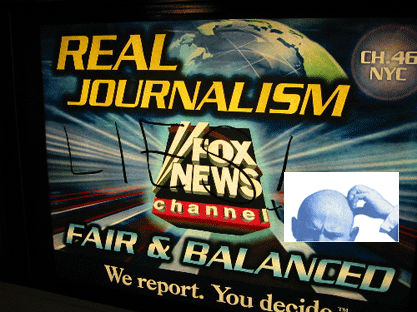
Most of us probably passed April Fools Day with only minor irritations. After all, fooling in jest is sort of fun. Then there are those fools who seem to operate 365 days a year and stream into our consciousness non stop. Take, for example (and it is a very foolish example that unfortunately fools quite a few people) Fox News Facts (and please forgive the oxymoron but remember the moron part). On April 1 anchoress Alisyn Camerota interviewed one Nonie Darwish about the appointment of Harold Koh, a former dean at Yale, to be the State Department legal advisor. The following is the transcript, and you can watch the video here.

ALISYN CAMEROTA (Fox anchor): The White House is defending its nominee to be State Department Legal Adviser. Now, some of the criticism of this nominee, Harold Koh, is based on remarks that he reportedly made saying that Islamic Sharia law should apply in U.S. courts, even though those laws are used in some countries to justify stripping women of basic rights and even worse, frankly. Continue reading April through March Fools

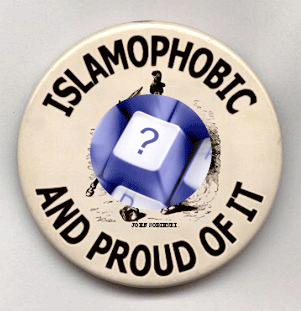
Islamophobia 101, A call to analyse

[Webshaykh’s Note: This is the start of a new blog thread dedicated to energizing scholarly and pedagogical attempts to combat, or at least mitigate, the ongoing volume of Islamophobia in the media, especially on the Internet. The question is simple: what can be done to respond to Islamophobia in the media by our efforts in the blogosphere, formal media outlets, classroom, community and scholarly forums? I invite fellow scholars, professors and teachers and anyone concerned with this issue to contribute to the discussion here at Tabsir.]

People of any particular religious faith are understandably offended when someone or something they hold to be sacred is dragged through the media-made mud of ridicule. There is no way to completely stop desecration, even when hate crime laws are in place. As long as there are synagogues with walls and anti-Semites with paint, swatstikas will be painted. As long as there are artists who stretch their creative energies to the limit of tolerance, animal dung will adorn the body of the Madonna. And as long as so many individuals in Western societies fear Islam through the veil of their own ignorance and historically constructed disdain, the Prophet Muhammad will be pictured as a profligate. The Danish cartoon controversy was only the tip of the iceberg, one that created a titanic rift in the Muslim community worldwide. The irony is that portraying Muhammad in any form is considered wrong in Islam, so that placing a stud missile in the turban of a caricatured Mahound (to drop a literary motif of the same controversial dimension) glosses over the level of misunderstanding motivating those who made and appreciated the cartoon images.

So what is the proper response to the volume of prophet bashing out there, not only in the case of Islam. Here are a few suggestions to jumpstart the process of analysis so that we as scholars can mitigate the paralysis created by an Islamophobia that is only a mouse click away.

• Identify resources (books, relevant articles, websites, speakers) which provide a scholarly and objective-as-possible perspective on Islamophobia
• Discuss the merits of whether or not to provide examples of Islamophobic writing, art and videos that are admittedly offensive to many Muslims
• Provide lesson and project ideas to encourage students to critically assess the Islamophobia in specific examples they are likely to find in the media and on the Internet
• Engage with fellow scholars and concerned Muslims about the most effective and least offensive ways to combat and mitigate Islamophobic writing and art
• Link examples of Islamophobia to other forms of verbal and artistic ridicule of sacred materials.
• Expose Islamophobic rhetoric by politicians, celebrities and other people in the news.

Having set out the goals, I invite colleagues contribute comments, commentaries and examples for and against Islamophobia for this series, please email the webshakh at daniel.m.varisco@hofstra.edu. I will post the first commentary tomorrow.

Daniel Martin Varisco