All posts by dvarisco

Smoke Rises in the Middle East


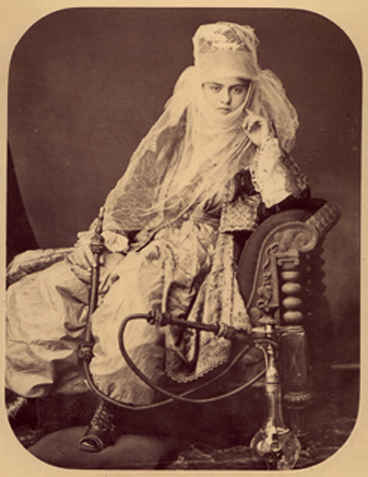
Hooked on Hookah, 1909

No, this is not another post about terrorism, nor the violent protests following the recent Iranian election, nor more reports of suicide bombs in hotel lobbies. The smoke from these tragedies is not about to disappear any time soon. The smoke I am talking about is from the tobacco industry. Newsweek (July 27 issue) provides a breakdown of smokers worldwide. While China leads all populations with almost 334 million smokers (32% of the overall population), they are actually lower percentage wise than Turkey with its 19 million users, accounting for 36% of the population. Other Middle Eastern countries surveyed fare a bit better than the United States (24% of the population) with 21% (28 million users) in Pakistan, 17.6% (9 million users) in Iran and only 14.2% (2.4 million users) in Iraq. I suspect even these numbers are under reported, given the ubiquity of cigarettes in the region. Health warnings or not, tobacco is still sultan in the Middle East and indeed the entire world. Continue reading Smoke Rises in the Middle East
The Fortress of Saone and Salah al-Din, 2


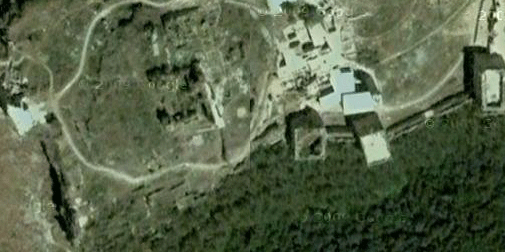
Figure 1: Google Earth map of the southern edge of the fortress area, with north to the top of the picture

[Note: This is the second in a series on a visit to the fortress castle known as Qa‘lat Salah-al-Din, near Lattakiya Syria. For the first, click here.]

Before continuing with my recollections of a tour of the castle fortress of Robert of Saone and Salah al-Din, it might be useful to take an aerial view. Thanks to Google Earth, you can get a bird’s eye view of the fortress, indicated in the above photo (Figure 1) only partially, but available with functions here.

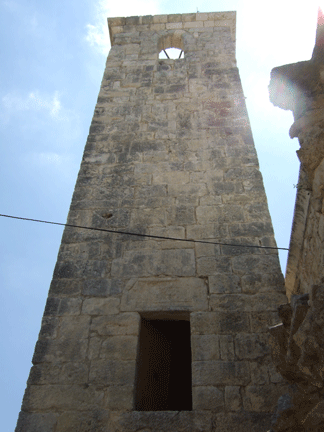
In the Google Earth image above, the formal entrance today is through the tower in the bottom center of the picture, with the mosque and madrasa to the north. The mosque and madrasa were reconstructed with support by the Aga Khan Trust for Culture in 2000. This involved a careful rebuilding of the minaret, which had partially collapsed (Figure 2).


Figure 2: Reconstructed Ayyubid minaret

Continue reading The Fortress of Saone and Salah al-Din, 2

Tracing the History of Qat


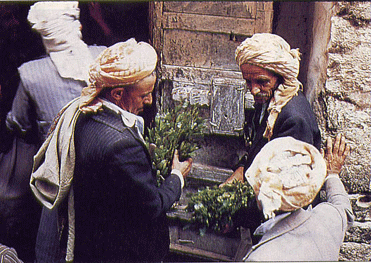
Selling qât in Yemen. Photo by Pascal Maréchaux

Much has been written, pro and con, about the chewing of qât leaves in Yemen. In addition to the economic and social problems over qat, there is a historical puzzle. When and how did the plant Catha edulis come from Ethiopia, its botanical origin, to Yemen? Yemeni legend and folkore suggest that the stimulant qualities of qat leaves were first discovered by a goatherd who noticed the effect on goats who browsed on the plant. A variant of this goat legend, told to me in 1979 by a poet from Husn al-‘Arus, suggests that an Ethiopian came along to explain to the goatherd what was happening. The goat is one of the few animals that can be seen occasionally eating qât leaves, but the story is surely apocryphal. Sometimes it is told for the origin of coffee, another stimulant brought from East Africa. Continue reading Tracing the History of Qat

The Fortress of Saone and Salah al-Din, 1


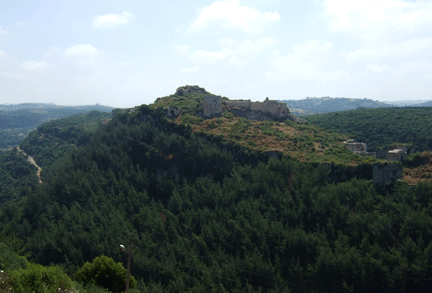
Figure 1: Looking northeast at the western town and central fortification of Qal‘at Salah al-Din

On my recent visit to Lattakiya, Syria, I was given a guided tour of a most extraordinary castle/fortress with visible Crusader and Mamluk ruins. This is the crusader castle named for Robert of Saone, who was given control of it by Roger, Prince of Antioch in 1119 CE. Located almost 30 km from Lattakiya, it was obviously a strategic asset for the Crusaders. But it appears Robert of Saone chose a bad architect for his expansion of the existing fortress. Instead of building up the Byzantine fortress at the high point, he built along the walls, so there was not a second site of defense once the walls were breached. He also failed to consider the range of mangolins, which Salah al-Din used effectively from the nearby ravines to breach the castle walls.

It is no wonder why this impressive location also appealed to defenders from the Phoenician period on. It is recorded that Alexander the Great conquered it, but only with the divine help of Hercules’ club, in 334 BCE. In the 10th century CE the Byzantine Emperor John I Tzimisces gained control and built up the walls, which were expanded by the crusaders. The crusaders did not even last a century, despite the seemingly impregnable aspect of the castle. The walls were breached by the armies of Salah ed-Din in July 1188. In 1957 the official name of the remains was fixed by the Syrian government as the castle (qal‘a) of Salah al-Din, proving once again that to the victor go the spoils and history’s nod. Continue reading The Fortress of Saone and Salah al-Din, 1

On God and Obama: When Wright is Wrong

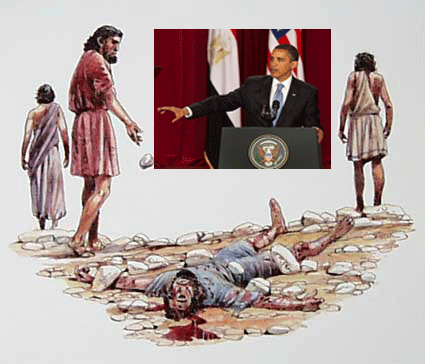
A new book with the promising but pathetically journalistic title The Evolution of God has just appeared with media fanfare. The fanfare I have seen thus far is an op ed piece and a Time Magazine article by the author, Robert Wright. In both the author’s lack of knowledge brands the work fiction from the start. Let’s start with the Time Magazine article, which is entitled “Decoding God’s Changing Moods.” As a veteran journalist, Wright knows that Bible codes sell well, even though there is nothing to decode in his supposed code. Continue reading On God and Obama: When Wright is Wrong

AhmadineBush

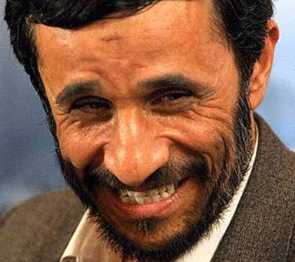
Color Iran today in black; it is not yet ready for a greening. The smiling face of Mahmoud Ahmadinejad is in victory mode. What was thought would be a close election turned out to be a seeming mandate for the man who would make Iran a nuclear power. The people have spoken or have they? Critics contend that the voting was rigged, that counting was being done before the polls closed (they had been extended up to six hours in some places), that there were not enough ballots and that Ahmadinajad even beat his main challenger Moussavi in the latter’s home town of Tabriz, an unlikely scenario. No matter, the Supreme Cleric has spoken, and in Iran that is the true nature of democracy, a theocracy that tolerates a parliament.

So do not expect the recent friendly overtures of President Obama to go very far in the second term of Ahmadinejad, whose tainted victory brings to mind the Florida recount that promoted George Bush into the White House in 2000. Indeed, there is a case for renaming the returning President AhmadineBush. Continue reading AhmadineBush

Hariri Lives on in Lebanon


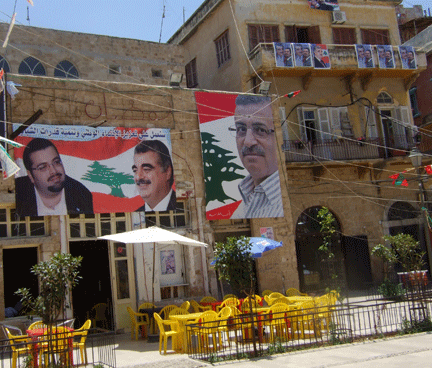
Political posters in a major square in the old city of Saida, the birthplace of former Prime Minister Rafiq Hariri.

Hariri Lives on in Lebanon

The recent election in Lebanon on June 7 was a surprise for Hezbollah and General Michel Aoun. A number of pundits thought this unlikely alliance would come to power and set Lebanon on a new and dangerous path. But, after all, this is Lebanon, one of the most unlikely spots for a conservative Islamic takeover anywhere in the Middle East. No doubt underestimated as a shadow of his famous father, Saad Hariri led his March 14 coalition to victory, actually gaining a seat in Parliament. The United States, Saudi Arabia and Israel are no doubt pleased that Hezbollah was denied bragging rights. Iran and Syria presumably are not. Continue reading Hariri Lives on in Lebanon

Conference on Said’s “Orientalism”

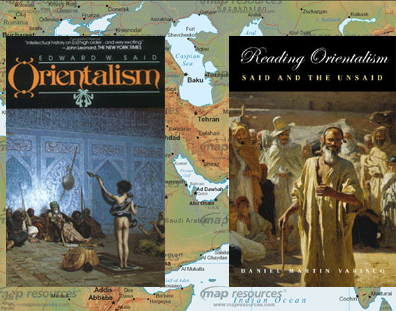
Today I am at the American University of Beirut for a one-day conference looking back on the impact of Edward Said’s seminal and polemical Orientalism, first published in 1978. The conference, “Orientalism and its Critics,” is sponsored by The Center for Arab and Middle Eastern Studies and the Department of Philosophy. Here is the line-up, for those who want to pseudo-twitter the event.

9:30 Basim Musallam (Cambridge University)
A First Reading of Orientalism

10:30 Daniel Varisco (Hofstra university)
Orientalism’s Wake: The Ongoing Politics of a Polemic

12:00 Ahmad Dallal (Georgetown University)
Cultural History and the Persistence of Orientalism: The Case of the 18th Century

1:00 Robert Irwin (University of London)
Pulp Orientalism

4:00 Robert Spencer (University of Manchester)
The War on Terror and the Backlash against Orientalism

5:00 Sadiq Jalal al-Azm (University of Damascus)
Political Said

My talk will be published this fall in a special issue of Viewpoints, an online forum of the Middle East Institute. It is a follow-up to my 2007 book, Reading Orientalism: Said and the Unsaid, published by the University of Washington Press.