All posts by dvarisco

Why Minarets?

Swiss voters, at least those who bothered to show up at the polls, today voted to deny any future building of minarets in their country. As reported on Al-Jazeera:

Of those who cast votes in Sunday’s poll, 57.5 per cent approved the ban, while only four cantons out of 26 rejected the proposals.

The result paves the way for a constitutional amendment to be made.

“The Federal Council [government] respects this decision. Consequently the construction of new minarets in Switzerland is no longer permitted,” the government, which had opposed the ban, said in a statement.

The minaret is, of course, a symbol, but a rather unusual choice. In one sense it is like saying that MacDonalds cannot have a high sign (as is the case in some municipalities) but they can serve all the hamburgers they want. Thus, this ban is not on building mosques, nor does it prevent Muslims from praying in mosques. Since minarets long ago ceased to have functional value, apart from perhaps holding a loud speaker, the minaret is indeed symbolic.

But why the minaret? Continue reading Why Minarets?
Going (after) Muslim


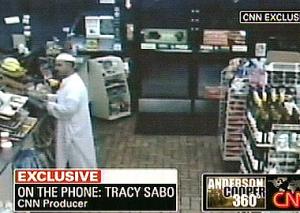
A picture making the news rounds of Major Hasan on the day of the shootings.

[Note: I have just published a commentary on a commentary in Forbes Magazine in which Major Nidal Hasan is said to have “gone postal” in his frenzy. This is published on Religion Dispatches. I excerpt the first couple of paragraphs here, but please go to the Religion Dispatches site, where you can post comments as well.]

If the media frenzy over the Fort Hood killings is any gauge, the ugly specter of 9/11 has again taken its psychological toll. This time, instead of the “bad Muslim” being a bearded terrorist called bin Laden, there is a US Army psychologist who was trained to be a healer of military personnel. He happens to have an Arabic ancestry and is Muslim.

Prominent American Muslim organizations issued statements right away condemning the murders. Debate in the media is now focused on his motivation. Was he a fifth-columnist wolf in military dress? Did his sympathies for innocent victims in our ongoing wars in Iraq and Afghanistan overwhelm his common sense of decency? Should the FBI and security arms of the US military have pounced on him when they uncovered his initial links to a radical imam?

One result that I have noticed among those who study Islam, especially my Muslim colleagues, is a growing fault line over the dubious “good Muslim/bad Muslim” binary. As Mahmood Mamdani has eloquently argued, the choice is not between good and bad individuals or citizens, but about being Muslim. Major Hasan is a man who looked very much like a “good Muslim”: a military officer providing therapy to returning veterans. But, now, it seems that at some tipping point he became the “bad Muslim,” the kind who places mosque above state.

For the rest of this commentary, click here.

Daniel Martin Varisco

Ignorance is no Excuse


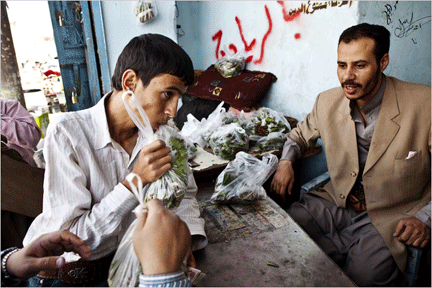
Selling qât in Sanaa, Yemen’s capital. Photo: Bryan Denton

These days if you run across an article on Yemen, it will no doubt feature a scenario of gun-toting tribesmen swearing allegiance to Al-Qaeda, the latest German tourist hijackings or feigned shock at the terrible, terrible addictive drug called qât. At least this was the case in Sunday’s New York Times in another piece of mixed journalistic pablum by roving reporter Robert Worth. Entitling the article “Thirsty Plant Dries Out Yemen,”, the author seems unaware that the site of his posting (Jahiliya) is in fact the Arabic term for the time of “Ignorance” before the rise of Islam. I doubt this reporter stepped out of a Queen-of-Sheba-era time machine and interviewed Abraha about his recent defeat at the “Battle of the Elephant” before Mecca. So where exactly is the fabled posting site of Jahiliya? Ironically, it is part of a World Bank irrigation project. I will leave the irony about IMF money being poured into Jahiliya in the strict sense to the imagination of the reader. And I strongly suspect the posting was made from a fancy hotel in the capital Sanaa and not from a rural internet cafe, while sipping qishr. But for a front page article on a major newspaper, ignorance is no excuse. Continue reading Ignorance is no Excuse

Healing Herbs in Yemen


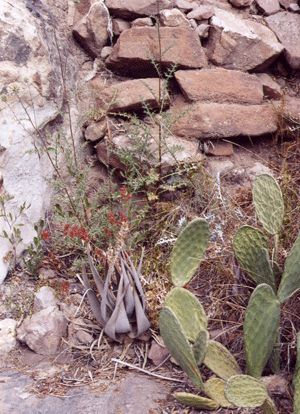
Aloe and Opuntia (balas Turkî) in al-Ahjur, central highlands of Yemen

Today I am flying on Lufthansa to Leipzig, and then on to Halle Wittenberg for a conference called “The use of herbs in Yemeni healing practices. An interdisciplinary workshop on traditional knowledge and cultural concepts in scientific perspective.“ The conference takes place September 25-26, 2009 at the Orientwissenschaftliches Zentrum , Martin-Luther-Universität Halle-Wittenberg, Germany. It has been funded by the Royal Ontario Museum Foundation, Ryerson University (both Toronto/Canada), and Martin-Luther-Universität Halle-Wittenberg, Germany. Click here for the order of the program.

The organizers are Dr Hanne Schönig (Orientwissenschaftliches Zentrum
Martin-Luther-Universität Halle-Wittenberg, homepage: http://www.owz.uni-halle.de/owz.php?pid=2) and Dr Ingrid Hehmeyer (Department of History, Ryerson University, Toronto, homepage: http://www.ryerson.ca/history/faculty/Hehmeyeri.html) and Dr Anne Regourd, Collaborateur Scientifique, Dept of Islamic arts, Musée du Louvre, Paris – France, homepage: http://www.anne.regourd.org.

The conference participants and papers are noted below: Continue reading Healing Herbs in Yemen

Satanic or Silly: Does Yale Press Censorship of Cartoons Insult Muslims?


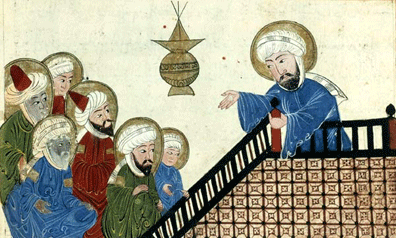
The Prophet Muhammad, 17th century Ottoman copy of an early 14th century (Ilkhanate period) manuscript of Northwestern Iran or northern Iraq (the “Edinburgh codex”). Illustration of AbÅ« Rayhān al-BÄ«rÅ«nÄ«’s al-Âthâr al-bâqiyah ( الآثار الباقيةة ; “The Remaining Signs of Past Centuries”). Source: Wikipedia article on Muhammad

Satanic or Silly: Does Yale Press Censorship of Cartoons Insult Muslims?
By Daniel Martin Varisco, Religion Dispatches, September 8, 2009

Two decades ago, the publication of Salman Rushdie’s The Satanic Verses caused a tsunami of protest in the Muslim world. The author was forced into hiding for nearly a decade after Ayatollah Khomeini called on Muslims to kill him and his publishers. Rushdie was accused of blasphemy, both for slandering the prophet Muhammad by subverting his character to Mahound (a medieval English term synonymous with the devil) and for reducing the holy city of Mecca to Jahiliya (a term used by Muslims to refer to the pagan past of Arabia). It was only a novel, but the fact that it was written by an Indian-born Muslim and published in the West was enough to frustrate even moderate Muslims.

Academic books rarely cause riots in the streets, but a forthcoming study on the recent Danish cartoon controversy may come close. Continue reading Satanic or Silly: Does Yale Press Censorship of Cartoons Insult Muslims?

Reviewing the Review

In 2005 I published Islam Obscured, a critical assessment of four books widely read as “the” anthropology of Islam. The books I examined were by Clifford Geertz, Ernest Gellner, Fatima Mernissi and Akbar Ahmed. Having wielded an iconclastic hammer over the first four chapters, I concluded the book with a brief question-and-answer survey of the ways in which “Islam” has and should be studied by anthropologists who value the role of ethnographic fieldwork. At the time, the publisher failed to send the book out for review, although some review copies finally went out over a year ago. There are many, many books out there on “Islam,” but my text was, to not mire myself in humility, somewhat unique. It faulted these texts for not using ethnographic data but rather essentializing their own views of what Islam should be.

I recently received a lengthy review by Ken Lizzio, whose research was on Sufi texts, in The Journal of North African Studies (14:309-316, June, 2009). Having written my book in large part for non-anthropologists, I was quite interested in how a specialist in Near Eastern Studies would react to it. The thrust of the reviewer strikes me as quite positive, especially when he states: “As Varisco proceeds to fell some of the giants in the anthropological forest, he does so with an axe sharpened with impeccable logic and refreshing intellectual honesty” (p. 310). The reviewer agrees with me that both Geertz and Gellner both fail to apply data from fieldwork to their assertions. So far, so good. Continue reading Reviewing the Review

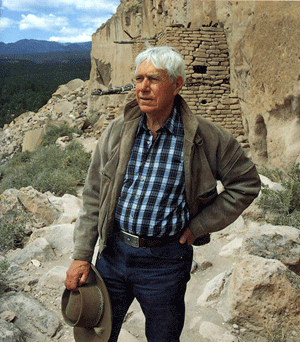
Edward T. Hall (1914-2009)

One of the most readable anthropologists of the 20th century passed away earlier this month on Monday, July 20. Most known for his The Silent Language (1959) and The Hidden Dimension (1966), Edward T. Hall specialized in the analysis of body language and established his theory of proxemics. Hall received his Ph.D. from Columbia University in 1942. In 1979 Hall was interviewed by Kenneth Friedman in the August issue of Psychology Today for an article entitled “Learning the Arabs’ Silent Language.” His comments on Arab culture are worth revisiting:

Kenneth Friedman: Do we Americans understand the Arabs, or do we tend to caricature or stereotype them?
Edward Hall: I don’t think we understand them. We ten to think of Arabs as underdeveloped Americans – Americans with sheets on. We look at them as undereducated and rather poor at anything technological. All we have to do is make believers out of them, get them the proper education, teach them English, and they will turn into Americans. Continue reading Edward T. Hall (1914-2009)