All posts by dvarisco

Islamic Folk Astronomy #1


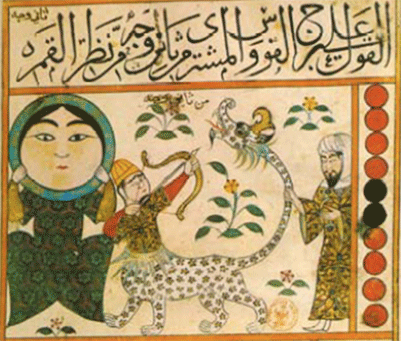
from Ibn Balkhi’s manuscript on astronomy, 850 CE

It was He that gave the sun his brightness and the moon her light, ordaining her phases that you may learn to compute the seasons and the years. He created them only to manifest the truth. He makes plain His revelation to men of understanding. Yûnus 10:9 (Dawood 1968:64)

When the Quran was revealed in seventh century Arabia as the basis for Islam, references were made to the sun, moon and stars as evidence of the creative power and practical foresight of God. The idea that God, or a particular god or goddess, had created the visible heavens was not unique. Creating stories about astronomical phenomena is as old as the first civilizations that appeared in the ancient Near East. Some of these survived, in highly edited variants, in the scriptures of Judaism and Christianity. As Muslim science evolved, a variety of religious and scientific knowledge from classical Greek texts, as well as Zoroastrian and Hindu sources, was encountered. While the influence of these classical and textual traditions on Islamic astronomy has been the focus of much previous study on the history of Islamic science, little attention has been paid to the oral folk traditions of peoples who embraced Islam. How ordinary Muslims viewed the same heavens visible to educated scientist or illiterate shepherd is the subject of this chapter. For practical reasons the focus here will be on the Middle East, especially the textual information on the pre-Islamic Arabs of the Arabian Peninsula and contemporary tribal groups in the region.

What is Islamic Folk Astronomy?

It is unfortunate that many times the idea of “folk astronomy” is understood mainly by what it is not. Continue reading Islamic Folk Astronomy #1
God is my co-sniper

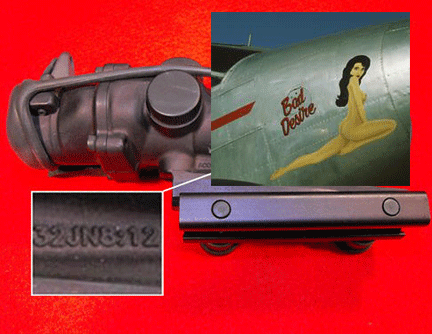
Not since Tammy Faye Baker embroidered Bible verses on her underwear has there been as eye-opening a scriptural scandal as the recent revelation that an American manufacturer routinely engraves Bible verses on U.S. military gun sights. As reported earlier this week, the Michigan-based corporation Trijicon has supplied the gun sights used by American marines to aim at and shoot the Taliban and their sympathizers in Afghanistan. The company may now be in quite a few critics’ sights given the new publicity. The Wikipedia entry already details the controversy. But the main company website has nothing to say. In the detailed descriptions of the gun sights on the website the biblical abbreviations are nowhere in sight. But it does say that “Trijicon self-luminous night sights are proven to give shooters five times greater night fire accuracy- with the same speed as instinctive shooting.” Five times, got it? Try MARK 6:38 (do look this up) and don’t forget the fishes. It may very well be that the procurement officers never noticed the addition of gospel acronyms after the serial numbers, but the company is not shy about its Christian views: “We believe that America is great when its people are good. This goodness has been based on biblical standards throughout our history and we will strive to follow those morals.”

The actual verses are not inscribed, only the chapter and verse in code. It appears that all of the verses are from the New Testament, so at least it cannot be claimed to be a Zionist plot (or perhaps it could be said to be a very clever Zionist plot…). I have no idea how many verses have appeared on the 800,000 units contracted for $660 million by the U.S. Marine Corps. I suspect that MATT 5:44 (do look it up) is not one of them. Perhaps the Sermon on the Mount is not part of what the company defines as “biblical standards.” Continue reading God is my co-sniper

On Yemen (and some a bit off)


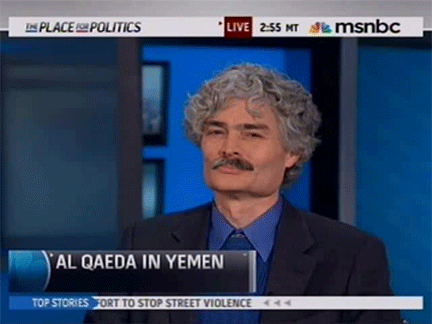
Varisco interviewed about Yemen on MSNBC, January 16

For the past week or so, just before the terrible human tragedy in Haiti, Yemen was once again a front page news story in the Western media. This time it was not about qât, nor about the rhino horn used in Yemeni dagger hilts, but the issue was exotic nevertheless. Yemen is newsworthy because of the recent attempted suicide mission of a Nigerian who met with members of the relatively recently reframed Al-Qaeda in the Arabian Peninsula. At first, the political talking heads were eager to brand Yemen as a lawless tribal haven for the next stop of our continuing war on terror. Joe Lieberman added Yemen to his own version of the axis of evil, which I have previously commented upon. But then late last week Yemeni officials announced that six al-Qaeda figures had been killed in an airstrike, and on Saturday three more had been arrested near the Saudi border.

On Saturday, on my return from delivering two lectures in Toronto, I went straight from the airport to MSNBC, where I was interviewed (if that term works for about two minutes of air time) about the recent strikes on al-Qaeda in Yemen. Earlier in the week, I sat down for an extended interview on the current situation in Yemen with Karla Schuster of Hofstra University, an interview which can be seen on Youtube. Continue reading On Yemen (and some a bit off)

With Kitto Illustrating Bible History

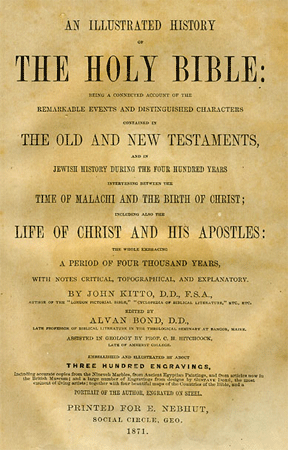
As a child I spent many inquisitive hours leafing through the books in my grandmother’s parlor bookcase. One that especially attracted my attention was John Kitto’s An Illustrated History of the Holy Bible (Social Circle, Georgia: E. Nebhut, 1871). Rev. John Kitto, recognized on the title page as author of the London Pictorial Bible, the Cyclopedia of Biblical Literature, ETC, ETC, retells the entire history of the Old and New Testament, from creation to the destruction of Jerusalem. Kitto was born into poverty in 1804 in Plymouth, England and due to an unfortunate accident ate age thirteen became entirely deaf and was forced into the poor house at the age of fifteen. This is quite an inauspicious beginning for a waif who went on to be a respected theological scholar. Through the local humanitarian efforts of several men in Plymouth, Kitto became a lay missionary to Malta and then for three and a half years in Baghdad. “While residing in that city,” writes Alvan Bond in the preface to Kitto’s book, Cairo “was visited by the plague, the terrific ravages of which swept off more than one-half the inhabitants in two months. Amidst this fearful desolation he remained calm and active at his post.” Once back in England he married and produced a travel account and several pictorial histories of the Holy Land. In 1844 the University of Giessen conferred upon him the degree of D.D. His ill health forced him to seek help in the spas of Germany, where he died after a mere half century in 1854. Continue reading With Kitto Illustrating Bible History

Resolving the New Year


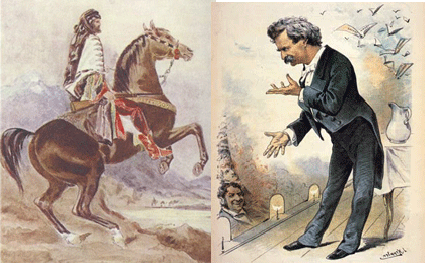
Wilfrid Scawn Blunt, left; Mark Twain, right

There is a curious annual custom inherited in many of our families, but one I am resolved not to take too seriously this year. I refer to the half-drunk notion of making resolutions for the new year (which I see no sound reason to capitalize, as my German blood is very far removed), as though the arbitrary turning of the calendar is a time to reflect on what went wrong over the last 365 days and pretend that things should go better in the next eighteen and a quarter score days. I have heard the rural urban tale that the pin-up 19th century cowgirl sharpshooter Annie Oakley started the custom of sending out Christmas Cards, but I am not sure which genius came up with penning new year’s resolutions, unless it was Johnny Walker in one of his more sober moments. Most people, and I surely fall into this anomalous category, do not remember the resolutions made a year ago. But then most godfearing redneck Americans could not repeat the 10 Commandments in order to save their souls, unless perhaps they were dead drunk. So my re-solution, since it is the defacto one I have been following for quite a few years, is to resolve to forget any resolution before I even make one. This saves me from having to make up a resolution, which is the same as making as silly a resolution as I can imagine.

I am not the first person to take aim at this impotent cultural pastime which has long since ceased to have any influence on what people really do. Mark Twain said it well over a century and a half ago:

New Year’s Day–Now is the accepted time to make your regular annual good resolutions. Next week you can begin paving hell with them as usual. Continue reading Resolving the New Year

The Influence of Edward W. Said

[Webshaykh’s note: I recently came across a book review I had written several years ago, but which was never published by the journal which solicited it. As the issue is still relevant, even after publishing my critical assessment of Said’s Orientalism two years ago, I present the review as written in 2001.]

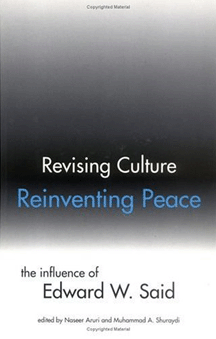
Revising Culture, Reinventing Peace: The Influence of Edward W. Said. Edited by Naseer Aruri and Muhammad A. Shuraydi. New York: Olive Branch Press, 2001. Xvi, 190 pages. ISBN 1-56656-357-7

Review by Daniel Martin Varisco

“Indeed, anywhere that intellectuals with a progressive or internationalist outlook gather on this planet, there is an awareness and appreciation of the indispensable contributions that Said has made to the life of free and independent inquiry, and beyond this, to a whole style and method of thought that takes ideas and cultures seriously as crucially linked to structures of oppression and processes of emancipation.”

If this accolade from Richard Falk’s glowing introduction to a volume of papers under the influence of Edward Said sounds good to you, this is a book you will probably enjoy. If you are looking for something new, that has not already been said or that has even a modicum of critical distance, you may want to skip this recent addition to what has become a virtual cottage industry of Saidiana. Continue reading The Influence of Edward W. Said

More than just (a) war


President Obama speaking to the Nobel Prize Committee

As the season has arrived in which “Peace on Earth” fills the airwaves and resonates from church choirs, the recent choice of President Obama for the Nobel Peace Prize becomes ironic as well as iconic. The icon is obvious, as no president since John F. Kennedy has elicited such fanfare at his entry into office. As the chairman of the Nobel committee, Thorbjorn Jagland, introduced President Obama, it was clear that in part the real choice was the man who pledged to reverse the isolationist and publicly entrenched private sectoring of George W. Bush. Had our previous president not been the bearer of two made-for-Hollywood wars in the guise of a nebulous “War on Terror,” Obama would have had to wait his turn. The irony is manifold. American dissatisfaction with the costly war in Iraq led to a political surge for the Democrats for a change; the man who pledged to end the war mongering is still saddled with the two wars he did not start. On the home front, the financial tsunami he inherited now tarnishes virtually every attempt to pull the economy out of its cross-the-boards harm from the combustable engine of Wall Street to the reckless drivers on Main Street.

The liberals and centrists who voted to give hope a chance have all too soon decided not to give it much of a chance. Those who actually prefer to call themselves liberals no doubt hoped that Obama was just politicking when he touted centrist positions to secure some of those Red State votes. But the man from Illinois, who kicked off his run with the symbolic capital of an earlier president-to-be from Illinois, is decidedly centrist, the mad ravings of vanity pouting Glenn Beck and publicity whoring Sarah Palin notwithstanding. If you want to probe the postmodern meaning of irony, just listen to what President Obama said about war in being honored as a man of peace: Continue reading More than just (a) war

Like a Virgin, but not for the very first time

Virginity, at least when it comes to the female of the species, is one of the most critical ethical melting points of societies in which females are burdened with a symbolic honor that denies their own control over their own bodies. The Virgin Mary in Christian theology remains a virgin, since the heavenly father of Jesus had no earthly form with which to impregnate her. Much is made in the media today about honor killings in Mediterranean societies, and in areas where more conservative forms of Islam merge with patriarchal ideology, like Pakistan and Afghanistan. Since the self righteous males who guard their sisters hymens but frequently dally with the hymens of other men’s sisters or daughters are not likely to go feminist and vote pro-choice, women must either remain strict virgins (and hope that they are not one of those women who are born with perforated hymens quite naturally) or find some chicken blood. But now the Japanese and Chinese have a more sanitary solution: a kit that allows a woman to insert an artificial hymen in only five minutes.

Where do you find such a product? It is widely sold in the Middle East, but those in America have only to click on Gigimo.com to find a Japanese kit available for $29.90 (or “suggest a price”). Continue reading Like a Virgin, but not for the very first time