All posts by dvarisco

Jihad for Jesus?

Those Americans who feel compelled to rewrite our collective history as the emergence of an avowedly Christian nation are fond of quoting scripture. Take the seemingly noble sentiment in John 15:13, where Jesus said, “Greater love hath no man than this, that a man lay down his life for his friends.” I say “seemingly noble” because even the Devil is good at quoting scripture. Consider the fringe Christian apocalyptic group called the Hutaree; there this motto blazes their website just above the image shown above. Yesterday, the U.S. Attorney General announced the arrests of nine individuals accused of “plotting to kill law enforcement officers in hopes of inciting an antigovernment uprising, the latest in a recent surge in right-wing militia activity,” as the New York Times reports. The plan is right out of what is often called the Al-Qaeda playbook, one played out in Pakistan, Iraq and Afghanistan on almost a daily basis: kill a police officer and then when there is a funeral procession, set off an i.e.d. Were these Muslim extremists, the word “jihad” would be on every television newscast. But, no, these are individuals who claim to be following a commandment of Christ. So why not face the fact that rhetorically it is possible to jihad for Jesus?

Speaking of those who believe in a literal Devil and do not recognize they are doing his work, earlier today I happened to be leafing through The Devil’s Dictionary by the Ohio-born American journalist Ambrose Bierce. Here is what Bierce had to say a century ago about the real-world definition of “Scriptures”:

“The sacred books of our holy religion, as distinguished from the false and profane writings on which all other faiths are based.”

Continue reading Jihad for Jesus?

On the honor of being dissed

About two and a half years have passed since my Reading Orientalism: Said and the Unsaid was published by the University of Washington Press. Being an academic book, as opposed to a short-life trade paperback written for anyone who might have failed Middle School English, the reviews have come in a trickle rather than due to a publisher’s promotional media torrent the week of launch. One of the first reviews came in the TLS from Robert Irwin, one of the most qualified reviewers and an astute student of Orientalism himself. Irwin found that my book is “closely argued” and “makes for exhilarating reading,” despite the annoying (intentionally so) stream of puns. I appreciate a thorough German review by Siegfried Kohlhammer, who was kind enough to remark: “Jede Verteidigung von Orientalismus wird sich mit dieser sorgfältigen und präzisen Summa der Said-Kritik auseinandersetzen müssen.” In Common Knowledge, David Cannadine continues sweet music to an author’s ear by concluding that my book “is an important and impressively documented work, which deserves a wide audience.”

But now along comes a review that is breathtaking (I tend not to breathe when I am convulsed in laughter), however, one that I am honored to receive. The venue is telling: the Middle East Forum, which is affiliated with the websites of Campus Watch, Daniel Pipes and Islamist Watch. Were I to receive a favorable review from this forum-idable group, I could only conclude that my book was an utter failure and would be tempted to buy back all the existing unsold copies for a large Obsession-triggered book burning. I can now breathe a sigh of relief that a site defending the offensive opinions that I set out to counter has seen fit to dismiss my book as an uninformed and witless screed. Continue reading On the honor of being dissed

Ramadan: Slow not fast justice


Mirror, mirror on the terrorist list wall,
Whose the most likely terrorist of them all?

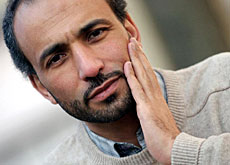
In the post 9/11 world it is not easy to have a Muslim name. Just because your name is Khan, does not mean you are a terrorist. Just because your university (Harvard, for example) has a fellowship paid for by the Bin Laden family does not mean it is an academic haven for suicide bombers. But if you have a last name of Ramadan, you are not going to be put in the fast lane for an entry visa. Literally. In 2004 the distinguished Islamic scholar Tariq Ramadan was appointed to a tenured professorship at the University of Notre Dame. One would think having a major contemporary voice for Islam, especially Muslims living in secular societies, at an acclaimed Catholic university would help break down or at least counter the hatred that fueled the Twin Towers bombers. Such thinking was not on the agenda of the Bush administration, which was more attuned to the slimy interrogation technique of water boarding than interfaith dialogue. Continue reading Ramadan: Slow not fast justice

If your name is Khan…


Kajol Devgan and Shah Rukh Khan

On Sunday I finally saw the new Bollywood film with Shah Rukh Khan, “My Name is Khan.” It is well worth seeing, although the minimalist dancing and singing in the film make it more Hollywood (not Fred Astaire’s) than Bollywood. Add to this the fact that many parts of the film were made in San Francisco and California and the Bollywood connection is even more estranged. The plot of the film has gaping holes, but it is not meant as a documentary. I walked away feeling good about two aspects of the film. First, it is a stirring educational lesson in Asperger’s Syndrome. One of Bollywood’s most glamorous male stars provides a moving performance of this disability, disabling those critics who dismiss the victims of the syndrome as dumb or retarded (neither of which they are).

Second, given all the Islamophobic films out there, where jihad is the only plot associated with Islam, it is refreshing to see the tables turned. While most Americans did not use 9/11 as an excuse to go out and beat up Muslims (or Sikhs or anyone who was not “white” enough), a number of prejudicial people did. The hate was real and most Muslims have felt it, even if only the cold stare. Finally here is a fantasy that goes the other way, while making Muslims heroes and lovers of peace. Continue reading If your name is Khan…

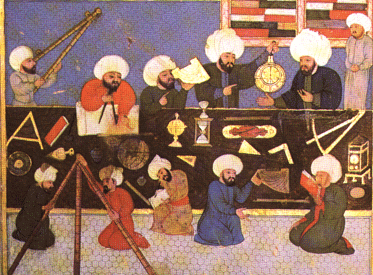
Islamic Folk Astronomy #4


Modern photograph of the Pleiades

The Pleiades in Arab Folklore

The most famous star in Islamic folklore is undoubtedly the Pleiades. Commentators regard the reference in surah al-Najm (#53) of the Quran as the Pleiades; in fact the Arabs often referred to the Pleiades simply as al-najm (the star par excellence), a usage parallel to that in Sumero-Akkadian (Hartner 1965:8). In a well-known tradition, Muhammad links the early summer heliacal rising of the Pleiades with the beginning of the heat, crop pests and illnesses. In another tradition, more political than weather-related, Muhammad is supposed to have told his uncle Abbas (for whom the Abbasid caliphate was later named) that kings would come from his descendants equal to twice the number of stars in the Pleiades. This would imply that Muhammad thought there were 13 stars in the asterism, since the Abbasid caliphs numbered twenty-six (Ibn Mâjid in Tibbetts 1981:84). Continue reading Islamic Folk Astronomy #4

Islamic Folk Astronomy #3


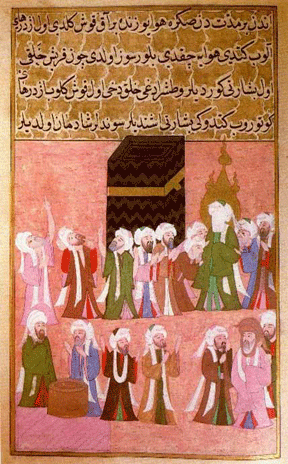
Mohammed at the Kaaba. Miniature from the Ottoman Empire, c. 1595. Source: The Topkapi Museum, Istanbul

Folk Astronomy and Islamic Ritual

Astronomy was relevant to Muslims in large part because of several of the ritual duties proscribed in the Quran and Islamic tradition. The three most important of these are determining the beginning of the fasting month of Ramadân, reckoning the times for the five daily prayers, and determining the proper direction of the qibla or sacred direction toward Mecca. While Muslim astronomers later worked out mathematical solutions to some of these problems, correct timing and orientation could be achieved by those untrained in astronomy and with virtually no computation skills beyond simple arithmetic (King 1985:194). Continue reading Islamic Folk Astronomy #3

Mocha Musings #1: Mecca and Arabia

Arbuckles’ Ariosa (air-ee-o-sa) Coffee packages bore a yellow label with the name ARBUCKLES’ in large red letters across the front, beneath which flew a Flying Angel trademark over the words ARIOSA COFFEE in black letters. Shipped all over the country in sturdy wooden crates, one hundred packages to a crate, ARBUCKLES’ ARIOSA COFFEE became so dominant, particularly in the west, that many Cowboys were not aware there was any other kind. Keen marketing minds, the Arbuckle Brothers printed signature coupons on the bags of coffee redeemable for all manner of notions including handkerchiefs, razors, scissors, and wedding rings. To sweeten the deal, each package of ARBUCKLES’ contained a stick of peppermint candy. Due to the demands on chuck wagon cooks to keep a ready supply of hot ARBUCKLES’ on hand around the campfire, the peppermint stick became a means by which the steady coffee supply was ground. Upon hearing the cook’s call, “Who wants the candy?” some of the toughest Cowboys on the trail were known to vie for the opportunity of manning the coffee grinder in exchange for satisfying a sweet tooth.

While sorting through a bevy of late 19th century advertising cards and magazine illustrations collected by my great, great aunt in several yellowing albums, I came across several for the Middle East that were published for Arbuckle’s coffee. Continue reading Mocha Musings #1: Mecca and Arabia

Islamic Folk Astronomy #2

Time Reckoning

Era means a definite space of time, reckoned from the beginning of some past year, in which either a prophet, with signs and wonders, and with a proof of his divine mission, was sent, or a great and powerful king rose, or in which a nation perished by a universal destructive deluge, or by a violent earthquake and the sinking of the earth, or a sweeping pestilence, or by intense drought, or in which a change of dynasty or religion took place, or any grand event of the celestial and the famous tellurian miraculous occurrences, which do not happen save at long intervals and at times far distant from each other. Al-Bîrûnî (1879:16)

Time is relative. Given the modern world’s reliance on formalized calendars and machines that define time for us, it is easy to forget that the expansion of Islam occurred at a time when telling time was not dependent on a formal science of astronomy. How time is measured is not only a practical issue but also reflective of the desired interval of duration and the precision in defining it. Simple observation of the sun rising and setting, as well as its location, can easily yield calendars to determining hours, days, months and years. Similarly, the moon’s phases made it a useful measure for the Islamic lunar calendar. Observations of movements by the stars, as well as the planets, also provided practical ways of measuring units of time both short and long. Continue reading Islamic Folk Astronomy #2