All posts by dvarisco

Last day in Lamu


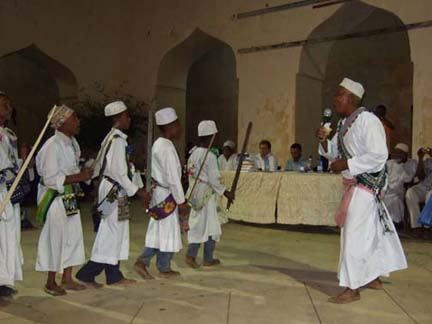
Chamba dance in Lamu Fort

I am sitting in the lobby of Lamu House on the delightful Swahili island of Lamu, my last day after a seminar sponsored here by the Rift Valley Institute on the Horn of Africa. On Wednesday night I attended a reception given by the Lamu museum and other respected officials and members of Lamu town. The highlight of the evening was a performance in “The Fort” of the Chamba wedding dance, a slow-moving line dance with swords and sticks held steadily. On Saturday I went on a dhow trip with Captain Abu (anyone going to Lamu should ask for Abu; he is superb and knows the area well, and the Rasta man Hasan is a fantastic cook) and met Muhammad Famou Othman, head of the dance troop, who took us on a tour of his village.

On Monday I delivered a talk to the Lamu community in The Fort. The talk was in English and I will post it here anon. But I also gave a brief introduction in Arabic, which was well appreciated. I would very much like to learn Swahili now and inshallah return to Lamu to do research on those here who have Yemeni ancestors.

My last day, chilling in a rather warm climate but with a strong breeze.

Horn Talk in Lamu


Dhow near Lamu at sunset

I am writing this from the exquisite Island of Lamu in Kenya. As someone who has spent over thirty years rambling around Yemen, across the Gulf of Aden, it is quite eye-opening to take a look up at the southern part of the Arabian Peninsula from an African perspective, especially a view that has been influenced in many ways by earlier generations of migrants from Yemen. It would be nice if I was here only because it is such a beautiful tourist spot with a rich cultural heritage, and indeed all this is nice, but I am actually attending an annual seminar on the Horn of Africa hosted by the Rift Valley Institute. The organizers recognized that cultural history and contemporary politics in the Horn can hardly be separated from Yemen, which lies so close across the Red Sea and Gulf of Aden. Hence I was invited to contribute on the links between Yemen and the Horn and also to discuss the relevance of Islam and the contentious issue of “Islamism.” Continue reading Horn Talk in Lamu

Facebook vs. the Holy Book

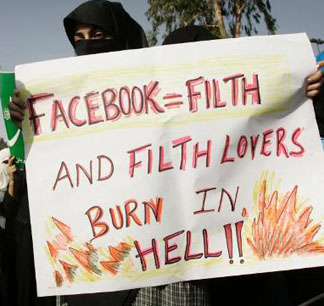
The news out of Pakistan teeters between bad and worse. First, there are the drones targeting Taliban leaders and often taking out civilians as long-range missile attacks tend to do. Then there is the lingering concern about the government’s stability, especially given the fact that Pakistan has nuclear weapons. Throw in the claim that as many as a quarter of the population is below the poverty line and it is hard to see a silver lining in all the doom and gloom statistics. But this is the Internet Era, so virtual reality is not out of touch with reality in contemporary Pakistan. Now it seems that virtual reality has become more important than the price of bread, perhaps in part because of the price of bread. In recent days the government of Pakistan has started blocking both Facebook and Google.

The problem with Facebook is with a group that launched an “Everybody Draw Muhammad Day,” a group that most professional political cartoonists see as “shock for shock’s sake.” Continue reading Facebook vs. the Holy Book

Hate, Times Squared


Photos juxtaposed on May 6 by the New York Post, tabloid journalism at its most blatant

Faisal Shahzad, not your typical terrorist: unless you think being a Pakistani Muslim makes you a typical terrorist. Anyone reading yesterday’s New York Post (Wednesday, May 5) and taking the blustered and bloated tabloid rhetoric seriously could easily make such an assumption. I do not, as a rule, read tabloids, although seeing what many others do read is a useful reality check from time to time. But on the train home from Manhattan yesterday there was a crumpled up newspaper under the train seat and at least 45 minutes to unwind. The cover was, for a change, not a pun. It might be called a revelation, as it read: “REVEALED: WHY HE DID IT. EXCLUSIVE. Revenge for US drone attacks on Taliban terrorists.” Six pages (and more) were devoted to the story, although there was little that I found exclusive in the shoddy news reporting and vengeful commentary by the tabloid’s stalking heads.

Let’s start with the cover and what the tabloid pictures for us. Continue reading Hate, Times Squared

On Colonels, pantyhose and honor killings

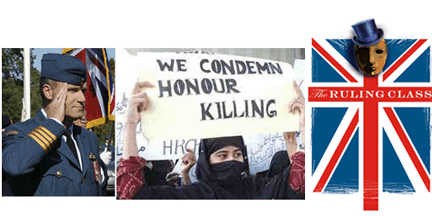
At the start of one of my all-time favorite movies, The Ruling Class, actor Harry Andrews as the 13th earl of Gurney returns to his well-groomed estate to relax after a long day of waxing conservative in the House of Lords. While this film should be required viewing for the current British parliamentary campaign, my interest is in the way this revered judge and former soldier relaxes: by dressing in a ballet skirt and jumping off a stool with a silk noose around his neck. Last Friday the New York Times carried a story about Col. David Russell Williams, a Canadian commander of a major air base in the Afghanistan war. He is described as “once among Canada’s most successful military officers,” the automatic pilot for visiting dignitaries, including Prime Minister Harper. Why “once”? Because the colonel on the battlefront against those honor-killing Taliban appears to be a “serial sexual predator.”

Ottawa police arrested Colonel Williams last February in connection with two murders of women, two sexual assaults and numerous break-ins in the Ottawa area “most of which involved lurid sexual details.” Continue reading On Colonels, pantyhose and honor killings

The Baraka 500

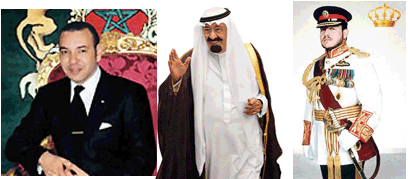
Every good capitalist knows about the Fortune 500, the annual ranking of the top grossing corporations in the United States. Now Muslims who read English have their own ranking of the top 500 most influential Muslims. The Royal Islamic Strategic Studies Center in Amman and Prince Alwaleed Bin Talal Center for Muslim-Christian Understanding have jointly issued a new book, edited by John Esposito and Ibrahim Kalin of Georgetown University. This is scheduled as the first in an annual series that will provide short biographies of prominent Muslims in a variety of fields. According to the editors, the aim is to “highlight people who are influential as Muslims, that is, people whose influence is derived from their practice of Islam or from the fact that they are Muslim.” So who tops the list?

As fortune would have it, this effort should probably be dubbed the Baraka 500, but more for the politics of the sponsors than the demonstrated holiness of the individuals. Deciding who are the influential individuals that happen to be Muslim is no easy task, especially considering that most Muslims have not been consulted in the process. So before you read any further, jot down who you think are the top ten Muslims in the world. I suspect that you will not duplicate the “official” list provided by Esposito and Kalin for their Saudi and Jordanian sponsors. Continue reading The Baraka 500

Islamic Folk Astronomy #5

The Pleiades Conjunction Calendar

One of the indigenous calendars from the Arabian Peninsula is based on the monthly conjunction of the Pleiades with the moon. The moon conjuncts with the Pleiades about once every 27 1/3 days. This conjunction was visible monthly from autumn through spring and occurred about the same time each year; thus it coincided with the main parts of the pastoral cycle on much of the Arabian Peninsula. According to Abû Laylî (in al-Marzûqî 1914:2:199), these conjunctions began at the time of the autumn wasmı rain. This observation is still found among contemporary Sinai Bedouins (Bailey 1974:588). Ibn Qutayba (1956:87) noted that when the moon conjuncts with the Pleiades on the fifth day of the lunar month, winter goes away. The new moon coincides with the Pleiades during the month of Nîsân or April during the naw’ of simâk. This was considered to be one of the most fortunate star movements in the sky, perhaps because of its unique annual character. Shortly thereafter the Pleiades disappears from view at the start of the heat. Continue reading Islamic Folk Astronomy #5

Blame it on Lady Gaga

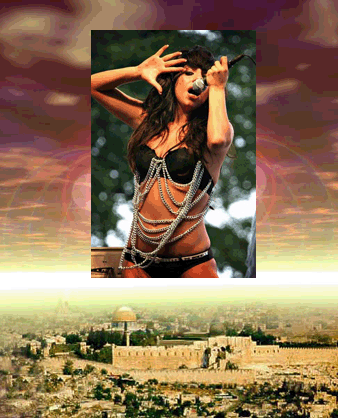
Why is the “Muslim world” angry with America, asks columnist Bret Stephens in the Wall Street Journal? Well here are your two choices:

Pop quiz—What does more to galvanize radical anti-American sentiment in the Muslim world: (a) Israeli settlements on the West Bank; or (b) a Lady Gaga music video?

If your answer is (b) it means you probably have a grasp of the historical roots of modern jihadism. If, however, you answered (a), then congratulations: You are perfectly in synch with the new Beltway conventional wisdom, now jointly defined by Pat Buchanan and his strange bedfellows within the Obama administration.

Of course, how could it be Israeli policy. It must be the loose women and jazz singers that really upset Muslims, because that is what Sayyid Qutb said way back in 1951 after visiting Colorado (if only they had shut down those speak-easys in Boulder, who knows!). Yes, here is what Qutb, the “intellectual godfather of al Qaeda,” said:

“The American girl,” he noted, “knows seductiveness lies in the round breasts, the full buttocks, and in the shapely thighs, sleek legs and she shows all this and does not hide it.” Nor did he approve of Jazz—”this music the savage bushmen created to satisfy their primitive desires”—or of American films, or clothes, or haircuts, or food. It was all, in his eyes, equally wretched.

Qutb, notes the columnist, was also anti-Semitic, and blamed the Jews for being at war against Islam. And, to seal the argument for Stephens, here is the real beef (or cheesecake or kosher wine) because: Continue reading Blame it on Lady Gaga