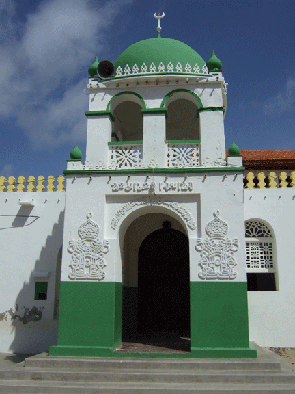
Riyadiya Mosque, Lamu
The essential problem in the study of Islam is precisely that: essentialist reduction of a diverse religious tradition across cultures into an ideal essence. In a provocative article published three decades ago, Muslim anthropologist Abdul Hamid el-Zein wondered in print “if a single true Islam exists at all.†(1) This was not an attempt to dismiss the faith of Islam, but a challenge to scholars who blithely assume the existential ‘truth’ of concepts. “But what if…†asked el-Zein, analysis of Islam “were to begin from the assumption that ‘Islam,’ ‘economy,’ ‘history,’ ‘religion’ and so on do not exist as things or entities with meaning inherent in them, but rather as articulations of structural relations, and are the outcome of these relations and not simply a set of positive terms from which we start our studies?†(2) If so, he reasoned, it would do no good to start with a textbook version of the five pillars, a famous scholar such as Ibn Khaldun, or a Western sociologist like Max Weber, because all this is what Islam is supposed to be. For el-Zein, true to his anthropological roots, it was important to start with the “native’s model of Islam†as it is articulated in a given social context. This is not because the native is “right,†a nonsensical term for non-theologian el-Zein, but in order to see how Muslims adapt what analysts call “religion†to everyday life. Continue reading Is there one “Islam†or many “islamsâ€?