All posts by dvarisco

Ablution Pollution


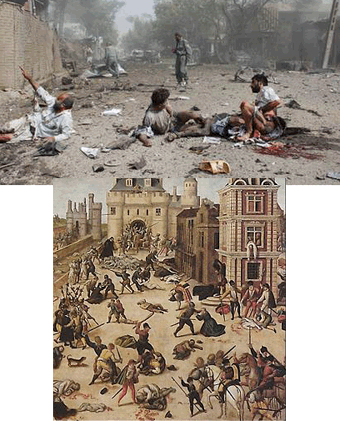
A report in yesterday’s Los Angeles Times is a chilling reminder of the utter absurdity of out-of-control sectarian violence in Afghanistan.

Reporting from Kabul, Afghanistan —
A suicide bomber blew himself up Friday at a public bathhouse in southern Afghanistan that was filled with men washing themselves before the main prayers of the Muslim week. At least 17 were killed and 23 injured, provincial officials said.

The Taliban claimed responsibility for the attack in Spin Boldak, in Kandahar province. The district, a main crossing point to and from Pakistan, is a longtime nexus of drug and weapons smuggling. Continue reading Ablution Pollution

Grease-Monkeys and Bedouin Girls


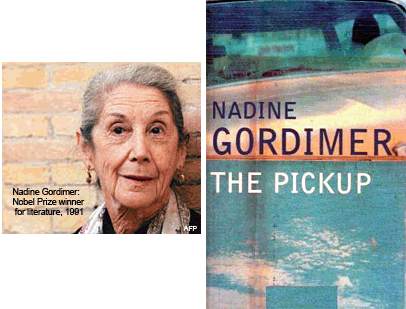
Grease-Monkeys and Bedouin Girls: The Rhetorical Fate of Arabs and Muslims in Nadine Gordimer’s The Pickup.
By Daniel Martin Varisco, Tingis Redux, December 11, 2010

Novels tell Stories, allowing readers to fantasize about reality but with no obligation to represent that reality as anything other than fantasy. Good novels, at least the kind that garner a Nobel prize for their author, capture the imagination through creative engagement and style. The South African author Nadine Gordimer has been writing about the shame of apartheid in her native land for more than half a century. Her focus on the moral and psychological tensions of racial inequality provides a welcome political stamp to her fiction. Yet, sometimes in telling one kind of story, especially teasing out the relationships of lovers across cultural boundaries, another story can be read between the lines. The Pickup, Gordimer’s acclaimed novel which pairs a privileged South African white girl named Julie with an Arab Muslim and illegal alien named Abdu, traces an unlikely love story but leaves the identity of Abdu literarily in the dust, the dust of a stereotyped Orientalist denigration of his homeland and his religion. One need not follow Edward Said’s controversial contrapuntal reading to find in this novel a generic image of Arab and Muslim that serves the plot only in its unrelenting negative portrayal. The Pickup, whatever its merits as a close study of personal dislocation, succeeds by picking on distorted images of Arab and Muslim.

For the rest of this essay, read it on Tingis Redux.

Still in a pretty pass …


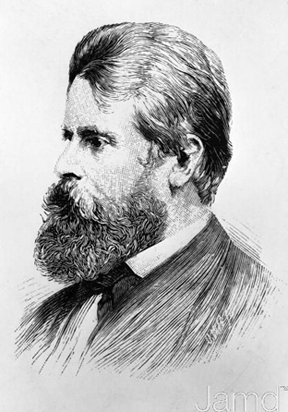
English poet and traveller Wilfrid Scawen Blunt (1840 – 1922), circa 1880.

Webshaykh’s Note: Given the ongoing crises in the Middle East, it is useful to return to earlier commentaries. In the excerpt below the voice of Wilfrid Scawen Blunt echoes with resonance for events currently in the news about Gaza, Iraq and Afghanistan. Let us all hope that the new year brings tolerance and peaceful intentions for us all.

Wealthy and well connected Wilfrid retired from the foreign service in 1869 and soon the traveling Blunts went east. As Wilfrid noted about his first visit to Egypt in 1879, he was still “a believer in the common English creed that England had a providential mission in the East.” After learning about Bedouin customs firsthand in Syria Lady Anne spoke for both travelers about their interest in no longer looking at the people “with the half contemptuous ignorance” of Europeans. Not only were the Blunts aware and appalled at Eurocentric attitudes, but Wilfrid wrote of Islam as a “true religion,” which certainly had far more to offer African converts than Christianity. In 1881 Blunt bought an estate in Cairo, where he became a neighbor and friend of the Islamic reformer Muhammad ‘Abduh. On a visit to England Blunt arranged a visit between ‘Abduh and the reigning social philosopher, Herbert Spencer; the Egyptian reportedly told Spencer that the East was learning the evil rather than the good from the West, but the best of both was the same.

Blunt was perhaps the most famous aristo-critic of British imperialism in Egypt. With the impunity his elite upbringing bequeathed at the time he admonished Lord Cromer, whose “wrong-headed administration” only served to Anglicize Egypt. He used his impeccable social connections to lobby British politicians, including Prime Minister Gladstone, whose “Oriental” policies he deplored. Blunt’s radical critique of the colonial transgressions committed by the burdensome white race is second to none, including Fanon and Césaire. Consider his prescient diary note at the close of the nineteenth century:

The old century is very nearly out, and leaves the world in a pretty pass, and the British Empire is playing the devil in it as never an empire before on so large a scale. Continue reading Still in a pretty pass …

Buried Texts Recovered: An American Consul goes to Bethlehem, 2

I continue a thread on one of the numerous 19th century Bible customs travel accounts by Christian enthusiasts able to travel to their “Holy Land.” The author, Frank S. DeHass, served as the United States Consul in Palestine in the mid 19th century. His text is aptly entitled Buried Cities Recovered, or, Explorations in Bible Lands, giving the results of recent researches in the Orient, and recovery of many places in sacred and profane history long considered lost. My copy, handed down from my grandmother, was published in 1886 in Philadelphia by Bradley & Company; the tenth edition no less! This is a wonderful read and it is worth reading the entire book online, thanks to Google Books.

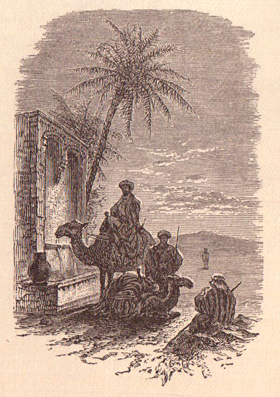
An eastern inn, or khan, never was a house of entertainment in the sense that Americans understand a hotel to be. Such accommodations as provision, bed, and other comforts at an inn are unknown int he Orient, and belong exclusively to western civilization. In the East all travelers carry their own bedding and provision with them, and must dress their own food, kindle their own fire, and spread their own table. An Oriental inn is merely a place of shelter from the storm, or protection from robbers, where a man and his beast can safely lodge for the night free of charge. A portion of the khan was assigned to the beasts, generally one side, and travelers who came in late, if they found the khan full, would have to make their beds in the manger with the horses and camels, as Joseph and Mary were forced to do. These caravansaries, or inns, were sometimes very rude, simply a rough wall built around a house, or natural caves int he rocks, as appears to have been the case at Bethlehem. Many of these grottoes are used as stables in the neighborhood, and some of them as dwellings by the Arabs. Continue reading Buried Texts Recovered: An American Consul goes to Bethlehem, 2

Buried Texts Recovered: An American Consul goes to Bethlehem, 1

Yesterday, I began a thread on one of the numerous 19th century Bible customs travel accounts by Christian enthusiasts able to travel to their “Holy Land.” The author, Frank S. DeHass, served as the United States Consul in Palestine in the mid 19th century. His text is aptly entitled Buried Cities Recovered, or, Explorations in Bible Lands, giving the results of recent researches in the Orient, and recovery of many places in sacred and profane history long considered lost. My copy, handed down from my grandmother, was published in 1886 in Philadelphia by Bradley & Company; the tenth edition no less! This is a wonderful read and it is worth reading the entire book online, thanks to Google Books.

Bethlehem, and Hill Country of Judea

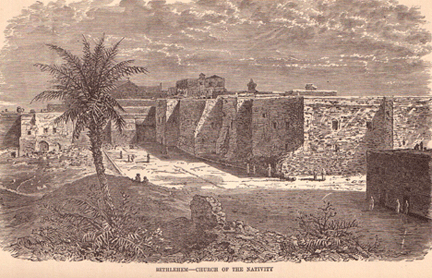
Situated on a fruitful ridge about six miles south of Jerusalem, overlooking the Valley of the Kedron on the north, and the deep chasm of the Dead Sea on the east, is Bethlehem of Judea, to the Christian the holiest place on earth.

It is one of the oldest villages in Palestine, and associated with some of the most stirring events in the religious history of the world. Here Ruth gleaned after the reapers of Boaz; here the youthful David kept his father’s flocks, and was annointed King of Israel; here, also, Jeremiah, after denouncing God’s terrible judgments upon the people, foretold the coming of “The Lord of Righteousness;” and here the shepherd’s who watched their flocks by night were startled by the angelic song announcing the Messiah’s birth, and proclaiming the evangel of “peace on earth, and good-will toward men.”

The name signifies the Hosue of Bread, and truly it may be said, Bethlehem has given to our perishing race the bread of eternal life. What countless millions have feasted on this heavenly loaf!

As we rode along the well-beaten path leading from Jerusalem, crowded with pilgrims from all lands going up to visit the place that gave birth to the Saviour of mankind, what old memories were awakened! Continue reading Buried Texts Recovered: An American Consul goes to Bethlehem, 1

Buried Texts Recovered: An American Consul in the Holy Land

“The author’s object in accepting an appointment under the United States Government was not the honor or emoluments of office, but a desire to visit the lands of the Bible, that he might see for himself how far the manners, customs, and traditions of the people and topography of those countries agreed with the inspired word.”

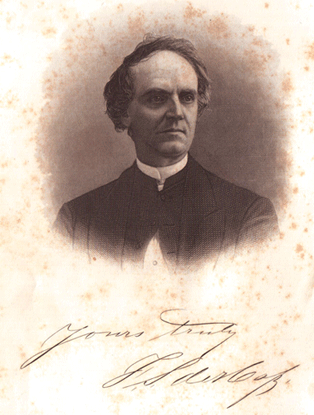
So begins one of the numerous 19th century Bible customs travel accounts by Christian enthusiasts able to travel to their “Holy Land.” The author is Frank S. DeHass, who served as the United States Consul in Palestine in the mid 19th century. His text is aptly entitled Buried Cities Recovered, or, Explorations in Bible Lands, giving the results of recent researches in the Orient, and recovery of many places in sacred and profane history long considered lost. My copy, handed down from my grandmother, was published in 1886 in Philadelphia by Bradley & Company; the tenth edition no less! This is a wonderful read and you can read the entire book online, thanks to Google Books.

Like so many other Bibliophiles of his generation, DeHass extols the virtue of actually visiting the land where Jesus was born and died. In his own words:

Recent explorations in the East have resulted in the recovery of many places in sacred and profane history long regarded as lost; and as the facts brought out by these researches are not accessible to the general reader, the author has compiled them in this concise form, and at the request of numerous friends gives them to the public, not as a scientific work for the antiquarian, but as a humble contribution to Biblical archaeology for the home circle, believing that such a volume will add greatly to the elucidation of the Scriptures, and serve to correct some of the errors which many travellers have fallen into by a too hasty or superficial view of the places visited. Continue reading Buried Texts Recovered: An American Consul in the Holy Land

Rediscovering the Uncovering of King Tut


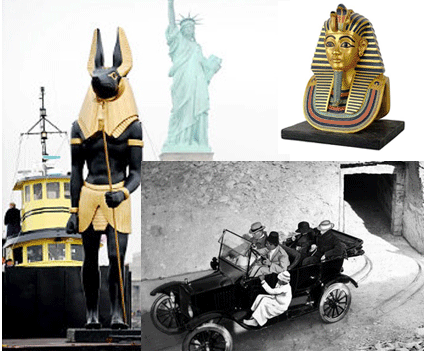
bottom right, Car used to transport Lord Carnarvon to and from Tut’s tomb in the 1920s

Conspiracy theorists and Hollywood movie moguls love King Tut. Take a young boy who becomes Pharaoh at age 9, only rules for a decade, marries his sister, and whose long forgotten tomb with gold aplenty is discovered in full media light in the Roaring 20s … and what do you have: an Ancient Egyptian prequel to Star Wars. Add to it a curse like “Death shall come on swift wings to him who disturbs the peace of the king” and there is even more mummy stardust. But the curse has it wrong; it should have read “Profit shall come on swift wings to him who distributes as many pieces as possible about the king.” Millions of people worldwide have read about King Tut, stood in line to see the major exhibitions and come under the spell of the glittering gold. I remember the long lines outside the Met in 1976, the emptiness on descending tourist-style into King Tut’s tomb in the Valley of the Hidden Kings, and the less than spectacular ambiance of Tut’s remains in Cairo’s old museum.

Yesterday I had the opportunity to rediscover Tut in the exhibit still running at the Discovery Times Square Exhibition. But hurry, if you are in New York, because Tut moves on to another set of paying admirers after January 17. Continue reading Rediscovering the Uncovering of King Tut

Loving Yemen


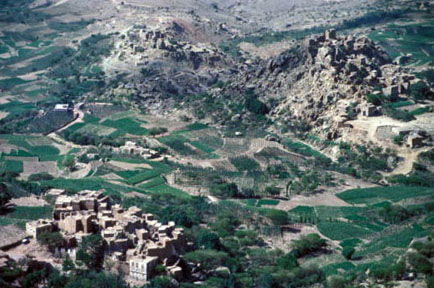
Yemen is not quite the desert journalists dream up

The journalistic war talk on terror took a sidestep over the past week or so as commentators sought to tweak the Wikileaks for all they could be imagined to be worth. Here was cable-ready proof that diplomats do not believe exactly what they say in public, that rulers are not always stable and “secret” communication may be secret for a reason. Ah, yes, diplomats with no clothing. But now it’s back to Al Qaeda. In a recent commentary for The Christian Science Monitor, a former senior international correspondent for CNN, Walter Rodgers, weighs in on Al Qaeda in Yemen.

The result is a prime example of run-of-the-treadmill sinthetic (spelling intended) reportage. All the right people are quoted, those who actually know something about Yemen. This includes a former ambassador, Barbara Bodine, a historian, Bernard Haykel and a young political scientist, Gregory Johnsen. Each is granted a short quote, although the reader has no idea what the full context of each comment was. So Ambassador Bodine at some point said “The issue is geography,” which clearly needs explanation. Unfortunately Rodgers flunks his geography lesson. Yemen is not “nearly all mountainous desert.” The only true desert areas in Yemen are along the coast and entering the Arabian desert, not in the mountain valleys and plateaus.

The journalist’s geographical blunders are equaled by his historical ignorance. Continue reading Loving Yemen