All posts by dvarisco

Gaddafi: odd and daffy to the end


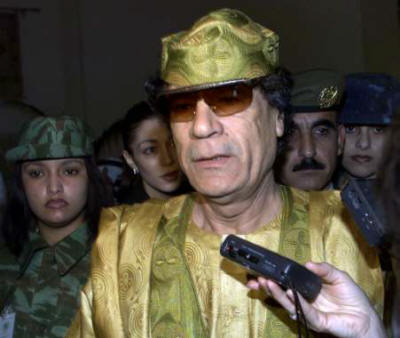
After the outing of two long-standing autocrats in Tunisia and Egypt, the domino theory pizza delivery is now at the shores of Tripoli. What can one say about Colonel Muammar Gaddafi that does not sound like a bad Hollywood movie? He is, of course, also a dear friend of Italy’s clown prince Berlusconi. If Gaddafi did not exist in his Libyan tent, guarded by a bevy of young ladies, Monty Python would have invented him. Here is a guy who came to power at age 27 in the year that Led Zeppelin dominated the pop chart with ‘Whole Lotta Love.” That was over four decades ago. It appears that in Libya today there is not a whole lotta love for this odd and daffy caricature.

Gaddafi is too easy to satirize. Blaming Al-Qaeda for putting drugs in the coffee of young Libyans is about as bizarre a claim as one can imagine. One of the few admirable qualities may be that Gaddafi never promoted himself to General; although he hardly needed to do so given his absolute power. His ruthless response to the recent peaceful protests follows on his long history of brutality against Libyans who dare to oppose him. At present he is clinging on to power in Tripoli with mercenaries and a few surviving “loyal” supporters. Those who stand to lose may stay “loyal” for the moment, but as his power grip nears the end I suspect he will have few if any willing to follow him into exile (or die fighting). Thus far perhaps as many as 2,000 Libyans have been killed with indiscriminate firing in the squares and side streets. The scene has become far uglier than anything that transpired in either Tunisia or Egypt. Fortunately, it appears that a large part of the army has deserted Gaddafi. Continue reading Gaddafi: odd and daffy to the end
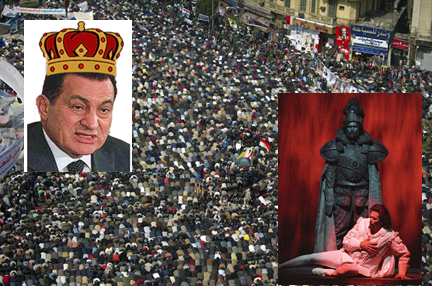

Hosni Mubarak and Don Giovanni


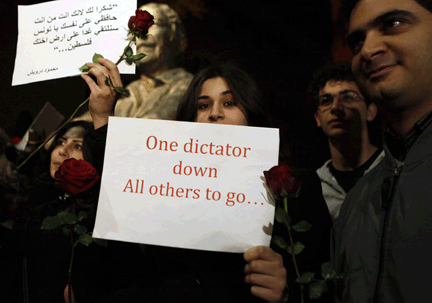
Eighteen days and no longer counting. On this day of farewell, although the wellness wished was not very strong for Hosni Mubarak among the thousands upon thousands of protesters gathered today in Tahrir Square, the Pharaoh left Thebes for good. There have been so many questions swirling in central Cairo and streaming into households worldwide that none of the thousands of pundit-pandered answers were able to satisfy. Never has a revolution been witnessed by so many people; never have so many questions been asked with so little ability to predict precisely what would happen. Will he leave? Or perhaps, more likely, when will he leave? Or, perhaps, has he already exited, stage right? Now we know, Mubarak has resigned.

Yesterday there was a brief spell of hope that Mubarak had finally accepted his fate. I attended an Egyptian event in Manhattan about as far away from the protests in Tahrir Square as can be imagined. This was a performance of Mozart arias translated into Arabic, some into Egyptian dialect. A friend arrived full of relief, having heard the earlier news that Mubarak was planning to leave. The old man’s long and self-serving speech seemed to squelch any hopes for that; the sighs and groans of the unified Egyptian spirit of protest could then be heard around the world. During intermission a long-time Egypt watcher told me that Mubarak will not leave and violence was sure to start up again. Thankfully, he was wrong. Continue reading Hosni Mubarak and Don Giovanni

Streaming Revolution, Screaming Revolution


Al Jazeera offers live coverage of events in Egypt on the internet

Not even Rupert Murdoch, the media mogul who I suspect lies awake at night (just as many of his news outlets lie throughout the day) thinking of new ways to manufacture news, could have imagined the current crisis streaming live on the cable channels and over the Internet for well over a week. America has had its tea party and birthers with Fox gobbling up Sarah Palin to supplement the loonies already on the payroll. I suppose the Israel/Palestine issue was getting too stale, so why not a domino fury across North Africa and the Middle East? No, Murdoch did not cause the overthrow of Ben Ali, the massive anti-Mubarak protests in Egypt, the ripple effect of less virulent protests in Yemen, Jordan, Syria, and Sudan. There are very good local reasons why the streets are filled with angry people from all walks of life (well not the corrupt elites who benefit from dictatorial spoils).

It is not about hating the United States, not when the signs spell out freedom and democracy instead of “Death to America.” It is not even about Islam, certainly not the silly rantings of Glenn Beck that a new chalkboard caliphate is in the making. It is about frustration that reached the boiling point, the astronomical rises in food costs, the lack of jobs, the growing income gap between the average person and friends of the regime. When you have a president alleged to be worth 40 billion dollars, you get the picture of why there has not been an end to the takeover of Tahrir Square in Cairo. Continue reading Streaming Revolution, Screaming Revolution

Yemen is Not Tunisia, not Egypt

Yesterday I published a commentary on CNN Opinion about the recent protests in Yemen. I attach the start of this here, but the full account can be read at CNN.com.

(CNN) — “Yemen is not Tunisia.” These were the words that President Ali Abdullah Saleh spoke to his people on television last Sunday.

As street protests erupt in Yemen’s capital, it is not surprising that an Arab leader who has held power since a bloodless coup in 1978 would dismiss calls for his ouster.

But he was correct.

Although his regime has been accused of corruption, Saleh is no Zine El Abidine Ben Ali of Tunisia, nor even Hosni Mubarak of Egypt. Instead of using an iron fist, he has maintained power by cleverly playing off rivalries among tribal, religious and political divisions.

When he became president of North Yemen, he allied himself with Sheikh Abdullah al-Ahmar, who headed the most powerful tribal alliance in the North. After negotiating the unification of Yemen’s North with the socialist South in 1990, Saleh fostered a climate of grass-roots democratization before outmaneuvering the socialists for total control of the country.

Power is shared in Yemen largely because of the continuing local importance of tribal affiliation. This is not always understood. A major conflict near Yemen’s border with Saudi Arabia, for example, has been wrongly characterized as an Islamist rebellion. Like most political conflict in the region, the battle has religious overtones, but it is mainly over tribal autonomy…

I was interviewed this morning for the program Worldview of WBEZ in
Chicago and this interview aired today but is archived on the website.

Daniel Martin Varisco

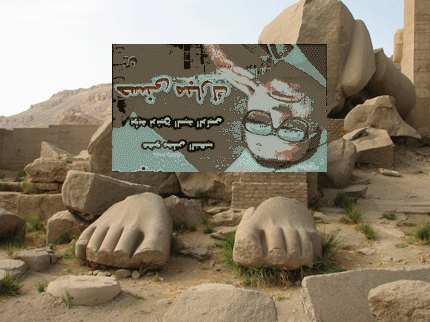
Ozymandias Redux


One of the great Victorian Orientalist poems, Ozymandias, was penned by Percy Bysshe Shelley almost two centuries ago in 1818. Substitute the name “Hosni Mubarakias” and experience the déjà vu that is Egypt, and indeed the entire world.

I met a traveler from an antique land
Who said: “Two vast and trunkless legs of stone
Stand in the desert… Near them, on the sand,
Half sunk a shattered visage lies, whose frown,
And wrinkled lip, and sneer of cold command,
Tell that its sculptor well those passions read
Which yet survive, stamped on these lifeless things,
The hand that mocked them and the heart that fed;
And on the pedestal these words appear:
My name is Ozymandius, King of Kings,
Look on my works, ye Mighty, and despair!
Nothing beside remains. Round the decay
Of that colossal wreck, boundless and bare
The lone and level sands stretch far away.”

The memories of past kings and pharaohs are not sacred, as looters were able to enter the Cairo Museum and damage some of the objects there. Looting is as old as the pyramids. Such was the fate with most of the pharaohs’ well concealed (and conceited) wealth for the afterlife. Now the objects preserved in the museum are also in danger.

Egypt will survive the fall of its latest pharaoh, but right now the sneer of cold command is once again sinking in the sand.

All Eyes on Egypt


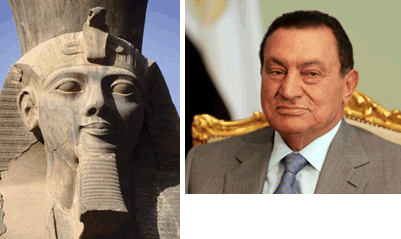
Ramses II, left; Mubarak I, right

About a month ago I visited the King Tut exhibit in New York. Here was the splendor of one of the minor pharaohs of Egypt, one that died at a very young age. Other pharaohs reigned for a lifetime, such as Ramses II who was in power over three millennia ago and ruled the mighty Egyptian empire for more than half a century. Hosni Mubarak on the Nile is no pharaoh any more than Saddam Hussein was Nebuchadnezzar on the Euphrates. Still, he has been in power almost three decades with a son said to be waiting in the wings for succession. But it is unlikely that he will match Ramses, and not simply because he would be over a century old if he did. The words of the Prophet Daniel, for a different time and place, are apt: mene mene tekel upharsin.

A Greek historian noted about the same time as Daniel that Egypt was a gift of the Nile. Not much has changed, since the vast majority of Egypt’s population lives along this river, including its delta at the Mediterranean. One of the major changes is the population density. With over 80 million Egyptians on the narrow strip along the Nile and southern Mediterranean coast, there is hardly an Egyptian more than a stone’s throw from water. When I worked on a sanitation project in 1981 for USAID, I visited a number of “villages” in the governorates of Asyut and Minufiyya. I say “villages” because of the lack of services, since some had more than 10,000 residents. At the time, as USAID was scrambling to spend development money promised to Egypt in the aftermath of Sadat signing a peace agreement with Israel, many people thought the problems in the country insurmountable. Continue reading All Eyes on Egypt

Tuning into Tunisia

The recent revolution in Tunisia has exploded across the blogosphere, with pundits talking about a popular tsunami that may promote democracy out of the ashes of a lifelong dictatorship. In yesterday’s New York Times, Roger Cohen provided an optimistic view from his journalistic perch in Tunis: “These are heady days in the Arab world’s fragile democratic bridgehead.” Cohen, and others, are wondering aloud if Tunisia can become the new Turkey, a more or less secular democracy in which the “Islamists” are moderate members of a political mosaic. If so, then he warns that the “tired refrain of all the Arab despots that they are the only bulwark against the jihadists will be seen for the self-serving lie it has become.”

Perhaps, but one does not have to go far back into the regime of Saddam Hussein to realize that his Ba’athi party did not tolerate religiously motivated sectarian violence. Brutal as it was, his regime was a bulwark (if such a metaphor really makes sense politically) against the continual round in “liberated” Iraq of sunni killing shi’a and vice versa. But then Saddam was not brought down by a popular street uprising. Continue reading Tuning into Tunisia

Guns don’t kill, neither do guns die


For the past week the American media has been fixated on an act of violence that has left six dead and wounded fourteen, including Arizona representative Gabrielle Giffords. Last night President Obama, in a stirring and emotional speech at a memorial service for the victims, urged Americans not to use this tragedy as a staging ground for the usual politics of blame:

But what we can’t do is use this tragedy as one more occasion to turn on one another. As we discuss these issues, let each of us do so with a good dose of humility. Rather than pointing fingers or assigning blame, let us use this occasion to expand our moral imaginations, to listen to each other more carefully, to sharpen our instincts for empathy, and remind ourselves of all the ways our hopes and dreams are bound together.

Beneath the brief aura of civility in this tragedy’s aftermath there lingers an ongoing current of uncivil rhetoric, fueled in large part by media pundits eager to gain an audience. The blame has already been assigned over and over again. In this particular case it appears that the killer, Jared Lee Loughner, was an emotionally disturbed individual who acted on his own. Thus, it is no surprise that a Tea Party icon like Kentucky’s newly elected senator Rand Paul would go on Fox News and remind us all: “But the weapons don’t kill people. It’s the individual that killed these people.”

It certainly is true that the Glock 9 mm pistol did not go off on its own, so obviously there is no need to punish the gun involved in this case, nor even the bullets used. The problem is that if we claim that guns don’t kill, we must also admit that guns don’t die either. Continue reading Guns don’t kill, neither do guns die