All posts by dvarisco

The State of Agriculture in Late 13th Century Rasulid Yemen, #2

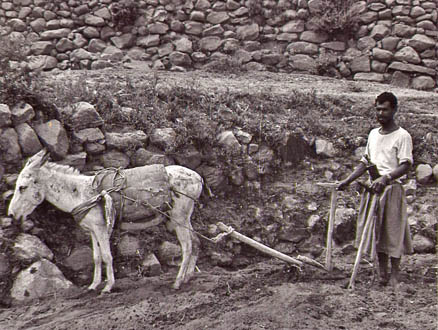
Yemeni tribal farmer in al-Ahjur, Central Highlands

By Daniel Martin Varisco

[In 2003 I attended a conference in Rome and gave a paper which was eventually published in Convegno Storia e Cultura dello Yemen in età Islamica, con particolare riferimento al periodo Rasûlide (Roma 30-31 ottobre 2003 (Accademia Nazionale dei Lincei, Fondazione Leone Caetani, 27, pp. 161-174, 2006). As this publication is virtually inaccessible, I am reprinting the paper here (with page numbers to the original indicted in brackets). For the previous part of this article, click here. The references are provided at the end of the first entry.]

VIEWING THE FIELD THROUGH AL-ASHRAF’S AGRICULTURAL TREATISE

I begin with al-Muẓaffar’s short-reigned son, al-Malik al-Ashraf Yūsuf, whose treatise Milḥ al-malāḥa not only defines the genre of Rasulid agricultural texts but is a primary source for the later, larger and more cosmopolitan Bughyat al-fallāḥīn of al-Malik al-Afḍal al-‘Abbās, which has been studied in part by the late Professor Serjeant. (5) Milḥ survives in at least two copies, both defective; one is in the Glaser collection in Vienna and the other was discovered in southern Yemen less than two decades ago by ‘Abd al-Raḥīm Jāzm. This consists of seven chapters. The first deals with the knowledge connected to times for cultivation, planting and preparing land. The next five chapters are arranged according to the type of crop or plant, with elaborate details on how each is cultivated. The final chapter, which has not yet been found apart from quotations in the Bughyat, discusses agricultural pests. The information provided on crops is almost exclusively for Yemen, unlike the penchant of the later Bughyat’s author to quote extensively from earlier non-Yemeni sources such as Ibn Waḥshiya and Ibn Baṣṣāl. Indeed, there is no explicit mention of other texts in Milḥ.

After the obligatory salutation of thanks, al-Ashraf begins his treatise with a poetic quatrain:

Fa-hādhā kitāb jama‘atuhu bi-ḥasab al-ṭāqa wa-al-ijtihād
wa-ista‘tab ‘alā dhālik bi-rabb al-‘ibād.
Waḍa‘tuhu ‘alā ḥukm iṣṭilāḥ ahl al-ma‘rifa fī al-Yaman
ba‘d al-baḥth ma‘ahum fī kulli mā fīhi min ṣanf wa-fann.
[p. 164] “I compiled this book according to diligence and capability
and solicit for proof of this the Lord of all humanity.
I recorded it from the wise practice of those Yemenis who know
only after research among them for all that is within their classifying and artful show.”

Continue reading The State of Agriculture in Late 13th Century Rasulid Yemen, #2

The State of Agriculture in Late 13th Century Rasulid Yemen


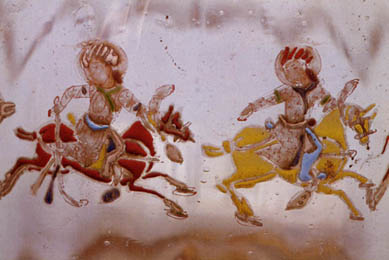
Rasulid polo players

By Daniel Martin Varisco

[In 2003 I attended a conference in Rome and gave a paper which was eventually published in Convegno Storia e Cultura dello Yemen in età Islamica, con particolare riferimento al periodo Rasûlide (Roma 30-31 ottobre 2003 (Accademia Nazionale dei Lincei, Fondazione Leone Caetani, 27, pp. 161-174, 2006). As this publication is virtually inaccessible, I am reprinting the paper here (with page numbers to the original indicted in brackets).]

INTRODUCTION AND SOURCES

[p. 161] About seven and a half centuries ago the second Rasulid sultan, al-Malik al-Muẓaffar Yūsuf ibn ‘Alī, was thrust into power in his youth after his father’s murder, just about the time the Genoan Marco Polo was born. The overlap between the Italian merchant mercenary and mercenary descendant sultan is fraught with irony. Al-Muẓaffar, the untested state builder came to power just a decade before the overthrow of the Abbasid caliphate, which had blessed Rasulid rule as a buffer against the Zaydī imams of Yemen’s northern highlands, while the future Italian diplomat set out on his trek only a decade or so after the Mongols had destroyed Baghdad. Polo was destined to serve an aging Kublai Khan, returning to Italy in 1295, the very year that the seventy-year-old-plus Rasulid ruler died. When Polo referred to the immense wealth of the sultan of Aden, “arising from the imposts he lays” in the Indian Ocean trade, he meant al-Muẓaffar. Marco Polo and al-Malik al-Muẓaffar never met, except in print, but the world that they both embraced was centered on an important trade network linking the Mediterranean and Africa with Persia, India and ultimately the lands of the great Khan.

Fortunately for the Rasulids, the merciless Mongol warriors never reached Yemen, apart from a few individuals who later assisted a Yemeni sultan in compiling a “King’s Dictionary” also known as the “Rasulid Hexaglot.” (1) [p. 162] Yemen also escaped the incursions of crusading medieval knights, although the legacy of Saladin played a major role in defining its political fortunes until the arrival of the Ottoman garrisons and Portuguese galleons in the sixteenth century. My focus is on the zenith of the Rasulid era near the end of the long reign of al-Muẓaffar, the preeminent state-builder of the dynasty. By 1252 he consolidated his hold over the coastal zone (Tihāma), southern highlands and Aden, as well as achieving periodic control over á¹¢an‘ā’, thus driving the ZaydÄ« imams back to their firm base in á¹¢a‘da. The sultan’s forces in the late 1270s took control, by land and by sea, of the important southern harbors at al-Shiḥr and Dhofar, two important sailing venues along the trade route to the Persian Gulf and India. In 682/1283, despite the ZaydÄ« loyalties of many of the tribes, al-Muẓaffar was able to briefly take hold of á¹¢a‘da, even striking coins there. Military success led to increased diplomatic recognition for the Rasulids; later delegations are described in the chronicles as arriving from Persia, Oman, India and China. Fortunately, al-Muẓaffar was an avid patron of architecture and learning, so that the material and written records of Rasulid activities are quite extensive. (2) Continue reading The State of Agriculture in Late 13th Century Rasulid Yemen

Be careful what you pray for


Today’s New York Times contains a commentary by Timothy Egan on “Rick Perry’s Unanswered Prayers.” Perry, who today is declaring his bid for the Republican presidential nomination, has been governor of Texas since his predecessor George W. Bush left that office to become president. Despite the fact that both Bush and Perry wear religion on their sleeve, the front of their chest, indeed on just about every bit of clothing (I am not sure about tattoos), both seem to have a poor record of getting their God to do their bidding. Unless this God west of the Pecos has a wicked sense of humor, I think the debacle of the Iraq War is an answer only to the prayers of arms dealers and Blackwater International. But Perry has no problem putting the ball (like the economy or the drought in Texas) in Jehovah’s court. Last April he declared a three-day prayer for rain. Not a drop has fallen since. Now he thinks the time is ripe for another Texas governor to run for president. Let us all hope he does not have a prayer.

I mention this goobernatorial prayer fiasco as a contrast to an istisqā’ (Islamic prayer for rain) that I witnessed in the highlands of Yemen in the spring of 1979. At that time, when I was conducting ethnographic fieldwork in a highland valley full of tribesmen and women (with nary a terrorist in sight, as is the case today), the usual spring rains were late in coming. There is within Islam a specific prayer that the community can offer up to Allah in times of drought. I have no way of knowing whether Allah has a better track record of sending rain than Jehovah does in Texas, but here is my own experience. Continue reading Be careful what you pray for

No food for thought


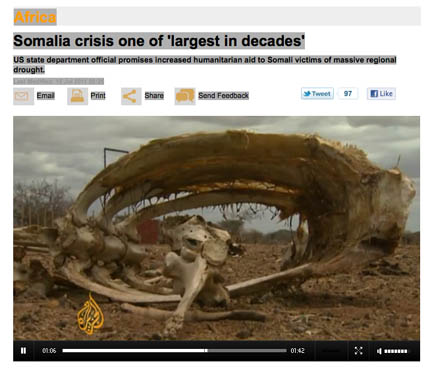
Politics trumps virtually every other kind of news until a natural disaster breaks through. For those of us watching the daily reports of protests in the Middle East and North Africa, it is easy to be absorbed by the sheer amount of coverage and websites available. This morning I noticed two “front page” stories that stopped me in my tracks, one in the New York Times and the other a special report on the website of al Jazeera. Freedom from dictatorial rule is a dream shared across a spectrum of people, and not only in this part of the world, but there is no ultimate freedom from Nature.

Drought is as much a killer as any ruthless dictator, which is not to diminish the negative impact of even the worst of the lot. But Saddam met his fate, as will Qaddafi. With all our technological savy, however, Nature still calls the shots, whether it is a tsunami, hurricane or prolonged drought. There is a cruel irony that some places have far too much water, especially at the wrong time, and others have no water all. No place is more miserable both politically and from drought than Somalia, a land that has been racked with civil war creating one of the worst humanitarian crises around (and there are quite a few). The camp of Daabab just across the Kenyan border already has hundreds of thousands fleeing the turmoil in Somalia. The UN estimates that 10 million people in the Horn of Africa are suffering directly from this crisis. Picture what this number means. If these people were lined up so that each one took only one foot of space the line would stretch over 630 miles. This means that if a bread line started in Boston and stretched south to Washington, D.C. it would still have almost two hundred more miles to go before it would end. A car driving the distance would take at least ten hours. And this is just for the crisis in the Horn.

What if the money spent on military weapons per year were actually spent on food aid and development assistance to people who are in danger of dying? The drones sent to destroy suspected terrorists in Afghanistan, Iraq and Pakistan (and now in Yemen) cost about 4.5 million each. The U.S. just gave Kenya an extra 5 million dollars in aid to help cope with the influx of refugees, about one drone’s worth. As Mark Twain said in a speech in 1881, war is “a wanton waste of projectiles.”

Daniel Martin Varisco

On Mahometism, 1833 style: #2


A History of the Church, p. 95

One of the books owned by a great, great aunt of mine in Cleveland was A History of the Church, etc., published in 1833. In a previous post, I offered some excerpts from its coverage of “Mahometanism.” The author is a certain C. A. Goodrich, who is decidedly Protestant and as unfriendly to Roman Catholicism as he is to Islam and Hinduism. Near the end of the book is a section entitled “The Story of the World” by Josiah Conder, originally published in the Missionary Annual for 1833. Its comments on the various religions, including Islam, is quite fascinating, again as a reflection of a time when the United States was barely half a century old. Continue reading On Mahometism, 1833 style: #2

An American Treaty on Religion


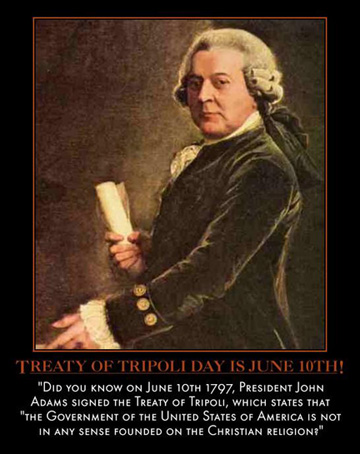
Yes, a treaty and not a Humean treatise, although Hume’s treatise on Religion no doubt had an influence on the creators of the text. The third treaty established by the young United States, recently liberated from British rule, with the nations of the “Barbary Coast” was with the Bey of Algiers in 1797. Like the earlier two treaties, the focus was on maritime trade in the Mediterranean and the problem of Barbary “pirates” as well as neutrality of the Barbary states when the U.S. was battling other “Christian” powers. Our Founding Fathers (for surely those members of Congress in 1797 were as close to being Founding Father’s as Sarah Palin’s contorted dubbing of John Quincy Adams, who had just turned 20 and had yet to enter politics) were obviously not working hard to free slaves (as these treaties will bear out), but they did stress a point that many rightwing pundits conveniently gloss over: the United States was not created as a “Christian nation.”

As you read the treaty below, in celebration of the 4th of July, note article 11 in particular. It turns out that the translation provided to Congress by Joseph Barlow, is not very accurate and the original Arabic version did not contain what we find in Article 11. But in fact, Congress never knew that and only saw the version printed here; this was accepted unanimously and then acknowledged as well by President John Adams at the time. So it was certainly not the contention of the Dey of Algiers that the U.S. was not a Christian nation, but an idea that resonated well with the young Congress.

Treaty of Peace and Friendship, signed at Tripoli November 4, 1796 (3 Ramada I, A. H. 1211), and at Algiers January 3, 1797 (4 Rajab, A. H. 1211). Original in Arabic. Submitted to the Senate May 29, 1797. (Message of May 26, 1797.) Resolution of advice and consent June 7, 1797. Ratified by the United States June 10, 1797. As to the ratification generally, see the notes. Proclaimed Jane 10, 1797.

[Translation]
Treaty of Peace and Friendship between the United States of America and the Bey and Subjects of Tripoli of Barbary.

ARTICLE 1.
There is a firm and perpetual Peace and friendship between the United States of America and the Bey and subjects of Tripoli of Barbary, made by the free consent of both parties, and guaranteed by the most potent Dey & regency of Algiers.

ARTICLE 2.
If any goods belonging to any nation with which either of the parties is at war shall be loaded on board of vessels belonging to the other party they shall pass free, and no attempt shall be made to take or detain them.

ARTICLE 3.
If any citizens, subjects or effects belonging to either party shall be found on board a prize vessel taken from an enemy by the other party, such citizens or subjects shall be set at liberty, and the effects restored to the owners. Continue reading An American Treaty on Religion

On Mahometanism, 1833 style


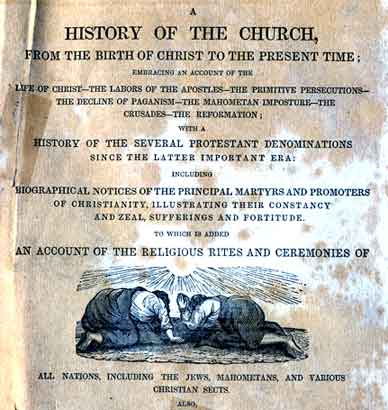
One of the books owned by a great, great aunt of mine in Cleveland was A History of the Church, etc., published in 1833. The bottom of the frontispiece is torn, so I do not know the publisher, although I suspect it was printed in Boston. It is a general history of Christianity with extended comments on other religions, including “Mahometanism.” The author is a certain C. A. Goodrich, who is decidedly Protestant and as unfriendly to Roman Catholicism as he is to Islam and Hinduism. Several parts of the text, which stretches a robust 504 pages, deal with Islam and are interesting for the biased perspective of the time. The history of the Church is according to periods, and Period V is labeled “The Rise of Mahometanism” (at the top of the pages of the chapter); the longer title is “The Period of the Rise of the Mahometan Imposture will extend from the establishment of the supremacy of the Roman Pontiffs, A.D. 606, to the first Crusade, A. D. 1095.” Period VI covers the Crusades, followed by the Reformation and then a very long chapter on the Puritans.

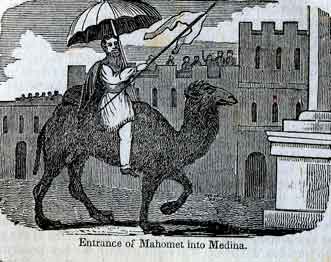
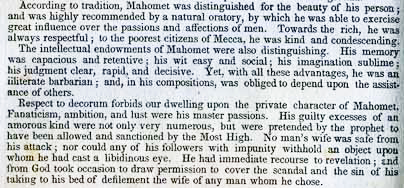
At the start of the section is a small lithograph of Muhammad, mounted on a steed with a sword in hand. Some of the information is descriptive; some even praises Muhammad, but it is clear that the author despises Islam as the excerpts below well show:


A History of the Church, 1833, p. 96

Continue reading On Mahometanism, 1833 style

Aesop’s Fabulous Camels #1


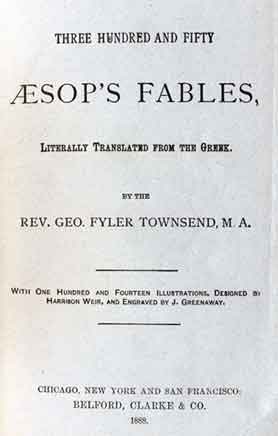
One of the joys of returning home to where I was born is going through the books that my grandmother once owned. One of these is an 1888 edition of Aesop’s Fables, translated by George Fyler Townsend, as shown in the frontispiece above. The cover, which is dark brown, notes it is a “Caxton Edition” and includes a marvelous quote from Thomas Carlyle: “May blessings be upon the head of Cadmus, the Phoenicians, or whoever it was that invented books.” I suppose today we must add: “And curses upon the creator of the Internet idea of an e-book.” As noted in the preface, not all of these tales date back to Aesop; some indeed were thought up by Christian monks in the Middle Ages. According to the same preface no book, apart from the Bible, had a wider circulation in the era just prior to the printing press.

After commenting that these fables have been translated into languages, East and West, the preface continues by saying that they “have been read, and will be read, for generations, alike by the Jew, Heathen, Mohammedan, and Christian” (p. xviii). In leafing through the fables I found several that talk about camels and one that refers to an “Arab.” Aesop might be surprised to find these, but since it is all Greek to me I am not sure how fluent he might have been with the unflappable ship of the desert.

In this post I provide two of the fables, with the rest to come in a future post. Continue reading Aesop’s Fabulous Camels #1