All posts by dvarisco

Camping Out for the Rapture


You may remember that May 21, 2011 was supposed to be the day the music stopped, well at least Gospel songs, since all the “real” Christians were supposed to be raptured into the air so that all hell could finally break loose here on earth. This was one of several predictions of the apocalypse by Rev. Harold Camping, who runs a “Family Radio” Bible-debasing empire. When May 21 passed, Rev. Camping when back to the numbers and lo and behold there was a new date of October 21, 2011. As he put it on his website, which has not been changed in the past several days:

Thus we can be sure that the whole world, with the exception of those who are presently saved (the elect), are under the judgment of God, and will be annihilated together with the whole physical world on October 21, 2011, on the last day of the present five months period. On that day the true believers (the elect) will be raptured. We must remember that only God knows who His elect are that He saved prior to May 21.

Mr. Camping and his followers are still here, so either the date is wrong again or perhaps the truth is that all the “real” Christians were indeed raptured out of this world but in fact there were none left, even Billy Graham, for the big event. There are a number of Christian groups who insist other Christian groups are not really Christian, such as the attack on Mitt Romney as a heretic Mormon or the man who on the day after the world was supposed to end disrupted a canonization ceremony in the Vatican and burned a Bible. Given that there are also Muslim groups which insist certain other Muslim groups are not really Muslim, perhaps there are no “real” believers at all, at least not in the narrow sense of the Campings and Ibn Taymiyas of this world.

This time around, without the “Family Radio” media campaign on billboards, there were other important news items; there were actually plenty of important news items back on May 21 as well, but this time there were no annoying reminders on Facebook that the secular jig was up. There will be more dates proposed and no doubt more gullible individuals will stand ready to be beamed up to Beulah Land. Camping might take some note of hope in the fact that Turkey has just experienced an earthquake, although it came a couple of days after the “for sure” Biblical date. And, after all, Turkey is mainly a Muslim country. But then we had a quake here on the east coast a month or so ago (perhaps Camping believes our President is secretly a Muslim, like some 20% of Americans and 30% of Republicans apparently think).

You might be wondering why yet another failed end-of-the-world prediction by a Bible-belabored Christian who thinks he is one of the few “real” Christians is worth a commentary on a blog devoted to thoughts on Islam and the Middle East. For most Americans, even the bulk of self-styled “evangelicals,” Camping represents a lunatic fringe. As the votes are being tallied in Tunisia, Egypt prepares for a vote, Libya begins the process of picking up the pieces after Qaddafi’s exit and Yemen is still waiting for Godot (I mean Ali Abdullah Salih) to go, there is a fear among many Americans that after the dictators another form of lunacy will take hold: Muslims who argue that only “their” way of being Muslim is valid. Actually, this problem is quite widespread and it is not as simple as Sunni vs. Shi’a, although that is an old and convenient fault line. Continue reading Camping Out for the Rapture
Lecture in New England


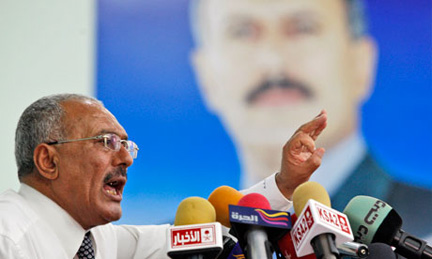
On Monday, October 24, 2011, I will be delivering a lecture entitled “What’s Happening in Yemen?” at the Portland campus of the University of New England in WCHP Lecture Hall at 6 pm. For more details click here.

This talk will focus on the impact of the “Arab Spring” political protests that started in Yemen, located at the southwestern corner of the Arabian Peninsula, in February. These led to unrest that brought the country to the brink of civil war and economic collapse. Yemen has been ruled by a military leader, Ali Abdullah Salih, who came to power in 1978. In 1990, North and South Yemen were united, followed by a brief civil war in 1993. Before the recent protests there was a secessionist movement in Yemen’s south and an open tribal rebellion near the border with Saudi Arabia. In the past decade the United States has given millions of dollars in aid to President Salih to theoretically combat al-Qaida in Yemen. Questions addressed include the influence of conservative Saudi-backed salafism, the nature of Yemeni tribalism, the role of youth and students in protesting for their own future in a democratic Yemen, and the exaggerated fears about Yemen as a terrorist haven. President Salih once remarked that ruling Yemen was like dancing on the heads of snakes. Now that the snakes have bitten, what is next?

Sic gloria mundi transit


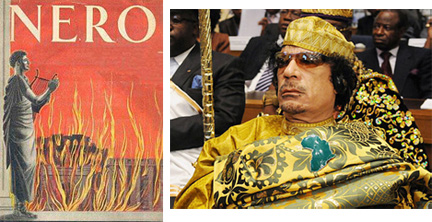
There is a phrase in Latin that seems to have been invented for the free fall of dictators in this year’s Arab Spring. Italian Prime Minister Berlusconi mentioned it when commenting on the death of Libya’s Qaddafi. Sic gloria mundi transit: the glory or fame in this world is fleeting. The man once styled the king of African kings is dead; long live an alternative to the agony and bloodshed that military coups and foreign meddling create. The killing of Qaddafi is a celebration for those who were brutalized during his regime of more than four decades and understandably so. But vengeance and reprisals need to be transit, in the Latin sense, as well. The focus of positive hate must be to change the system of corruption that allows any single person to have such absolute power. Countries do not need dictatorial “fathers” and citizens are not children to be ordered about or slaves to be disposed of at the whim of a self-styled master.

There is a deeper lesson in the Latin phrase, a poignant reminder that Rome had its Nero and Caligula. Every age and every place has its would-be masters, who have a tendency it seems to become delusional when there are no checks on their ability to control wealth and weaponry. The Abbasid caliph Mansur, for example, attempted to exterminate his main opposition of Shi’a who questioned the legitimacy of his caliphate. The story is told that after his death, his annointed heir and son al-Mahdi found a locked room in which there were carefully placed the mummified bodies of all the prominent Shi’a men that his father had killed, each with a name plate attached; all of this monstrous monument enmeshed in a trove of gems, precious jewelry and dinars. The gloria of the Roman Empire and of the Abbasid Empire (and the list goes on and on and will never end) is fleeting in hindsight, but not, of course, to those who fell victim to the brutalities or lived to mourn the atrocities.

All eyes are on Libya now to see what will come out of the ashes of a madman’s playground. Hail to the Libyan people but hell to the would-be caesars…

The Peace Push and Shove

As readers of Tabsir can easily see, I am no friend of dictators or military rulers masquerading as democratic demagogues. The fall of Ben Ali, Mubarak and Qaddafi is a welcome sign, even though it is not clear that the people will be able to achieve the kind of government most want. In Yemen the handwriting and a smatter of twittering is on the wall for Ali Abdullah Salih. He has held on to power far too long, allowing for an ugly power grab that could have been avoided if he had done the noble thing and stepped aside earlier, when given ample chance. But Salih is not Asad and Yemen is not Syria. The swell of the Arab Spring has somehow thrown all the dictators into one soup, one overly ladled with self-righteous indignation. Hatred for the man at the top is clouding the pragmatic need for effective political reform.

Yesterday the recent Nobel Peace Prize recipient, Tawakkul Karman, came to New York and demonstrated outside the U.N. It should be noted that her efforts in Yemen, as one among many individuals organizing the widespread protests, have not yet resulted in the exit of Salih or the emergence of a new viable government. Since she is now center stage as a symbol of peaceful protest, it is strange that she would leave Yemen and vow to stay in New York until Salih’s assets are frozen and he is put on trial in The Hague. Does she really think that this is a bargaining point? Receiving a peace prize is indeed a great honor, but it hardly makes someone into an effective powerbroker. The last thing Yemen needs at this time is for the United Nations or the United States to meddle into the political mess by dictating rather than working with the various Yemeni parties in negotiation. Karman is opposed to the GCC transition proposal because it grants immunity to Salih, but is it really so important to seek revenge on the man at the top when the entire governmental system has been corrupt and military men like Ali Muhsin have as much blood on their hands as the president? Continue reading The Peace Push and Shove

Plot of the day


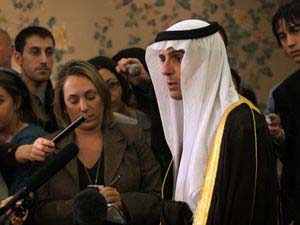
The Saudi ambassador to the US Adel al-Jubeir speaks during Middle East peace conference in Maryland in 2007

The news dominating coverage of the Middle East today catapults Iran and the Palestinians over the ongoing Arab Spring. Even the fact that tens of thousands of Syrians turned out in Damascus to support the Asad regime pales in relation to the James Bond scenario of Iranians, drinking tequila with Mexican drug runners in order to set up the assassination of the Saudi ambassador in Washington. It sounds like a movie plot, but then so does the whole Arab spring since February. American officials are acting as though they have slam-dunk proof, which is a dangerous sign when no one has seen even an iota of that proof apart from the allegations given by Attorney General Holder. And it seems the culprit has confessed, so what more needs to be said? The plot is plausible to most Americans, I suspect, because one expects Iran to engage in terrorism and the government officials in Iran despise the Saudis as much as they do the United States. It sure makes Eric Holder, who has come under blistering attack by Republican hawks, smell like a rose.

Also headlining the news today is the agreement between Israel and Hamas in which some 1,027 Palestinians being held in Israel jails will be exchanged for one Israeli soldier, Gilad Shalit, captured some five years ago. And the plot thickens, because the exchange of 1000/1 is taken as a victory by both sides. The dark side is that such a deal reinforces the notion that Israel lives are more valuable than Palestinian lives at the same time as individuals are being freed rather than blown up. Given previous hard-line rhetoric of Netanyahu, the idea of such a trade also seems something dreamed up in a novel.

There are serious plots in which people die every day, such as more bombs in Iraq. And there are, in biblical terms, rumors of plots. These two events today would be earth-shaking on any day, but are especially ripe for punditry at this juncture in the region. What will the impact of this release mean on the Palestinian quest for statehood in the U.N.? What new sanctions can be brought out against Iran? And if the Saudi ambassador had been killed, along with a number of Americans, what would have been the response of the Obama administration? I can only imagine the re-election landslide if Obama and the Israelis were to successfully launch an attack to destroy Iran’s nuclear plant. He would be drinking tea all the way to a second term in the White House.

Let’s see what new plot unfolds tomorrow…

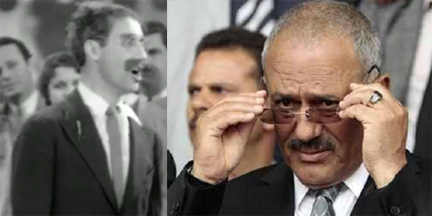
Salih and Groucho: “Hello, I must be going”


Get ready to roll the dice again. The almost off-again, persistently on-again Ali Abdullah Salih has once again signaled his stage exit. After some seven months of his citizens shouting “Irhal, ya Ali,” the embattled president of Yemen is once again on the ropes. When he announced yesterday that he would be handing over power, most Yemenis were somewhat skeptical. The old phrase “three times and you are out” rings true in American baseball but hardly in contemporary Yemeni politics. Nor does “the third time’s the charm” charm the majority of Yemenis who want a major change at the top. Does he mean it this time?

There is something about the roller coaster politics in Yemen this year that makes a perfect Marx Brothers (and I don’t include Karl in this family) movie. When I heard Salih’s latest swan song, I could not help but think of the classic song by Groucho Marx as Captain Spaulding: “Hello, I must be going”:

Hello, I must be going.
I cannot stay,
I came to say
I must be going.
I’m glad I came
but just the same
I must be going. Continue reading Salih and Groucho: “Hello, I must be going”

Yemeni woman shares Nobel Peace Prize


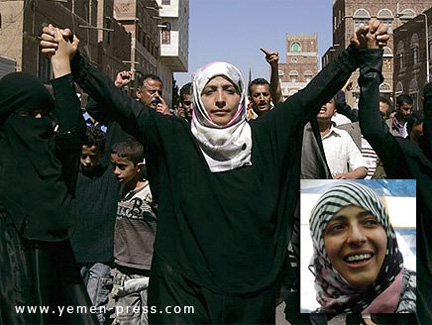
The Nobel Peace Prize for 2011 has just been released with three recipients: Ellen Johnson Sirleaf, Lehmah Gbowee and Tawwakul Karman. All three were chosen “for their non-violent struggle for the safety of women and for women’s rights to full participation in peace-building work.” Karman is Yemeni; but beyond this she is the first Arab woman to win a Nobel prize, a point proudly noted on the Yemeni media site Yemen Press. It will be interesting to watch the reaction to the choice. Here is an activist who took to the streets to promote a peaceful transition from the corrupt secular dynasty of Ali Abdullah Salih. She is one of many Yemenis sharing the same goal and not a principle organizer, although her superb English skills attracted attention in the foreign media. She is also actively involved in the powerful Islamic party of Islah.

As always there will be much second guessing as to why these particular individuals were chosen. I suspect that Karman was not near the top of any speculation list. The Nobel Peace Prize, however, is the most symbolic of these “dynamic” Swedish awards, with the aim of promoting an idea more than finding the “best qualified” candidate. The stated aim this year, however, was a focus on the role of women as peacemakers. Fortunately there are many women activists peacefully advocating against corrupt politics and prejudicial practices. The choice this year appears to be a consciously rounded decision, also including the Liberian president Ellen Sirleaf and Lehmah Gbowee, a social worker also involved in the peace movement in Liberia. If it had just been Sirleaf, one might have dismissed the choice as yet another politician, no matter how worthy, but including Gbowee and Karman may have more to do with inspiring more women to participate at the local level than their actual accomplishments or impact.

As a senior member of the prominent Yemeni Islamic party Islah, Karman does not fit the mold most Westerners hold of Muslim women. She covers her hair with a scarf, but without the extreme niqab or even the more ubiquitous Yemeni sharshaf ( a full-length black outer veil introduced to Yemen by the Ottoman Turks). While the media is for the most part fixated on the masculine culture of Al Qaida, the role of women in Yemen is either ignored or stereotyped. So this choice will draw attention to the fact that there are women who are proud to be Muslim and do not view themselves as servile slaves. But it will also, I suspect, result in detractors within Yemen who will be jealous of the attention she is receiving and perhaps even dismiss it as yet another “Western” intrusion. Will the leaders of Islah promote this honor to one of their members? Will rival Islamic groups use her as a wedge issue? Continue reading Yemeni woman shares Nobel Peace Prize