All posts by dvarisco

A Tale of Two Brothers


The late Tariq al-Dhahab

Yet another tale of two brothers, this time in Yemen and it is not about brotherly love. What drives a man to kill his brother? For Cain in the Garden of Eden it was jealousy that God preferred his brother Abel’s sacrifice to his own; in effect the God of Genesis wanted blood. Several Abbasid caliphs were adept at taking their brother’s lives, a royal custom that knew no geographic or cultural boundaries. The American Civil War is remembered as a family conflict in which brother at times fought brother. When fratricide does occur, it is always a sad affair, whether the passions are aroused by politics, religion or a more mundane jealousy.

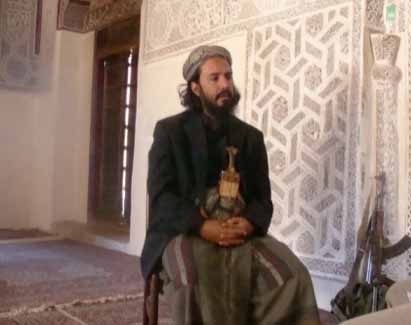
The two Yemeni brothers are Tariq and Hizam al-Dhahab. Tariq gained international attention on January 16 when he seized control of the Yemeni town of Rida’ and declared himself Amir of a new Islamic regime. A self-important proponent of Al-Qaida in the Arabian Peninsula (as useful a banner as any these days in this region), Tariq was related to Anwar al-Awlaqi by marriage and this made the event all the more newsworthy outside of Yemen. But the purpose of the raid, which was symbolic more than bloody, was to negotiate release of prisoners and not jumpstart a new caliphate. After nine days they pulled out when Hizam’s brother Nabil was released, but the main impetus was opposition within his own tribe against such actions. Continue reading A Tale of Two Brothers

Behold the Huthis


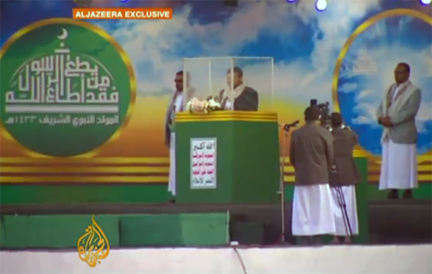
Huthi political rally near Sa’da this week

The ongoing political turmoil in Yemen has been overshadowed, and understandably so, by the increasing bloodshed in Syria, soccer riots in Egypt and lingering resistance by a few Qaddafi supporters in Libya. The past year of protests and revolution, unprophecied by political pundits, reminds me of a giant tire with so many holes that it is impossible to stop the air from escaping, even when one hole seems to be plugged. Meanwhile the road gets bumpier and bumpier in Yemen. Now for the latest recap… about-to-be-former President Ali Abdullah Salih is still in New York receiving medical treatment. He is in principle immune from prosecution, but certainly not immune from the continuing opposition to the excesses of his long rule in Yemen. A recently infused political form of Islam, known as Ansar al-Shari’a (with its own Facebook page) has all but replaced the infamous name Al-Qaida, in the south. The upcoming election, with one emerging compromise candidate for President, hardly seems headed for a democratic exercise apart from name only. Several aid workers were captured earlier this week and then released. And, behold the Huthis…

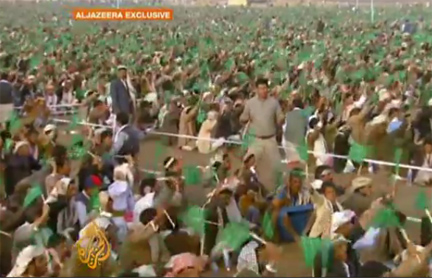
Al-Jazeera posts a video of a celebration of the Prophet Muhammad’s birthday in a remote area outside of the northern city of Sa’da. There on a platform etched against a barren landscape, a region less vibrant after almost eight years of conflict with the government that has left the ancient town of Sa’da in tatters, stood Abd al-Malik al-Huthi, the leader of the rebellion. Reports of his death at the hands of a government raid in 2009 are, as Mark Twain once noted about a premature obituary for himself, greatly exaggerated. While I do not doubt the sincerity of those present who celebrated the birth of the Prophet, the political flavor of the event certainly dominated the scenes shown on al-Jazeera.


Abd al-Malik al-Huthi speaking near Sa’da this week

Continue reading Behold the Huthis

The Islamists are coming, the Islamists are coming


The Arab Spring has morphed into the pundits’ pandering about Islamism. An example, and there are many to choose from in the current political orgy of right-wing rhetoric, is in a New York Times op-ed by John M. Owen IV. It seems that when Muslims elect representatives who are Muslim they must be a new species called “Islamists.” Yes, throughout the Middle East, where the dominant religion happens to be Islam and there happen to be many forms of Islam, there is a strong interest in electing leaders who espouse religious values. In part this is due to decades of dictators who barely gave lip service to Islam and did all in their power to demonize those Muslims who opposed them. But just look at the current GOP field of candidates and tell me that voting on religious values is somehow unique to Muslims. Do read what Owens writes and then my reasons for being critical of this Islamist hunting…

Why Islamism Is Winning
By JOHN M. OWEN IV, The New York Times, January 6, 2012

EGYPT’S final round of parliamentary elections won’t end until next week, but the outcome is becoming clear. The Muslim Brotherhood will most likely win half the lower house of Parliament, and more extreme Islamists will occupy a quarter. Secular parties will be left with just 25 percent of the seats.

Islamism did not cause the Arab Spring. The region’s authoritarian governments had simply failed to deliver on their promises. Though Arab authoritarianism had a good run from the 1950s until the 1980s, economies eventually stagnated, debts mounted and growing, well-educated populations saw the prosperous egalitarian societies they had been promised receding over the horizon, aggrieving virtually everyone, secularists and Islamists alike.

The last few weeks, however, have confirmed that a revolution’s consequences need not follow from its causes. Rather than bringing secular revolutionaries to power, the Arab Spring is producing flowers of a decidedly Islamist hue. More unsettling to many, Islamists are winning fairly: religious parties are placing first in free, open elections in Tunisia, Morocco and Egypt. So why are so many Arabs voting for parties that seem politically regressive to Westerners?

The West’s own history furnishes an answer. From 1820 to 1850, Europe resembled today’s Arab world in two ways. Both regions experienced historic and seemingly contagious rebellions that swept from country to country. And in both cases, frustrated people in many nations with relatively little in common rallied around a single ideology — one not of their own making, but inherited from previous generations of radicals. Continue reading The Islamists are coming, the Islamists are coming

Babel: A New Post-Occupation Translation


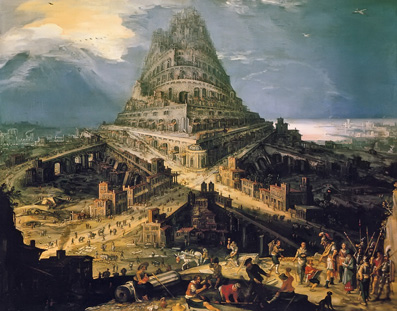
Tower of Babel artwork in Pinacoteca Nazionale in Bologna, c. 1500

The beginning of a year that is yet again an apocalyptic venue is as good a time as any to quote from the biblical book of Genesis. Many of the events in Genesis took place in the legendary space that we now call Iraq, a space that the United States military is unoccupying after a prolonged mission that appears to have accomplished more mayhem than a lasting peace (at least in the recent holiday “peace on earth” spirit). Remember the story of the Tower of Babel; well here is my take of a new translation, being as faithful as I dare to the original King James English:

Genesis 11: The Tower of Babel
1 And the whole earth outside the Axis of Evil was of one mind, and of one resolve about the WMD of King Saddam.
2 And it came to pass, as the coalition troops journeyed to the east, that they found a plain in the land of Shinar, but no WMD; and they dwelt there for almost a decade.
3 And they said one to another, Go to, let us make bombs, and burn them thoroughly. And they had billions of dollars in weapons for battle, and slime had they in mind for talking about the party of the king.
4 And they said, Go to, let us build us a democracy, and a puppet regime, who will sell us oil that reaches unto the ports of Texas; and let us make us a name to be feared, lest we not have economic hegemony upon the face of the whole earth.
5 And the ones who lorded over came down to see the democracy and the puppet regime, which the children of the founding fathers builded.
6 And the ones who lorded over said, Behold, the people is one, and they have all one dangerous religion; and this they begin to do: and now nothing will be restrained from them, which they have imagined in their sharia to do.
7 Go to, let us go down, and there stoke their differences, that they may attack each other because of one another’s sectarian speech.
8 So the ones who lorded over scattered them with superior air power from thence upon the face of all the earth: and they left off to build the democracy.
9 Therefore is the name of it called Babel; because the ones who lorded over did there confound themselves, not knowing what they needed to know about Islam, Iraqi culture or the Arabic language.

A problem in the translation, you say? Continue reading Babel: A New Post-Occupation Translation

Welcome to America?


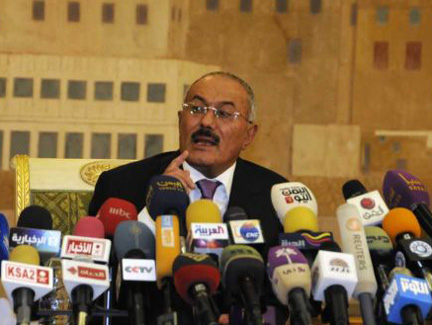
Photo credit: AP | Yemen’s President Ali Abdullah Saleh speaks to reporters during a press conference at the Presidential Palace in Sanaa, Yemen. (Dec. 24, 2011)

Yemen rarely makes the front page of The New York Times, but today it did. The seesaw political succession game underway in Yemen has seen President Ali Abdullah Salih’s head bobbing up and down in the power vacuum like a bobblehead doll in the hands of a Little Leaguer on opening day in Yankee Stadium. According to the article, Salih requested a visa to receive medical attention at New York’s Columbia Presbyterian hospital. Why it is not sufficient to return to Saudi Arabia, where he first underwent surgery and medical attention for major burns and other complications, is not clear. To complicate matters, and Salih has a knack for complicating matters, Salih told the Yemeni public in a recent televised address that he was not seeking medical treatment in the United States but simply wanted to allow the political process to evolve with him on the sidelines.

The Statue of Liberty still holds the beacon of hope aloft. So what does Salih hope to get from this visit. The Obama administration is keen to insist that Salih is welcome only for medical assistance, not for refuge. There is a glaring precedent that urges such caution: when Jimmy Carter allowed the former Shah of Iran entry to the United States for treatment, the pre-nuclear revolutionaries back in Iran went ballistic and stormed the U.S. Embassy. The rest, as they say, is history, but not the kind one likes to repeat. Continue reading Welcome to America?

Doha Dèjá Vu


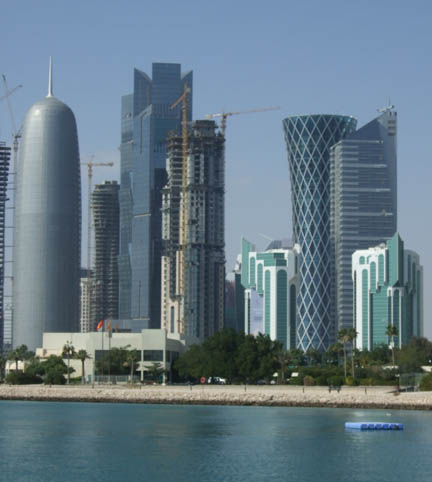
Skyscrapers dominate the modern skyline of Doha

In 1988-1989 I received a Fulbright Islamic Civilization Research Grant to carry out research on the Arab almanac tradition. Most of this time I was sponsored in Doha, Qatar by the Gulf States Folklore Center. Tempus fugit, to be sure. The folklore center no longer exists and Doha is quite a different city these days. A week ago I arrived in Doha to give two lectures at Qatar University, one on the sailing seasons around the Gulf and one on traditional agriculture in Yemen. In the two decades plus since I last visited Doha it is obvious that the city has changed dramatically. I do not remember any skyscrapers on my first visit. Doha was a sleepy little haven with the grand Doha Sheraton the eye candy. And quite an eyeful it was and remains.

I arrived at an auspicious moment, the evening of Qatar’s National Day. The entire day was devoted to celebration. Thus the trip that would normally take less than 20 minutes to go from the airport to the Sheraton was accomplished in six hours. The roads were blocked with SUVs and Mercedes colorfully marked and many with young boys on top waving the Qatari flag and sporting scarves with the image of the emir and his heir apparent. I missed the fireworks, but the enthusiasm of the throng made the long journey well worth it.
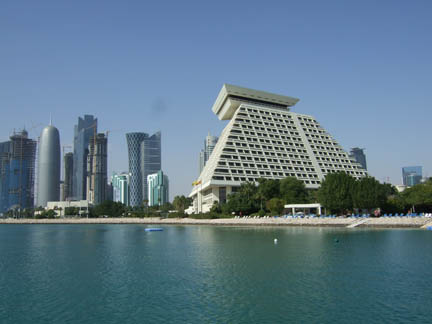

The majestic Doha Sheraton Hotel

The Doha Sheraton is a grand old place. Having been erected in 1982, such a luxury hotel is an architectural shayba. But it still inspires, with a pyramid exterior and inside right out of an arabesque garden from the 1001 Nights. Back then it stood alone, a harbinger of change; today it is almost dwarfed by a series of skyscrapers jutting out of the ground in various original shapes. Here is an architect’s paradise with almost every building sporting a unique design.
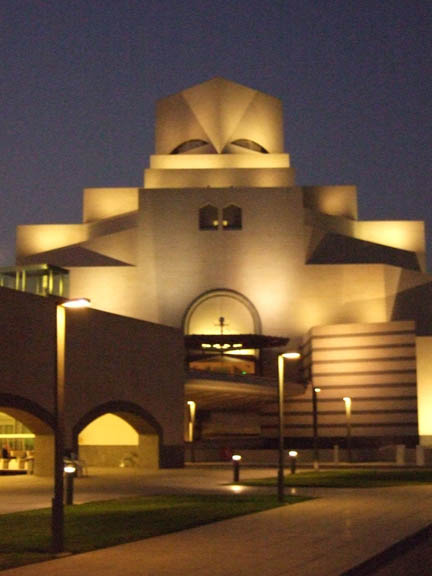

The Museum of Islamic Art at night

My last day I visited the Museum of Islamic Art, which houses a magnificent spread of Quranic manuscript pages, pottery, metalwork and jewelry from all over the region, especially from Iran. Their website has a number of impressive e-cards available. The main Qatar Museum is being renovated, but the Arab Museum of Modern Art has opened and one on Orientalism is in the works. Qatar’s wealth is making Doha a museum Mecca, one that is sure to draw a large number of tourists in the years to come.
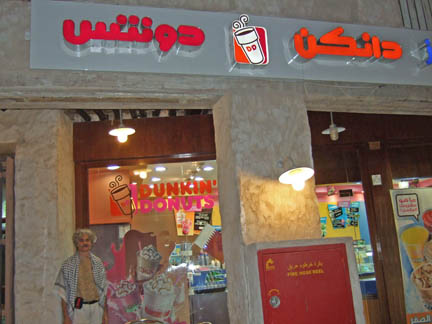

Dunkin’ Donuts invades Suq Waqif

When I first visited the Doha suq, it was hardly worthy of the title; to put it mildly, it was quite miskin. But now it has been recreated as a tourist attraction (with paid parking) and live music. It has many of the old kinds of shops, from textiles to spices, but then there are the foreign intrusions, such as a Dunkin’ Donuts located near the parking lot. Just what Doha needs: stale globalized donuts.

Flying to and from New York was on Qatar Airways, which has the most outstanding business class I have ever experienced. It is hard to imagine a better first class experience. Next time you are traveling to the Gulf, consider a stop in Doha. Midst the turmoil embroiling the region, Qatar remains a stable oasis of growth. Such a tiny nation, but one that is really making a mark culturally and politically in the region.
The picture


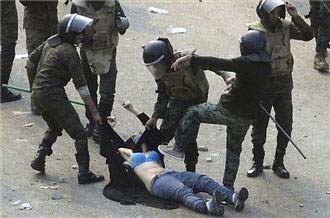
Beating a female protester in Cairo, Reuters

There it is above: the picture that sums up the resistance to political renewal more than any other image possibly could. It has been flashed across the world: a woman’s body exposed to anonymous male aggression. The issue is less the moment of an ongoing event which has riveted attention for almost a year than its symbolic depth. There are other images of security men beating protesters, including women. There are far more brutal shots of bloodied corpses and disfigured bodies. But this is the kind of picture that launches a thousand and one more protesters. Not only within Egypt. It is the kind of image that should shock us all, because it exposes an ugly truth we do not want to admit.

This is the kind of picture where the meaning far outstrips the specifics of the event. We do not know, nor do most people want to know, who she is or what she said or why she was singled out (if she was the only one), because she stands for the fragility of all protests against raw power. The reality is that force is entrenched. The purpose of military and security is to implement the policy of those who define power. Yes, there are revolutions and mutinies, but the need to control always wins out after a political house is “cleaned.” At times the power enforcers will give a little, but there is a point at which the batons are brandished and blood pours from the bodies of those who dare defy power.

What could this woman, dressed in the symbol of supposedly protective modesty — the hijab — have done to receive such treatment? Did they think she concealed an AK-37 beneath her black cover? Did they think any woman on her own posed a danger to men armed with crowd control equipment? Did they stop and think she is somebody’s daughter, probably somebody’s sister, perhaps someone’s wife or mother? No, because that is the ultimate tragedy of controlling protests, whether here on a Cairo street or a policeman spraying Occupy Wall Street young women with pepper spray. The only thing different this time is that the moment has been captured on film. It will never really be over, but replayed over and over again as a reminder that the violence never ends against those who dare protest a monopoly on violence.

While this beating was happening, several Egyptian protesters were killed and far more people were being eliminated in Syria. Such deaths are a daily occurrence in Yemen. Iraq and Afghanistan have not ceased to be killing fields. So why does this particular image have such power? Perhaps because it can resonate on all sides. For the liberal here is the epitome of woman’s ultimate lack of defense against male power. She had not stripped her own clothes off; she came to the square in the modest dress that was supposed to protect her, to set her off as immune to such actions. For the conservative here is the shame of exposing the body of a woman in public, not that of a criminal or a sorceress but a woman who dressed Islamically.

But there is another angle to this image that goes far beyond Egypt. Men virtually everywhere expose women’s bodies for their own perceived needs. On a gender scale the only real difference between this image and a simulated sex attack in a pornographic shot is that the woman is acting for money in the latter. But in both cases the message is that men are the ones who control women. It is a male power play to clothe the woman in any kind of dress and it is an ultimate male right to remove those clothes to suit his own purpose. A woman’s body is for the male to define. The young Egyptian blogger who posed naked, or nearly so, to speak up for freedom over her own body was roundly criticized by liberals and conservatives alike for rocking the voting public’s boat. How dare she defy the norm and expose her body voluntarily. It would only give more votes to the Islamic parties: such was the fear. But the issue is never really about the naked body, which men desire at almost any cost, but the fact that a woman dared defy the demanding male gaze by not letting the male strip her unilaterally or commercially. Look at the image above and look at the image of the blogger. If you see no difference, than you are the baton the security men wield against a defenseless body.

Daniel Martin Varisco

This commentary has been reposted on muftah.org.

Is it over “over there”?

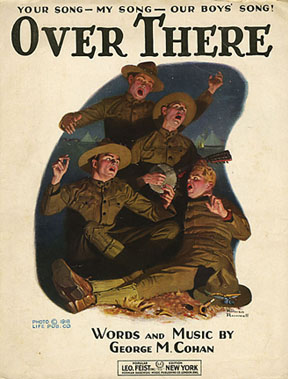
In the words of George M. Cohan from about a century ago, Johnny got his gun and the Yanks went “over there” and “they won’t come back ’til it’s over over there.” Billy Murray (the singer you probably do not know) sang it on Edison Records (the blue amberol cylinders you may never have heard). American troops have been over to several other “theres” since World War I, but ironically the longest lasting one has officially ended this morning in Iraq. There are only 4,000 troops of a high of 170,000 still left on the ground, a number less than the total of U.S. forces killed during the last nine years in Iraq. But if you think this is really “over”, think twice. The U.S. embassy will be the largest in the world with 15,000-16,000 people taking over a former air base.

The lingering question, for those who are even aware that Iraq is still on the current events map, is whether or not it was worth it. What started out as a big “if” (if there were weapons of mass destruction in Iraq) has made this an ever bigger “it.” As a ground war it was almost over as soon as it began. Sweeping through Iraqi territory to Baghdad was on the order of a Blitzkrieg; it was the ersatz policy for ensuring peaces that has been the problem. Iraq had no stockpiles of wmds. Yes, Saddam was a brutal dictator that most Iraqis were glad to see go, but few Iraqis have enjoyed the American occupation that ensued. The sectarian violence that continues to this day has ripped the society apart. Age-old fault lines of ethnic and religious were buried in historical rhetoric, but it was our invasion and inept mopping up that opened the wounds anew. The blood of tens of thousands of Iraqis is a legacy of this war that tarnishes any sense of having a “mission accomplished.” Continue reading Is it over “over there”?