All posts by dvarisco

How safe is home?


On March 11 an American soldier slipped out of his base before dawn and ended the lives of 17 Afghan civilians, who had returned to what they thought would be a safe home near the protection of the American military base. The general reaction to this is that the man “snapped,” an isolated act. Then there is the case of a Florida vigilante who shot an unarmed, young black kid wearing a hoodie and walking home; the man who shot him claims that it was in self defense. Someone must have “snapped” in the encounter. Yesterday an as-yet-unidentified killer took the life of an Iraqi mother living in El Cajon, California. The murderer snuck into her bedroom and bludgeoned her to near death, leaving a note that said “go back to your country.” Perhaps this was also an individual that “snapped”? A trial is now ending for a student at Rutgers who played a prank on his roommate by setting up a web-cam to record a homosexual encounter; his roommate killed himself. I guess one could say that the suicide happened because this young man “snapped”? Four different deaths, but all assumed to be because an individual acted in an abnormal way, a criminal act (suicide is still a criminal act in U.S. law) that goes counter to a society’s moral norms.

Such immoral acts have been going on since the get-go of human civilization; even ardent biblical literalists point to the fratricide of Cain. But assuming that an individual has “snapped” explains nothing, except to say “well, that is not supposed to happen.” Following the media, we are far too snap-happy in explaining away murder. Consider the bumper sticker mentality that “guns do not kill people, but people do.” To me this is like saying that malaria doesn’t kill people, but mosquitoes who carry the malaria do. Obviously it is a combination of the two. People use guns to kill people, either issued by the military (as in Afghanistan) or because of a constitutional American right to bear arms and stand one’s ground (as in Florida). People also use knives and steel rods, or even their bare hands. There are various means, but is it really useful to cite “snapping” as the rationale? Continue reading How safe is home?
Miniskirting the Issue


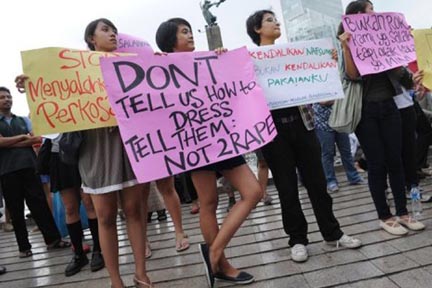
Indonesian women’s rights groups said they were outraged by the comments and called for a stop to the demonization of rape victims

Why is it that men blame women for their own failures? Whenever I hear a variant of the phrase, “Well, he couldn’t help himself,” I can’t but think that this excuse is in need of a lot of help. In Indonesia there is a bill being considered in parliament that would ban female lawmakers from wearing provocative clothing, such as miniskirts. Given that the number of Indonesian lawmakers wearing miniskirts must be a whopping minority, why is this needed? Here is the rationale:

“We know there have been a lot of rape cases and other immoral acts recently, and this is because women aren’t wearing appropriate clothes,” house of representatives speaker Marzuki Alie said.

“Women wearing inappropriate clothes arouse men, so it needs to be stopped. You know what men are like — provocative clothing will make them do things.”

So men rape women because women wear miniskirts. I have not seen the statistics, but I suspect the majority of women in Indonesia do not fall for the idea that all they have to do is dress conservatively and there will be no danger of a man raping them. This notion that the male rapist cannot really be blamed because “provocative clothing will make them do things” is not limited to any national or religious group. What is rather bizarre in this case is that the ban would only be to protect male lawmakers and not for the public at large. So either there is an epidemic of male lawmakers raping female lawmakers in Indonesia or these males are so easily aroused that the ban need only be to stop those provocative female lawmakers. I guess once outside the parliament building, male lawmakers can contain themselves. Continue reading Miniskirting the Issue

For the love of Jesus


There are a number of issues on which Christians and Muslims agree, despite the historical antagonism that Islamophobia and Sectarianophobia perpetuate. For example, boycotting the power drink “Red Bull” in South Africa. A recent ad showed Jesus walking on the water after he drank “Red Bull”, stepping gingerly on the rocks that he could see beneath his feet in the water. The only miracle was in the drink, if you follow the ad. While the advertisers did not expect people to take the ad literally, gulp down their “Red Bull” and promenade without their water skis, the premise of the ad indeed denies the miracle, a denial that many Christians accept post-Hume with little problem. As reported in The Washington Post and picked up by a number of Muslim media outlets, such as Cii, South Africa’s Roman Catholic hierarchy told the faithful to give up “Red Bull” for Lent. And then, South Africa’s Muslim Judicial Council, in solidarity, joined the boycott by saying that an affront to the Prophet Issa (Jesus) is an affront to Muslims.

From the Catholic perspective, at least one that focuses less on “turn the other cheek” and more on “Get thee behind me, Satan,” the moral outrage is understandable. Think of a possible amendment to the catechism as follows:

Question: “What would Jesus do if a television commercial made fun of his miracles?
Answer: “If you believe that Jesus walked on “Red Bull”, then render unto “Red Bull”, but if you believe Jesus walked on water, then don’t drink this whited sepulcher of a beverage during Lent. Remember that at the wedding in Cana Jesus turned the water into wine, not “Red Bull.”

Although I have not found any specific news accounts, I suspect that the Bible-believer missionaries will forego “Red Bull” as well, even if they don’t hold fast to the Lenten fast.

But the fact that a major Muslim organization in South Africa has joined in condemnation of the ad is a cautious welcome sign, no matter what you think of the ad itself. Continue reading For the love of Jesus

Berserk, Breivik and Barzakh


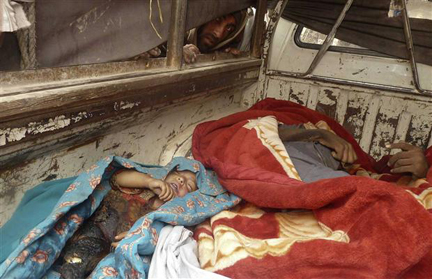
An Afghan man looks over the dead bodies of people killed by coalition forces in Kandahar province, March 11, 2012. Afghanistan’s defence ministry said coalition forces killed 15 civilians in a shooting spree in Kandahar province on Sunday.
Photograph by: AHMAD NADEEM, REUTERS

The senseless killing of more than a dozen Afghan villagers, while they slept, by a U.S. soldier has captured the headlines worldwide. Many of these headlines are variants of “In Afghan Civilian Killing Rampage, U.S. Soldier May Have Gone ‘Berserk'” The choice of “berserk” to describe this act is telling, since the word itself derives from old Norsk in reference to, as the OED puts it, “A wild Norse warrior, who fought with frenzied fury.” In the Norse legend, however, the warrior had a cause, while the Rambo-rampage here was a solo act, a random act as far as war strategy is concerned. The explanation that immediately comes to mind is that he “lost his marbles,” perhaps because those marbles had been jostled too many times during his three tours in Iraq.

A few days ago a court in Norway ruled that Anders Behring Breivik, “the 33-year-old right-wing extremist psychotic,” as USA Today terms him, might go to a psychiatric ward rather than prison for his “bomb and shooting rampage” that left 77 people, many who were young people, dead. News reports also labeled Breivik as someone “gone berserk.” But neither in Norway nor Kandahar do the men who aimed their guns at innocent victims demonstrate any kind of courage in the “just war” alibi. The old Norse warrior Berserk exuded raw courage, battling without armor and with the intensity of a bear or wolf. Of course, he was not a good man, having killed his wife after she delivered 12 sons (or so we are told in legend), but his battle-axe was aimed at fellow warriors, not sleeping children. One can understand, even if it is hard to appreciate, the fury of a battle, when blood runs hot as it is slashed out of bodies in hand-to-hand combat. But is “berserk” really the right word for deliberate singling out of men, women and children that in all normality are innocent? Continue reading Berserk, Breivik and Barzakh

International Women’s Day


Today, March 8, will be celebrated around the world as “International Women’s Day.” The question that arises each year at this time is what exactly is being celebrated. There are the historic victories, like the 19th amendment to the United States constitution in 1920, giving women the right to vote, but these are increasingly distant each year. There are the milestones over the years of the first woman to fly solo around the world, the first woman to go into space and many other unacknowledged firsts for women. But these are really about women catching up to roles or activities once reserved exclusively or mainly for men. What can be celebrated on this day about what it means to be a woman in 2012 without comparison to how she fares relative to men?

Recent political events in the so-called “Arab Spring” hold promise for people power, some form of democracy and the end of the line for masculine idol dictators. Gone is Qaddafi, but also his harem of female bodyguards seemingly dragged off the stage of a Fellini film. Gone are the wealthy wives of the dictators. Cries of freedom can be heard from Tunisia to Bahrain. But there is much that is not celebratory. Continue reading International Women’s Day

And the game goes on in Yemen


The ink is barely dry on the thumbs of millions of Yemeni voters and the political rhetoric has once again heated up. One of the leaders of AQAP, Fahd al-Qasa‘a, is lashing out against the election of al-Hadi. Hardly any surprise here. But at the same time, as reported in the Yemen Post, he is blasting (so far only in words) Islah, the largest Islamic party in Yemen. For anyone who knows Yemen, this is also hardly a surprise, although many on the outside still think an “Islamist” is an “Islamist” no matter what the facts on the ground. Alienating Islah, which is as much a regional power block as a religious party, seems a sign of desperation or else a calculated outreach to disaffected southerners. Criticism of al-Hadi as a clone of the United States, Saudi Arabia and the GCC resonates well with many southerners, where AQAP hopes to make inroads. The former President of the PDRY and Vice President to Salih after unification, Ali Salim al-Baydh, has also labeled al-Hadi a hack in the grasp of foreign interests. Strange bed fellows indeed.

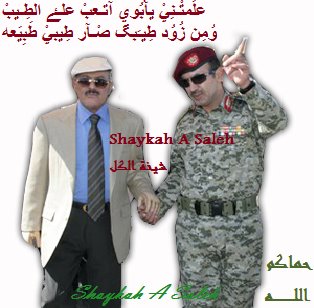
But the plot thickens. The statements by al-Qasa‘a were quoted in a newspaper owned by Ahmad Ali Abdullah Salih, the man who would be king after his father. You can follow his exploits on a Facebook page. The current dissension among the political rivals is anything but tranquil. It almost makes the current Republican debate circus in the United States look like a love fest. But one need not quote Machiavelli to see that the bottom line here is political power, not religious persuasion. Anyone who thinks that Zaydi vs. Shafi’i is still the way to carve Yemen up into sects or that Islah and AQAP are of the same cloth needs to do a lot of rethinking.

And the game is far from over.

The Yemen Election: No Surprises


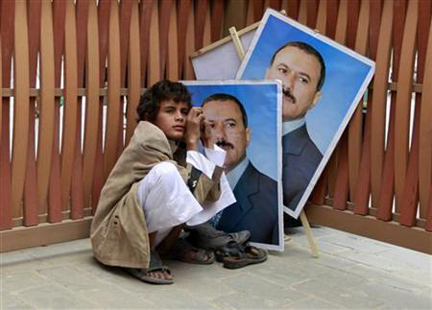
The Yemeni election was not destined to be a cliff hanger and never in doubt. With only one candidate, seemingly supported from many sides, millions of Yemeni citizens went to the polls yesterday with a blue thumbs up for the interim president-in-waiting, Abd Rabbou Mansour al-Hadi. Considering that al-Hadi has been in the innocuous position of Vice-President to the outgoing President Ali Abdullah Salih, for some 17 years, this changing of the guard is seemingly only at the palace gate. So some people might wonder why it was worth spending an estimated 48 million dollars to hold an election that was a foreordained outcome. The answer is not that democracy is served by having only one candidate to vote for, but democracy may be viable by the mere fact that Ali Abdullah Salih is no longer in charge. The vote for al-Hadi was less a vote for the consensus candidate al-Hadi than a vote to move on after the fall of Ali Abdullah. And despite the ongoing pockets of violence in several parts of the country, in effect this is the first relatively peaceful transfer of power where the leader is negotiated out of office rather than seeking asylum.

The issue is not whether Yemen is ready for democracy, as though democracy is pure only in its Western trappings, but if the various factions in Yemen can sort out their legitimate grievances without having a strong man in power for life. Before Ali Abdullah the tenure of Yemen’s military-coup leaders was cut short by assassinations. The fact that Ali Abdullah lasted for over three decades is remarkable, to say the least. While not the butcher that Asad has shown himself to be in Syria, the regime hardly had clean hands. But Yemen’s natural wealth has been squandered by corruption and incompetence, two problems that usually accompany dictatorships. The water is running out and so is the oil, so in a very real sense time is running out to resolve the political problems. The secessionists in the south and the Huthis in the north boycotted the election, but al-Hadi will have to bring them into the political framework. This is not an impossible task, but much now rests on the shoulders of a man who is not necessarily in control of the military, which itself is split. Continue reading The Yemen Election: No Surprises