All posts by dvarisco

Travels with Ibn al-Mujabbir #2


Sailing Seasons in the Red Sea and Indian Ocean:
The View from Rasulid (13th-14th Centuries) Aden

by Daniel Martin Varisco

[This is a lecture presented at the Red Sea Trade and Travel Study Day of the Society for Arabian Studies at the British Museum, October 5, 2002, and subsequently published in Yemen Update. For Part 1, click here.]

Monday, 13 Rajab, 691 (June 30, 1292)

Bismillah al-rahman al-rahim. I, Ibn al-Mujabbir, begin this diary full of hope, a pilgrim sure of his destination, not a lost soul adrift. Who but God in his indescribable mercy could have provided a calmer sea and more willing wind to our sails than our good fortune holds aboard this ship, Hut Yunis. As Jonah was saved in God’s good time, so I trust in that very God to set foot once again in my homeland. There are three ships under the protection of the Karimi assurances, traveling together for safety and among the last of the season bound south for Yemen. I humbly beg forgiveness from the One before whom I submit, who knows the danger in every unseen shoal.

In two hours time, before the evening prayer, the captain informs me we will put ashore in a safe place. We sail by day in sight of land, but at night we rest. As God is our only guide, the wisely guided do not lead themselves into temptation. There are many dangers here, for they say the devil himself is master of the sea when darkness settles and the afarit do his bidding. Even Solomon, wise and powerful as God made him, took precaution when traveling to see Sheba’s beauty queen. Should I, a poor Yemeni born in Zabid, and now a stranger to no land where freshly minted Kamiliya dirhams are valued, do less. There are, I trust, no monsters in these depths, but the jinn inhabit all seven climes and more, if there be more. Continue reading Travels with Ibn al-Mujabbir #2

Travels with Ibn al-Mujabbir #1


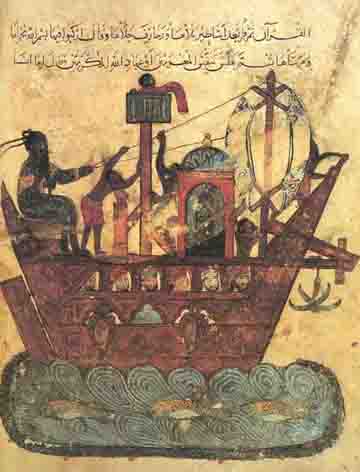
13th century illustration of an Arab ship in the Indian Ocean

Sailing Seasons in the Red Sea and Indian Ocean:
The View from Rasulid (13th-14th Centuries) Aden

by Daniel Martin Varisco

[This is a lecture presented at the Red Sea Trade and Travel Study Day of the Society for Arabian Studies at the British Museum, October 5, 2002, and subsequently published in Yemen Update.]

The province of Aden is governed by a king, who bears the title of soldan… The soldan of Aden possesses immense treasures, arising from the imposts he lays, as well upon the merchandise that comes from India, as upon that which is shipped in his port as the returning cargo; this being the most considerable mart in all that quarter for the exchange of commodities, and the place to which all trading vessels resort… Marco Polo, reflecting in a prison cell on information he obtained at the close of the 13th century.

The subject of my talk today is the view from a vital hub of the vibrant Red Sea and Indian Ocean trading network, the view from the Rasulid port of Aden; more specifically, a fresh re-view of what it might have been like to be an Arab merchant sailing to and from Aden at the same time as Marco Polo set out to return from his epic sojourn under the immense Oriental pleasure dome of Kublai Khan. I invite you to return with me to the year 1292 of the Christian Era – as it is commonly known – for a fleeting Arab businessman’s eyeview from the deck of a trading dhow bound from Aydhab on the Egyptian Coast to Aden, the best natural harbor on the South Arabian coast. Let us call this tajjir (merchant) Muhammad Ibn Mujabbir, a Yemeni by birth and at the time a successful merchant employed by the Karimi syndicate out of Egypt. He is about 35 years old, young enough to marvel at the outrageous tales told by sailors and fellow travelers, old enough to know better than to believe any of them. We will join him aboard ship sailing south of Aydhab and follow his diaried notes until he lands with his entrusted consignment of wares in Aden customs. We shall, in effect, sail through a narrow stretch of commercial maritime history with a seasoned traveler at the helm. Continue reading Travels with Ibn al-Mujabbir #1

A Salacious Salafi


Sheikh Wanis and his fellow adulterers

Al-Ahram has published an account of a salacious encounter of an Egyptian Salafi who is a former MP.

Egyptian authorities have decided to put on trial a Salafist ex-MP who was caught allegedly performing an “indecent” sexual act with a woman in public, a judicial source said on Thursday.

Ali Wanis’s trial is set for Sunday and will take place on time although he has gone missing since police found him last month engaged in a sexual act with a 22-year-old woman in a car parked on a highway.

The woman, a university student, is behind bars and the public prosecutor’s office has ordered the arrest of Wanis, a cleric and former MP for the ultra-conservative Al-Nour party.

After the incident in early June, Wanis denied any wrongdoing and said in a video posted on his website that he had parked along the side of the road because his passenger “became sick.”

But the pair have been accused of performing an “indecent” sexual act in public.

Al-Nour party, won the second largest number of seats in parliamentary elections last winter after the Muslim Brotherhood.

It was hit with a scandal in March when another lawmaker was forced to resign from parliament and from his party after claiming he was injured in a carjacking — to explain bandages on his face — when in fact he had had a nose job.

Wow — a blow job and a nose job and the appeal of Salafism takes a nose dive. Continue reading A Salacious Salafi

What (who) drives Muslim women


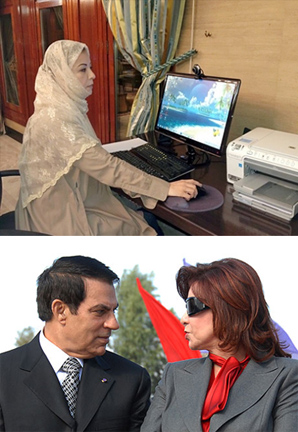
top, Leila Trabelsi in Saudi Arabia; bottom, Leila Trabelsi with Ben Ali in Tunis, pre-Jasmine Revolution

The West has long had a fascination with Muslim women, from the Oriental harem beauties of Ottoman seraglios to immigrants who wear niqab in Europe. As some critics have noted, perhaps those who laud or victimize the role of women in Islam (as though there could be “the” role), should look at the patriarchy in their own societies. The ability to go out in public with less of the body covered may be a sign of freedom in mobility, but it is not automatically symbolic of equality in economic or political terms. Ethnographic study for almost a century has illustrated the kinds of social contexts in which women and men are closer to being egalitarian, but there is no one factor (including religion) that is causal. The books and commentaries on women in Islam continue to proliferate and will into the foreseeable future. But what about the situation today within Islamic countries?

By today, I mean the totally unscientific sense of an arbitrary internet experience. In checking out several websites this morning to see what I might comment upon, several items caught my attention. First, a Yemeni website shows a photograph of Leila Trabelsi, the wife of the exiled Tunisian president Ben Ali; both are now living in Saudi Arabia (top picture, above). The picture is pregnant with interpretive possibilities. The former elegant first lady is now regaled in hijab while mouse-clicking her way through cyberspace. In that vast digital archive, she can easily come across previous pictures of herself, like the one shown below her new Saudi makeover look. So is one of these pictures of Leila more Islamic than the other? Does the veil indicate intent; does living in Saudi Arabia signify a closer relationship to Allah? Perhaps if we knew what websites she was surfing, we would have more clues. Continue reading What (who) drives Muslim women

Tabsir Redux: Mahdi Madness and the 2008 Election

[Note: The commentary below was published as the presidential politics of 2008 were heading into the rhetorical throes of summer. Religion was all over the map, with Obama’s Christianity being questioned and his supposed “Islamic” past salivated by the right. This time around religion seems to be taking a back seat to the economy, perhaps in large part because Evangelicals do not want to remind themselves they are about to vote for a Mormon. But the sentiments discussed below are still quite alive…]

For some partisans, no matter who is elected President to succeed George W. Bush, it will seem like the end of the world. We are in the apocalypse silly season once again. Take Tim LeHaye, the doctrinal inspiration of the WASP-friendly Left Behind book series (Jerry B. Jenkins provides the verbal inspiration in sci-fi style); he has been preaching the politics of biblical apocalypse for years. Indeed, since the apostle John allegedly first had his vision on the island of Patmos, the world has been teetering in the end times. This world is always going to hell; Jesus must be coming soon. Bible-belting believers and bible-belching evangelists constantly look to the heavens with rapturous delight for the mother of all shock-and-awe shows to begin. Up go the faithful in the twinkling of an eye and then it is open tribulation season on the Jews that will make the 20th century Nazi holocaust look like a sabbath picnic. Fortunately, most of the world’s Christians look at such a naive-ity scene with alarm. “Even so,” it might be said, “do not come Lord Jesus.”

Reverends Tim LeHaye, Pat Robertson and John Hagee are not the only mega-mouths who know deep down in their saved souls that they will not be left behind. Ironically, they share theologically-maddened space with Mahmoud Ahmadinejad, the shi’a-evangelical President of Iran. As noted in a New York Times article today by Nazila Fathi, the Iranian President’s “high father” is Imam Mahdi, the hidden 12th “twelver” Imam who occulted well over a millennium ago, but whose reappearance has been looked for year after year in popular imagination. Ahmadinejad, who loves to wear his religion on his sleeves, says that Imam Mahdi guides his day-to-day decisions as a president. In gratitude, Ahmadinejad has sponsored an institute to prepare Iran for the Imam’s immanent return. This would be like Bush asking his faith-based supporters to create a special office in Homeland Security on Eternal Security Risks to those Left Behind. Continue reading Tabsir Redux: Mahdi Madness and the 2008 Election

Timbuctu too…


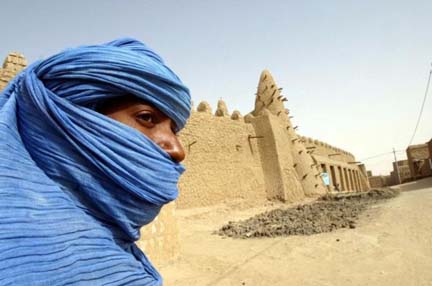
A Tuareg nomad stands near a 13th century mosque in Timbuktu in this file photo [Reuters]

There is an old saw in English: cutting your nose to spite your face. The sorry lot of vigilante Ansar extremists have already desecrated several Muslim saints’ tombs in southern Yemen, but now come reports of lawless fanatics destroying saint shrines in the famed city of Timbuktu in Mali. Al Jazeera is reporting that many, if not all, of the shrines there on the World Heritage List have been damaged or destroyed. These are ritual attractions considered sacred by local Muslims for several centuries, not replicas of the Buddha or foreign idols. So who exactly do these fanatics hate? If you think they are doing this because they hate America and its freedoms, think again.

Iconoclasm has a long history that is hardly unique to the Middle East. The modus vivendi is the idea that if you don’t like something, just get rid of it no matter what other people think. Tolerance and dialogue might as well be Satanic in this twisted worldview. It is important to observe that in both the Yemeni case and now in Timbuktu the destruction takes place because of an almost total breakdown of security. No government, responsible or not to world opinion, is behind this action to such a sacred Islamic site. It is very much a replay of the Wahhabi wave that swept across Arabia with the sword of the Sa’ud clan. The Wahhabis, considered fanatics at the time by most other Muslims, wanted to turn back the clock to a narrow understanding of what they thought life was like in the time of the Prophet. Were ‘Abd al-Wahhab, who died in 1792 (just six years before Napoleon invaded Egypt and proclaimed himself a true Muslim come to rescue Egypt from its corrupt rulers) to come back from the dead and see the palaces, shopping malls and gentrification of the ka‘ba as these have evolved with the vast oil wealth of the Saudi elite, he would no doubt follow Balaam and curse the day he ever met Ibn Sa’ud.

Timbuktu, as a major African center of Islamic education, is also a rich treasury of Islamic manuscripts. Will these fanatics torch the handwritten copies of the Qu’ran, traditions and other religious books in the libraries? ‘Abd al-Wahhab is not about to be resurrected, but there is a need for a modern day Muslim Balaam to get off his ass and curse such sacrilege.

The Road to Damascus


What a modern day Saul might hope to see

About 2000 years ago a zealot named Saul witnessed a blinding light on the road to Damascus; it was both a name changing and life changing experience. The great epistle writer and first missionary went on to create early Christianity, at least in the canonical sense. There are more blinding, life-and-death lights now ablaze on the road to Damascus as well as in Damascus. This time no one would mistake them for signs of the divine. While the world watched as the Egyptian people elected a leader with religious convictions, the last entrenched dictator (sparing the kings and emirs who still live as though the 1001 Nights never ended) to the north is spilling the blood of his own people. Asad, the dentist turned family potentate, is more like a modern-day Nero than a latter-day hero. His siege mentality, propped up by Russian economic and political interests, is not viable in the long run, but how long can Syrians survive the short run?

The issue is not if Asad can survive, but how long the drama will continue. Obviously he continues to rule because he and his minority have the guns and few qualms about using them. In February of 1982 his father was pitiless in ordering a slaughter in the city of Hama in which perhaps as many as 20,000 were killed. Although in many ways the gaunt and lackluster Bashir is not the charismatic clone of his father, his modus vivendi for taking the life out of his enemies is the same. There may not yet have been a blinding flash of light strong enough to overthrow Asad, but there is plenty of handwriting on the wall. Shooting down a Turkish plane, when relations with Turkey are as low as they can be without conflict , is a no-brainer dumb move. As a member of NATO, Turkey could call on its security allies to pull another Libya. If Asad thinks that such a provocation would stop Turkish support for the defectors from his regime, he is either desperate or deluded. Continue reading The Road to Damascus

Votes that count… this time in Egypt


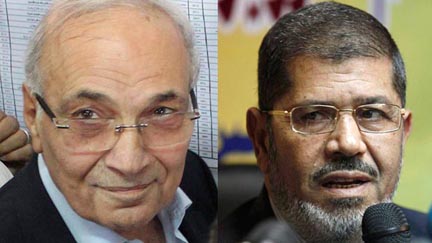
Al Jazeera just suggested, “I bet the world can hear the heartbeats of 80 million Egyptians.” With the heartbeat of Mubarak so close to closure, the irony in this statement does not escape me. Will it be Morsi, who virtually all the unofficial accounts indicate won the vote, or Shafiq, the epitome of the old guard that the revolution was supposedly ousting? I have no crystal ball and I have no doubt that votes can be manipulated (especially after having lived through the 1980 U.S. election in which our Supreme Court elected GWB (not the bridge) in full view). So as soon as I see the results across my screen, I will stop in my tracks and note the “winner.” I suspect that Morsi will be declared victor, as there have no doubt been negotiations behind the scenes to ensure that the military maintains its power. By recognizing Morsi, the military will be praised for not stealing the election, even though they have already stolen the power of the president. I also suspect that U.S. officials are pulling for Morsi as well, as that will lessen the chances for riots and will finally create a situation where the Brotherhood must put up or shut up.

Can the Brotherhood revitalize Egypt’s economy? This is the relevant question. An Islamic state in the image of Iran (which is not likely to happen unless the Fatimids regain power in Cairo) would not solve the problem of jobs. Egypt relies heavily on its greatest natural resource, apart from its people: an extraordinary history that the world adores and invites tourism. Tourists will only flock to Egypt if it is a safe environment with plenty of liquor flowing in the major hotels. Despite the number of veiled women in the streets, this is after all the country that Nasser built. Socialism may be passé, but the world that Umm Kulthum sang about lives on and this is not one that was around in the 7th century.

Much has been written about the Brotherhood, both pro and con. Apart from partisan Islamophobes, it is clear that Morsi is not Mullah Umar of the Taliban. If you were to poll Egyptians about the desire to see all statues of Ramses blown up, as happened to the Bamiyan Buddhas, I doubt you would find many who would applaud such an absurd idea. Islam is the dominant religion in Egypt, but the Pharaohs still reign in Egyptian hearts. To the extent that Egyptians view their cultural origins as Umm al-Dunya, they are not about to do in their mother. The Pyramids have survived for some five millennia, before Judaism, Christianity or Islam. They are more than likely to survive all three of these major monotheisms in their present form.

Time is twittering away, at least for me on a picture-perfect weather Sunday morning in New York. The hour of 3 pm in Cairo (9 am EST) has come and gone, but ma’a laysh. Inshallah the results will be out soon. Meanwhile, while browsing the Arabic edition of Al-Ahram, I see the picture (below) of Morsi.
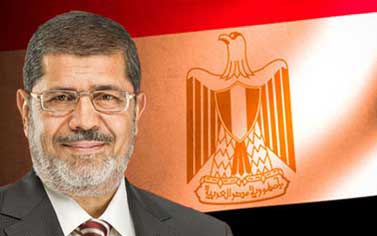

Al-Ahram reports that Morsi will be making a speech after the announcement,no matter which way it goes. This picture is fascinating. Morsi does not look very Brotherhoodish here and stands securely in front of the national symbol of Egypt. He sure looks like a winner here and I will hedge my bets and say that I think he will be the announced winner. But we await the official results, or at least the right kind of twitter… I see via twitter that the announcement is about to be made. Listening to the live broadcast on Al Jazeera… Long winded and driving everyone crazy… and we hear that the election commission has been guided by Allah (now that’s a change)… Millions of people watching and this gets dragged out in a boring monotone and with self promotion that nobody cares about… this will make a great Adel Iman film… or maybe it is one …

And the winner is … Morsi!