All posts by dvarisco

Poster War on the New York Subway


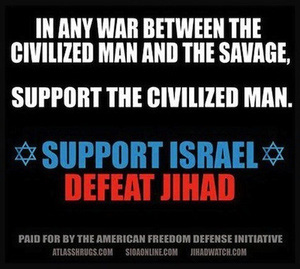
Poster from American Freedom Defense Initiative
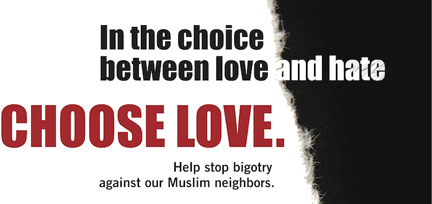

Poster from Rabbis for Human Rights

[The following commentary has just appeared on Anthropology News in my blog there called “Middle East Muddle.: I provide the first paragraph, and the rest of the commentary can be read here.]

In the late 19th century there was little doubt about the gulf between “civilized man” and the “savage,” as anyone reading John Lubbock or Edward Tylor or Lewis Henry Morgan would readily note. Anthropology has come a long way since the cultural evolution scenarios that followed immediately upon the Darwinian revolution in biology. By the time Claude Lévi-Strauss penned Tristes Tropiques in 1955, the tables had turned, with so-called “civilized man” seen as acting the “savage.” Anyone reading Bartolemé de las Casas on the Spanish atrocities in the New World in the early 16th century could have come to the same conclusion. So it is quite un-anthropological today to encounter a poster in the New York subway system about the “war between the civilized man and the savage,” let alone to be urged to “support the civilized man.” Yet, this is the message paid for by the “American Freedom Defense Initiative.”

For the rest of this post, click here.

Since writing this, several groups are now running counter ads in the subways. For more on this, see the commentary by Omid Safi.
Body Politics: Muhammad and Middleton


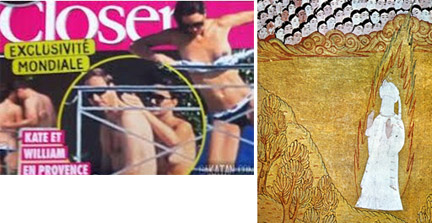
The offending photographs of Kate Middleton, left; an Islamic depiction of Muhammad by not showing his face, right


[Note: The following commentary has been posted to my column “Middle East Muddle” on the online website of Anthropology News, published by the American Anthropological Association. To read the entire commentary, click here. For more commentaries on “Middle East Muddle, click here.]

Two scandals have dominated the news, at least in Europe and America, over the week following the 9/11 anniversary. The first, which has yet to abate as I write this, is the widespread protests against a pathetic anti-Muslim film trailer trolled from Youtube, rhetorically warmed over in Arabic and promoted by extremist Muslims to stir up violence. The troll took a toll with the American ambassador and several other Americans killed in Libya, violent clashes in Egypt and in Yemen and a range of protests (many of which have remained peaceful) across Muslim communities. The second, which is equally absurd as a pretext, is the voyeuristic publishing by French, Irish and Italian tabloids of a long-distance photograph of the naked breasts of Kate Middleton, the newly wed wife of Britain’s Prince William. The paparazzi have once again harmed Britain’s royal family, first by chasing Princess Diana and now by turning a powerful lens on a private moment in a private home while Diana’s son vacationed in France. In both the body is all about politics…

For the entire commentary go to “Middle East Muddle” by clicking here.

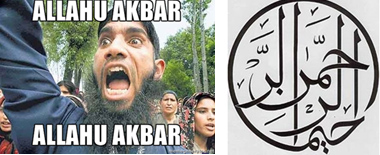
Beyond Allahu Akbar: WWMD, WWJD, WWYD


The manipulated political fury expressed in religious rhetoric over a pathetically provocative anti-Islamic film trailer buried among the millions of needles in the haystack that is Youtube continues, now with a focus in Pakistan. It is not surprising that most Muslims should find the film’s absurd claims offensive. Yet, despite the media images of angry rock throwers holding signs in English, this does not drive the vast majority into the streets or trespassing into Western consulates. If all the cameras stopped rolling, the riots would stop cold. But, of course, now the cameras never stop and any bit of footage can appear on Youtube in a nanosecond. What should we do?

My friend Omid Safi posts on a commentary blog he calls “What Would Muhammad Do?” In his comments on this controversy, he notes that there is enough textual information to reconstruct what Muhammad did when he was insulted:

Yet we know that our Prophet himself was the target of repeated assaults and mockery, and even in his moment of triumph when he had the power to punish, he chose to forgive his enemies and set a higher moral example.

We invite Muslims from every country to raise their voice and be heard, and yet to do so in a way that honors the very example of the manners, the ethics, the path, and the being of the Prophet that we so adore.

There is no way, other than by religious faith in sacred writings, to know what the real Muhammad would do in the modern world, all those hadiths notwithstanding. So in effect Omid and everyone else must argue for what they would expect Muhammad to do if he did live today. But he doesn’t, and neither does Jesus or Moses or any of the revered prophets of the three major monotheisms. In a sense all of the commentary on the reaction to the film is WWWWMTD “what we would want Muhammad to do.”

WWMD is, of course, a take off on WWJD. Since J (as in Jesus) happens to be a revered prophet in Islam as well as Christianity, in principle a Muslim can accept that Muhammad and Jesus would do the same thing morally as guided prophets of the same God. Continue reading Beyond Allahu Akbar: WWMD, WWJD, WWYD

Newsweak


Edward Said wrote a poignant critique of media coverage of the Iranian hostage crisis just over three decades ago. He called it “Covering Islam.” The subtitle was “How the Media and the Experts Determine How We See the Rest of the World.” Once again Islam is being covered, the latest being the “cover” on Newsweek Magazine. Said’s [Covering Islam (1997 edition), p. lv.] assessment is as relevant as ever today:

For the right, Islam represents barbarism; for the left, medieval theocracy; for the center, a kind of distasteful exoticism. In all camps there is agreement that even though little enough is known about the Islamic world there is not much to be approved of there.

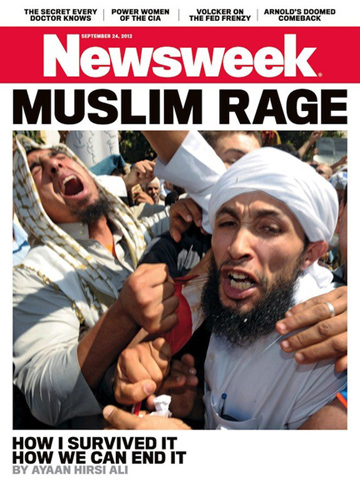
The latest Newsweek cover demonstrates just how weak its sense of responsible news reporting is. The trope of “Muslim Rage” conflates the cultural dimensions of politics with a religious faith. When Israeli planes bomb Hamas in Gaza, no major newspaper calls this “Jewish Rage.” When Terry Jones burns a Quran or when Anders Behring Breivik shoots fellow Norwegians, I have yet to see a headline of this act as one of “Christian Rage.” Rage is almost always political at base and the events subsumed under a blanket umbrella of “Muslim Rage” are local politics to the core. The fact that we see these images on CNN and the Internet tells us more about the audience than it does about those engaged in the activities.

The photograph captures “rage” to be sure, but the choice of turbaned and bearded protesters (when the majority in Cairo at least are young clean-shaven men in Western clothing lobbing rocks at the police) identifies rage with a style of dress and a style of dress with a violent religion. Ironically, the voices of those who are enraged are not to be heard anywhere inside the story. Instead, the cover boasts an article inside by Aayan Hirsi Ali, a controversial Somali whose claim to fame was posing naked with Quranic verses on her body and then becoming a darling of the Islamophobic mob. Her knowledge of Islam is so immature and biased that the very idea she might have something to contribute to the issue staggers my imagination.

I see little difference between this cover photo and that on the French tabloid Closer, which brandished the privately bared royal breasts of British princess Kate Middleton. Continue reading Newsweak

The “Muslim” Problem


The past week has seen a dramatic punctuation in the political present. This present is one in which several countries in North Africa and the Middle East are emerging from years of “stable” dictatorial rule in which human rights were ignored by the Western countries who philosophize how important human rights (or at least the right kind of rights) are. There is also a presidential election looming in the most powerful nation on earth, a nation divided in a partisan way with few realistic ideas on how to frame a way out of the greatest economic downturn since the Great Depression. It is raining politics and that is fire and brimstone in the current climate.

The drama starts with the anniversary of the 9/11 tragedy, which like the abduction of Helen of Troy, prodded the United States to engage in two decade-long wars that have resulted in the deaths of former figure-head foes (Saddam and Bin Laden) but which are unwinnable in the old-fashioned “sign a peace treaty and let trade make us friends” sense after World War II. The spark, a most surreal one at that, is a pathetic trailer for the kind of film no one would ever pay money to see. Before Youtube, before the Internet, this would have been yet another throw-away on the huge cinematic rubbish pile already brimming with porn. But in a scenario that a producer would probably laugh away, an Islamophobic individual dubs intentionally hateful dialogue denigrating the Prophet Muhammad. For non-Muslims the main thing offended is taste; for Muslims this is hateful and hurtful, akin to throwing something sacred into a toilet.

The politics has exploded all over the media, not in spits but a massive vomit. Continue reading The “Muslim” Problem

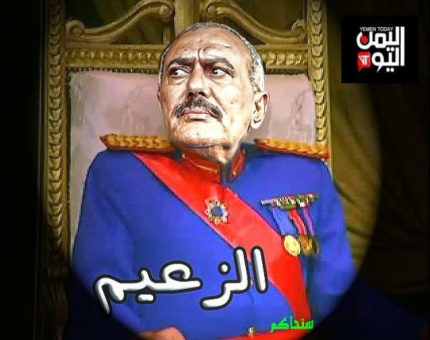
Ali Abdullah Salih: Not invincible, not invisible


A little over six months ago, Ali Abdullah Salih finally resigned himself to the fact that he was no longer wanted by the people of Yemen or the international community as president-for-life in Yemen. But instead of taking his stashed away millions to exile in Saudi Arabia, which has open-armed several past dictators with Muslim names, or bribing a poor country to host him and his family, he remains in Yemen. I suspect when someone is in power for as long as Salih was, that delusion is the normal path. Perhaps he thinks that if things keep on getting worse (ignoring the fact that the problems are largely his own creation), Yemenis will bring him back. Perhaps he has heard those Iraqis who say things were better under Saddam? Perhaps, but his delusion contributes to the problem as long as he is living in Yemen.

Salih played the “dancing on the heads of snakes” game throughout his tenure at the head of the Yemeni state. He built a family-run state, allying himself with tribal powerbrokers like Shaykh Abdullah al-Ahmar, and shaping the military into a private army. Corruption was rampant and few Yemenis were fooled by the state-tun media myth of Salih as the father of his country. His triumph of uniting north and south was a ruse from the start, extending his control rather than actually caring to build a united country. But his downfall is largely due to backing the extremists, the Jihadis back from Afghanistan, those whose ideology he could never uproot for his own advantage. When his troops took over Aden in the 1994 civil war, Salih allowed northern zealots to raze religious shrines and demolish the one beer factory in the country. As the zealots shouted “Allahu Akbar” the guy in the presidential palace could only think of himself as the “akbar.” Building a monster mosque in the capital, not unlike Saddam’s architectural piety, could hardly disguise the fact that here was a man who worshipped himself. He was not the first to do so, is not alone in doing so, and will not be the last. Continue reading Ali Abdullah Salih: Not invincible, not invisible

The Quran as a Great Book: Muslim Perspectives, 6


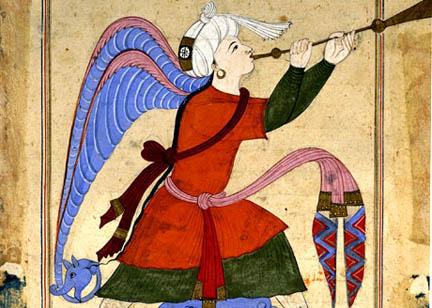
The angel Israfil from the Aja’ib al-Makhluqat of al-Qazwini, Mamluk, period. Illustration in the British Museum

[The following is part six of a series on a lecture presented in the Hofstra Great Books Series on December 5, 1993. For part five, click here.].

Concluding Remarks

The most important part of any lecture, assuming one is not completely turned off in the first minute or two, is supposed to come after the words “in conclusion.” In conclusion. This means there must be a need to conclude something. Regarding the Quran as a great book, there is little need to conclude anything. The mere fact that this talk was scheduled and that you came shows that a sacred scripture commanding the attention of so many people on earth warrants consideration. Regarding how Muslims view the greatness of their Great Book, there is too much to conclude, too great a gap in experience, too challenging a call for empathy. Rather than try to tell you what the Quran is in a nutshell, I would simply ask that sometime soon you try reading it or at least a selection of excerpts. A good place to start is the superb translation of select texts by Michael Sells’ Approaching the Quran.

However, having raised the issue of The Satanic Verses in a lecture on the Quran, a final comment does need to be made. If I were to simply tell you that most Muslims approach their sacred book quite differently, as I see it, than others approach their scriptures, you would probably say “alright, so things are different, so they have a right and we have a right, so what?” Even if the statement of faith outlined in the fatiha or the line of reasoning articulated by a brilliant scholar like Ibn al-‘Arabi is instructive, you would probably still walk away tonight basically unchallenged and unchanged. Continue reading The Quran as a Great Book: Muslim Perspectives, 6

The Quran as a Great Book: Muslim Perspectives, 5


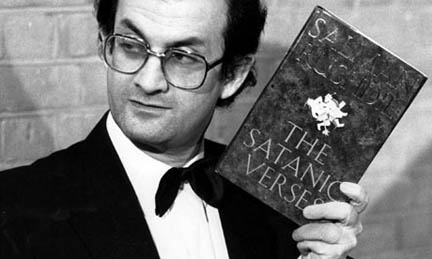
Salman Rushdie, author of The Satanic Verses

[The following is part five of a series on a lecture presented in the Hofstra Great Books Series on December 5, 1993. For part four, click here.].

The Struggling Believer’s Novel and the Text

I could easily continue this discussion of the views of Ibn al-‘Arabi for hours, days, or weeks (how long would it take to simply read 17,000 pages in his major work?) It is valuable to probe with a believer like this great scholar into the depths of his own meaning-rich search through the language of the Quran. But much has happened in the past 750 odd years in the Islamic World. Muslims, through no fault of their own, have been caught up in a broadening discourse defined in large part by the overtly Christian West, even though any distinctive Christianness may have largely eroded. In contrast, Ibn al-‘Arabi lived in a world in which the Quran’s detractors — those who did not grapple with this Arabic text as a revelation — were few and far away. To be sure there were debates over the form of the revelation, although these were tilted to orthodoxy rather early on. But in his day there was no viable reason in the Muslim context not to accept the Quran as revelation.

Muslims over the past couple of centuries have been compelled to defend the Quran against what they believe is a secular war aimed at the integrity of their religion. The heartland of Islam since the 16th century has been dominated by Ottoman Turks (Muslim converts, it must be remembered) up until this century, with European colonial powers nibbling away at the often frayed edges of the Sublime Porte. The more recent raw power politics of this century, be this the regimen of Western-trained military elite takeovers, the imposition of secular Israel in a predominantly Islamic Middle East, the cleric-driven drive for a militant, rejectionist radicalism in Iran and Afghanistan, the dirt-poor rage of simple Egyptian fundamentalists, the cold war Sadaamizing of Kuwait, the collective blinking as Bosnia bleeds non-Christian blood — these events have sharpened the frustration and anger of Muslims wherever they are. And at least three out of four Muslims are not in the Middle East. While we only rarely see these events on our evening news, for Muslims they are far more than ubiquitous sound bites; they are rather like pages torn without mercy, without compassion from their great book. Continue reading The Quran as a Great Book: Muslim Perspectives, 5